Rare meson decays are exceptionally uncommon disintegration processes of particles made of a quark and an antiquark, such as D-mesons (containing a charm quark) and kaons (containing a strange quark). In the Standard Model of particle physics, these decays are heavily suppressed by quantum mechanical rules, making their observed rates extremely small. Because new, undiscovered particles or forces would subtly alter these rates, measuring them with high precision offers a sensitive probe for physics beyond the Standard Model.
How it works
The suppression arises because the decays proceed through loop-level processes: virtual particles pop in and out of existence, mediating the transition. The probability of such a loop depends on the masses and couplings of all particles that can appear in it, including hypothetical ones. By comparing the measured branching fraction (the probability of the decay) with the Standard Model prediction, physicists can infer the presence of new physics that would shift the value.
In practice
These measurements are central to experiments at particle colliders like the LHCb at CERN, where rare decays of B-mesons and D-mesons are used to search for signs of new physics.
Fun fact
Some rare kaon decays are so improbable that they occur only once in every ten billion decays.
A handful of sand weighing as much as a small mountain: that's roughly what strangelets are like: tiny clumps of 'strange' quark matter where particles are squeezed to unimaginable densities. In a new study, astrophysicists tested whether such objects could exist in nature and what they would look like.
A drop of cream in a glass of milk. Shake it, and the fat doesn't spread evenly: it clumps into denser blobs that move differently from the rest of the liquid. Quarks inside mesons, tiny particles that live for mere fractions of a second, behave in much the same way.
A meson consists of a quark and an antiquark, and they are rarely equals.
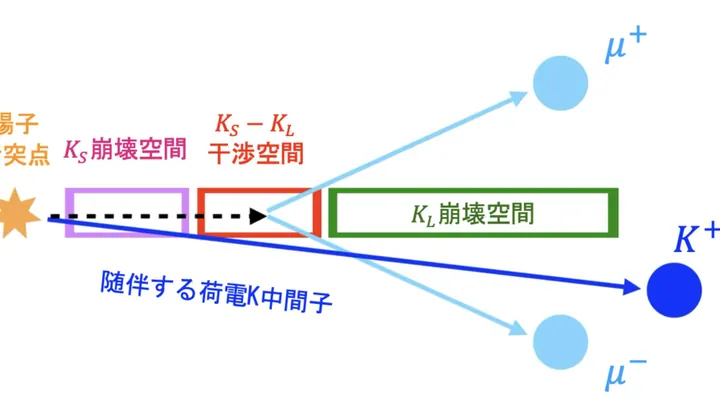
Two nearly identical pendulums are set in motion at the same time. One decays quickly, the other swings for a long time. At some point, their motions overlap, and in the combined picture, a subtle shift appears that would be invisible if you looked at each pendulum separately.
In the LHCb detector, where protons collide, one unusual track was found among billions of decays. The particle, named $$D_{s1}$$(2933)^+, appears for a moment and immediately decays into other particles. Its lifetime is so short that it cannot be observed directly — only through its decay products can its existence be reconstructed.
In the CMS detector at the Large Hadron Collider, protons accelerated to nearly the speed of light collided. Among billions of such collisions, physicists searched for a rare signature: the production of a single heavy particle that immediately decays into a W boson and a b quark.
In an underground ring 27 kilometers in circumference, protons are accelerated to nearly the speed of light and smashed head-on. At the collision point, conditions briefly recreate those of the first trillionth of a second after the birth of the universe.
At the center of a collision between two lead nuclei, a tiny fireball is born for an instant — matter so hot that protons and neutrons melt, and quarks and gluons swim freely in this 'soup.' This soup is called quark–gluon plasma. It existed in the first microseconds after the Big Bang, and now it is recreated in accelerators.