The D meson is a subatomic particle belonging to the meson family, composed of a charm quark and a light antiquark (either an up, down, or strange antiquark). It is the lightest particle containing a charm quark, making it a crucial probe for studying the strong force and the weak interaction. D mesons are produced in high-energy particle collisions, such as those at the Large Hadron Collider, and their decay patterns provide insights into the asymmetry between matter and antimatter.
History
The D meson was discovered in 1976 at the Stanford Linear Accelerator Center (SLAC) by the Mark I detector team, led by Burton Richter, shortly after the discovery of the J/psi particle. This discovery confirmed the existence of the charm quark and earned Richter and Samuel Ting the Nobel Prize in Physics in 1976.
How it works
D mesons are held together by the strong nuclear force, which binds the quark-antiquark pair. They decay via the weak interaction, where a charm quark transforms into a strange or down quark, emitting a W boson that subsequently decays into leptons or other quarks. By measuring the branching ratios and decay rates of different D meson channels, physicists can test the Standard Model and search for signs of new physics.
In practice
D mesons are used in particle physics experiments to study CP violation (the difference between matter and antimatter behavior) and to probe the properties of the quark-gluon plasma created in heavy-ion collisions.
Fun fact
The D meson's lifetime is about 10^-13 seconds, which, despite being incredibly short, is long enough for it to travel a few millimeters before decaying—a distance that can be measured with modern detectors.
A courtroom interpreter must relay every word without being distracted by noise in the room. In the quantum world, a superconducting resonator plays that role, losing photons on schedule without straying into spurious effects.
A handful of sand in your fist: the grains press against each other, and your hand can't squeeze any further. Ordinary matter behaves similarly. But in a neutron star, compression is billions of times stronger — atoms are crushed, electrons are squeezed into protons, and nearly all space is filled with neutrons.
The 21-kilometer ring near Protvino was once planned to accelerate protons. Today, the same tunnel could host a very different machine — a muon collider. The muon is a heavy cousin of the electron, and that's its strength. On a curve, an electron radiates like a searchlight, losing precious energy. A muon radiates a billion times less.
An inflatable balloon with magnetic field lines drawn on it with a marker is a simple model of how a weak magnetic field behaves in an expanding universe. While the balloon is small, the lines lie obediently on the rubber and don't hinder its stretching. That's roughly how a field fills ready-made space without arguing with its geometry.
In the world of magnetism, a simple dichotomy long reigned: ferromagnets, where spins point in one direction, and antiferromagnets, where they line up in a checkerboard pattern, canceling each other out. But a recent 'third player' — altermagnets — forced a rewrite of the rules.
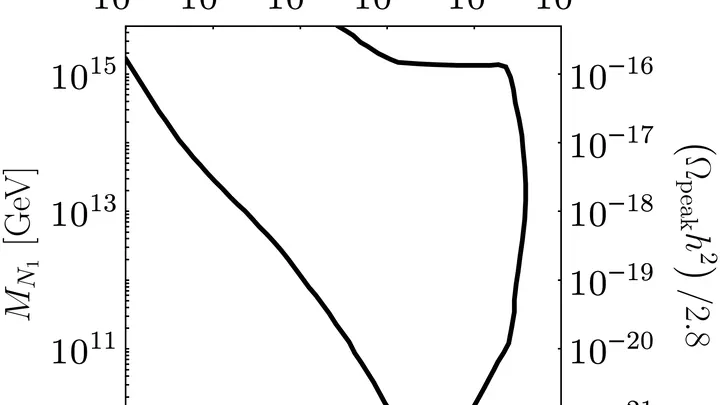
In the very beginning, moments after the Big Bang, the universe was ridiculously symmetric: particles and antiparticles in equal measure. But a tiny imbalance occurred, like one extra grain of sugar in a kilogram, and the entire familiar world, stars, planets, people, arose from that surplus. How nature created this imbalance remains a mystery.
In the LHCb detector, where protons collide, one unusual track was found among billions of decays. The particle, named $$D_{s1}$$(2933)^+, appears for a moment and immediately decays into other particles. Its lifetime is so short that it cannot be observed directly — only through its decay products can its existence be reconstructed.
Heavy particles, which physicists call baryons, are like tiny families of three quarks. The common baryons are protons and neutrons, which make up everything around us. But there are also exotic relatives: instead of light quarks, they harbor charm or bottom quarks — heavy and short-lived.
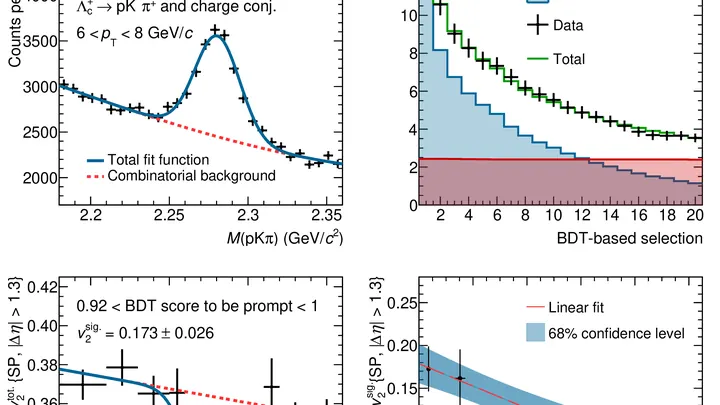
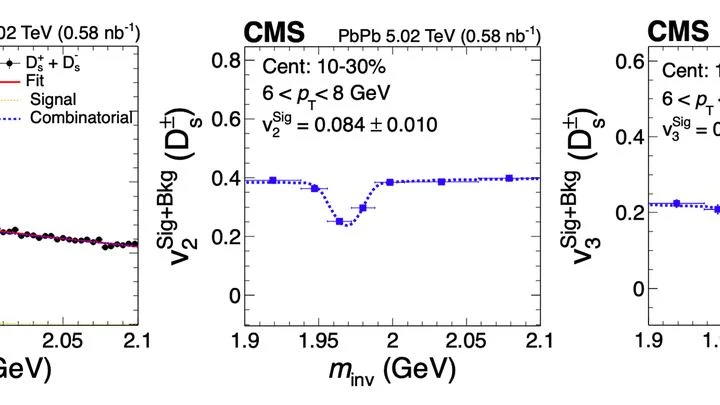
In 2010, physicists at the Large Hadron Collider first produced a quark-gluon plasma — a state of matter where quarks and gluons are as free as water in steam, not locked inside protons and neutrons. Now the ALICE collaboration has studied how charmed particles, those containing a heavy c-quark, move in such a medium.
When a fast proton slams into an atomic nucleus, new particles are born for an instant. One of them is the phi meson: a short-lived clump of matter that decays into an electron-positron pair. Catching this decay is like hearing the echo of a distant explosion: the blast itself is over, but its trace is still flying.
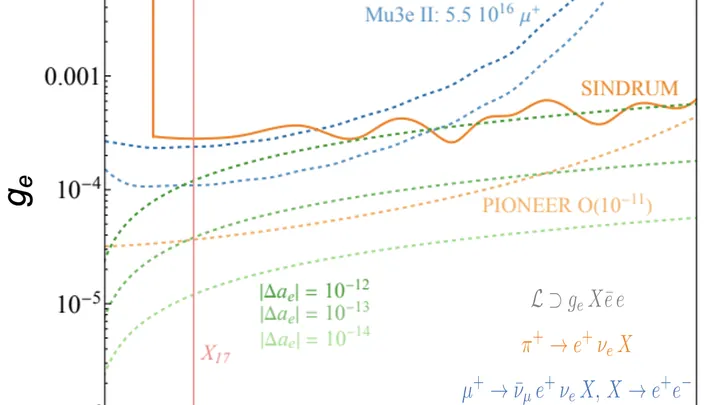
In nuclear transitions of beryllium-8, helium-4, and carbon-12, physicists from the ATOMKI collaboration have been seeing extra events since 2020—as if, when an excited nucleus decays, something else is sometimes born besides the usual photons. The energy of this "something" is always the same: about 17 million electron-volts.
At the Large Hadron Collider, by accelerating particles to nearly light speeds, top quarks are created — the heaviest building blocks of the Standard Model. They live for vanishingly small fractions of a second but manage to exhibit complex quantum connections.
At the center of a collision between two lead nuclei, a tiny fireball is born for an instant — matter so hot that protons and neutrons melt, and quarks and gluons swim freely in this 'soup.' This soup is called quark–gluon plasma. It existed in the first microseconds after the Big Bang, and now it is recreated in accelerators.
Dark matter is invisible, but according to calculations, it holds galaxies together. Catching its particles is like hearing a whisper in a noisy room. You need a material that responds loudly and noticeably to the slightest nudge.
Molecular magnets could be such a material — substances where each molecule acts as an independent tiny magnet.