Who's Raising Whom: The Galaxy or Its Black Hole express
Growing a galaxy is like a dance between two partners: at the center of nearly every large galaxy sits a supermassive black hole, and they grow together. But who leads? Observations of real galaxies give a contradictory answer: in spirals like our Milky Way, the black hole seems to pull the galaxy's growth along, while in ellipticals (bloated, ball-like galaxies) it merely tags along.
To sort this out, researchers ran the NIHAO computer simulation — a virtual universe where you can trace every galaxy's fate from birth to the present. They compared the black hole's mass to the velocity dispersion of stars in the galaxy's center: the faster the stars jitter, the more massive the black hole. And here's the curious bit: before the star-formation peak, when the galaxy is churning out stars like hotcakes, the galaxy grows first, and the black hole catches up. After the peak, the roles reverse — now the black hole piles on mass and dictates what the galaxy will become.
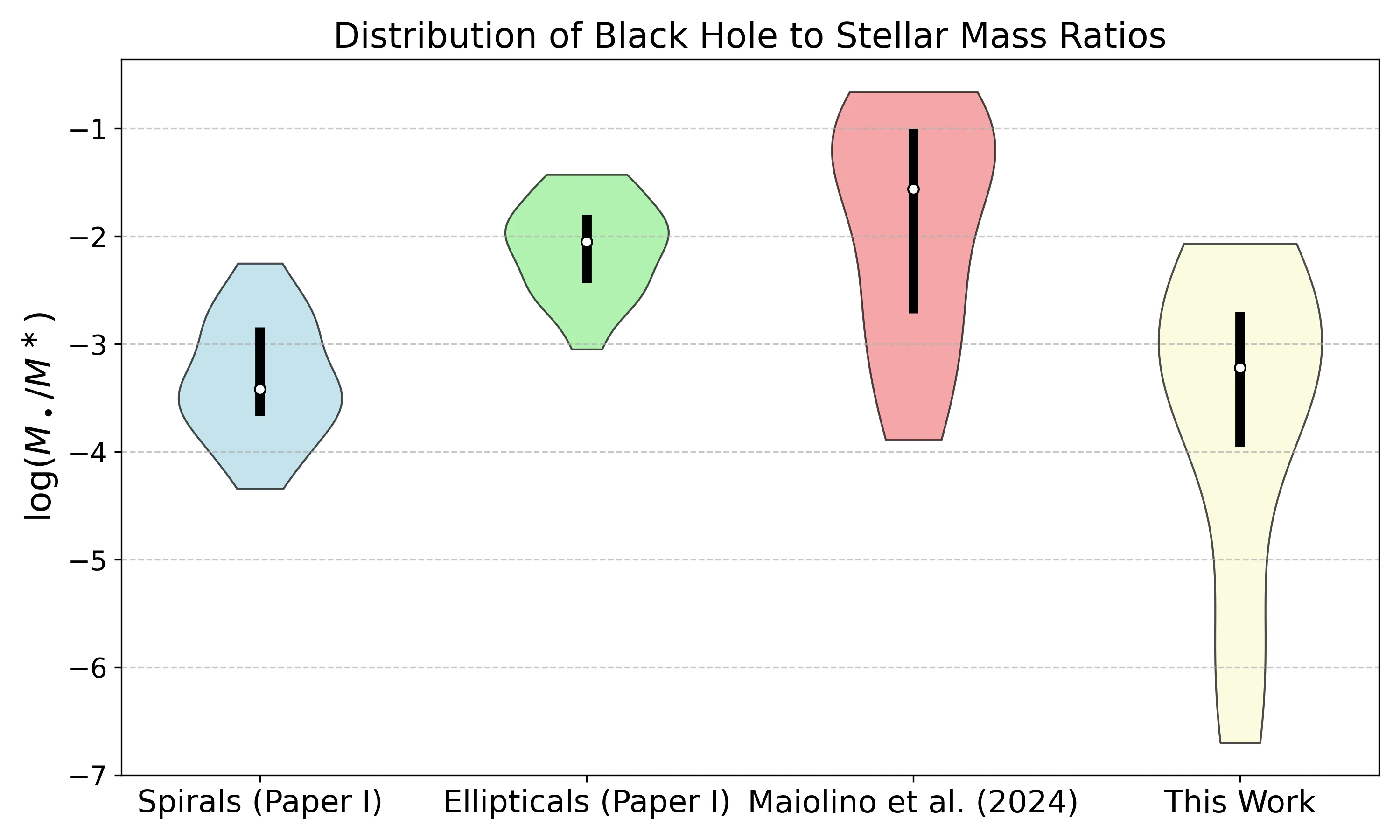
This flip has an unexpected consequence for distant galaxies we see in the young universe. If you apply the old formulas, their black holes look bloated — hundreds of times heavier than they should be. But new estimates that account for cause and effect show that ancient black holes were more modest, and there's no mass discrepancy at all.
Original abstract
as written by the authors arXiv:2602.16775
The nascent methodology of applying the principles of causal discovery to astrophysical data has produced affirming results about deeply held theories concerning the causal nature behind the observed coevolution of supermassive black holes (SMBHs) with their host galaxies. The key results from observations have demonstrated an apparent causal reversal across different galaxy morphologies$$\unicode{x2014}$$SMBHs causally influence the evolution of the physical parameters of their spiral galaxy hosts, whereas SMBHs in elliptical galaxies are passive companions that grow in near lockstep with their hosts. To further explore and ascertain insights, it is necessary to utilize galaxy simulations to track the time evolution of the observed causal relations to learn more about the temporal nature of the changing SMBH/galaxy evolutionary directions. We conducted experiments with the NIHAO suite of cosmological zoom-in hydrodynamical simulations to follow the evolution of individual galaxies along with their central SMBH masses ($$M_\unicode{x25CF}$$) and properties, including central stellar velocity dispersion ($$\sigma_0$$). We reproduce the causal results from real galaxies, but add clarity by observing that the SMBH/galaxy causal directions are noticeably inverted between the epochs before and after the peak of star formation. The implications for causal reversal of the $$M_\unicode{x25CF}\unicode{x2013}\sigma_0$$ relation portend larger concerns about the reliability of SMBH masses estimated at high redshifts and presumptions of overmassive black holes at early epochs. Toward this problem, we apply updated causally-informed scaling relations that predict high-$$z$$ black hole masses that are approximately two orders of magnitude less massive, and thus not overmassive with respect to local $$z=0$$ SMBH$$\unicode{x2013}$$galaxy mass ratios.
The supermassive black hole at the Milky Way's center weighs as much as four million suns, but compared to the galaxy, it's a grain of sand, just one ten-thousandth of a percent of the galaxy's mass.