Supermassive black hole formation addresses the question of how black holes with masses from millions to billions of solar masses came to exist. These giants sit at the centers of most galaxies, including our own Milky Way. The challenge is that we observe them already fully grown when the universe was less than a billion years old, leaving little time for them to accumulate mass through standard accretion processes. Understanding their formation is crucial for explaining galaxy evolution, quasar activity, and the feedback mechanisms that shape cosmic structure.
History
The concept of supermassive black holes was proposed in the 1960s by Donald Lynden-Bell and Edwin Salpeter, who suggested that quasars are powered by accretion onto massive black holes. The direct-collapse scenario for their formation was developed in the 2000s.
How it works
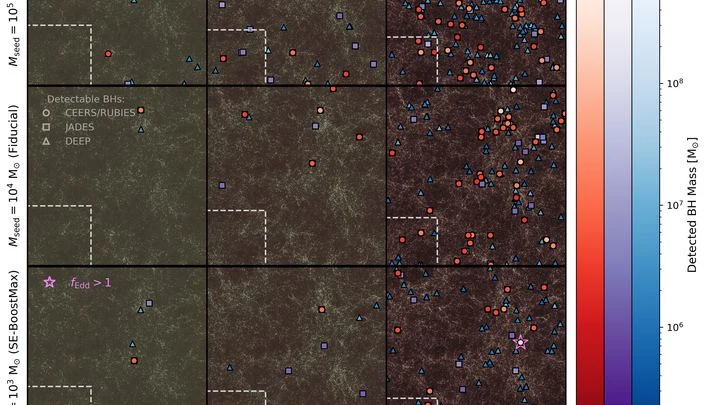
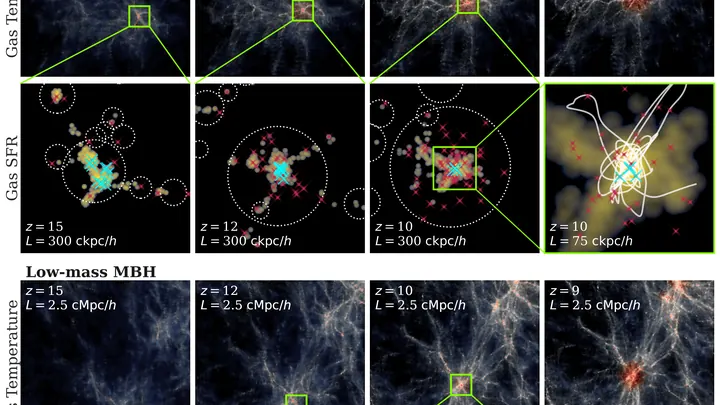
The leading scenarios involve 'seeds' that form in the early universe and then grow. Light seeds (around 100 solar masses) arise from the collapse of the first massive stars, while heavy seeds (10⁴–10⁵ solar masses) could form directly from the collapse of primordial gas clouds in dark matter halos. These seeds then grow by accreting surrounding gas and by merging with other black holes. The efficiency of accretion, which can be limited by radiation pressure, and the availability of gas in the early universe determine how quickly a seed can reach supermassive scales.
In practice
This research informs models of galaxy formation and evolution, and helps interpret gravitational wave signals from merging black holes detected by LIGO and Virgo.
Fun fact
Some theoretical models propose that 'dark stars' — powered by dark matter annihilation instead of nuclear fusion — could have grown to supermassive sizes before the first ordinary stars formed, providing seeds for the earliest supermassive black holes.
In a dense cloud of gas and dust where massive stars are born, two young stars recently passed very close to each other. Their dance has lasted only about sixty years, and astronomers have now seen it in detail for the first time.
A census by body shape: that's one way to describe what astronomers did with 6348 massive galaxies. Instead of height and weight, they measured how concentrated the light is toward the center, how flattened the galaxy is, and how asymmetric its shape is. Then they ran the same measurements on galaxies from three computer models of the universe and compared the results.
Deep inside molecular clouds hide natural amplifiers — cosmic masers. They work like lasers but in the radio band: excited molecules collectively emit waves of a single frequency, creating a bright beam. The catch is that these molecules often have several ways to shed energy.
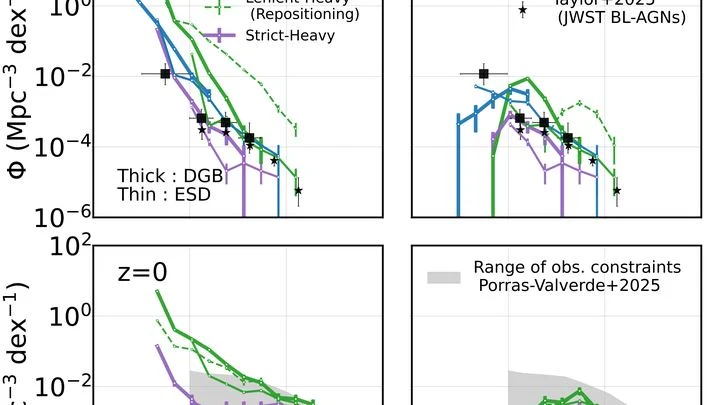
A marathon lasting 13 billion years started with different weights. A hundred solar masses — lighter than some gas clouds. A hundred thousand — gravitational dominance, comparable to an elephant among kittens. That's what black hole seeds looked like, ones that by our time should have turned into supermassive giants.
Eight hundred million years after the Big Bang, and at the heart of a young galaxy a monstrous engine is already throbbing. A black hole with a mass of ten billion suns devours matter so greedily that its radiation should outshine everything around it. But outside, silence.
The James Webb Space Telescope peered into an era when the universe was less than a billion years old and spotted strange objects—'little red dots.' These are black holes with masses of millions of suns, but in very compact, chemically pristine galaxies. Standard scenarios can't grow such heavyweights that early.
Massive stars are cosmic titans, living under the sign of indomitable energy. When such a star enters the B[e] supergiant phase, its radiation is so powerful that it would seemingly pulverize any molecule into atoms. The spectral lines, once systematized by Johann Balmer, blaze here with particular fury.
The early universe at redshift z>7 was an arena of rampant growth: black holes with masses up to a billion solar masses already blazed as quasars, devouring gas at monstrous rates. How these giants managed to grow in such a short time is one of astrophysics' sharpest puzzles.
Lenticular galaxies are the cosmic quiet types: they have a disk but no bright spiral arms. For a long time, their origin remained a mystery. A team of scientists ran the Hydrangea computer simulation and traced the fate of each galaxy from its youth to the present day.
On the mass–size diagram, these galaxies line up in a V shape.
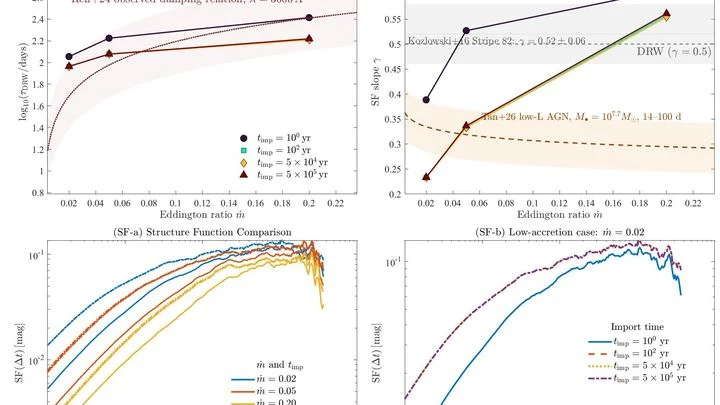
At the heart of nearly every large galaxy shines an active nucleus — a supermassive black hole surrounded by a flat, rotating disk of incandescent gas. The disk itself flickers, but astrophysicists suspect that within it lurks a whole swarm of small, stellar-mass black holes.
Imagine a spotlight: if you look at it from the side, it glows dim red, but if you stare straight into it, it blinds you with white-blue light. That, according to new data, is exactly what the mysterious 'little red dots' in the early universe look like. They are giant black holes, objects with gravity so strong that even light cannot escape, turned edge-on to us.
In the early Universe, tiny black holes could have been born — mountain-mass but atomic-nucleus-sized. Today they could serve as factories for dark matter. There are two mechanisms: the familiar evaporation (Hawking radiation) and the lesser-known superradiance.
A field sown with seeds. Some seeds are large and sprout at the slightest rain; others are finicky, requiring special soil and rare conditions. Which seeds fall into the ground determines what kind of forest will grow years later. Astrophysicists think about the birth of black holes in the early universe in much the same way.
The universe is full of the invisible. We know about dark matter from galaxy rotation and gravitational lensing, but its nature has eluded us for a century.
Heir to the ideas of Edwin Hubble, the James Webb Space Telescope has peered back to an era when the expansion of the universe was still picking up speed. At redshifts z>4, it spotted bizarre objects—"Little Red Dots" (LRDs).
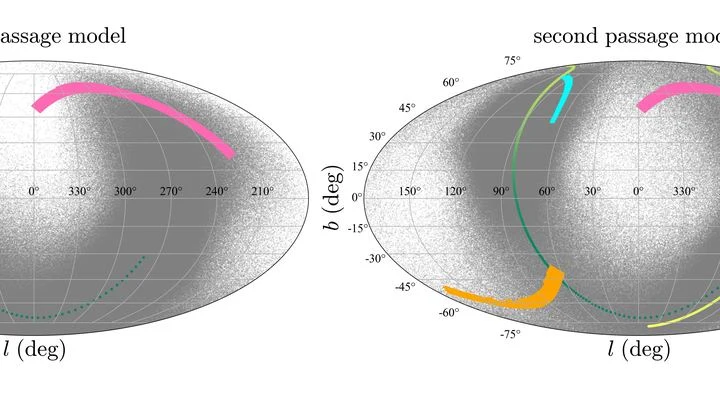
The stellar halo of the Milky Way is a galactic palimpsest: an ancient manuscript where earlier layers lie hidden beneath the visible text. For a long time, the Gaia-Sausage-Enceladus (GSE) structure was thought to be the final entry in this manuscript, the scar of a single catastrophic merger.
The James Webb Space Telescope has spotted astonishing objects in the depths of space — tiny red dots that shine so brightly it's as if a spotlight were hidden inside a small bulb. These dots are not stars or galaxies in the usual sense, but rather 'cocoons' around supermassive black holes greedily gulping down surrounding gas.
Just a few hundred million years after the Big Bang, in the ocean of invisible dark matter, giant black holes were already taking shape. They were born from the matter itself — without any help from stars. This mechanism, based on the equations of Lemaître, explains their early appearance.
Pairs of black holes dance in three different styles before merging. The first is a neat waltz: the objects swirl in the same direction, like partners facing the same way. Such pairs are born from binary stars and often have unequal masses. The second is chaotic disco: spins are scattered, masses nearly equal.
In space, merging black hole pairs are common, and often one is noticeably more massive than the other. This mass difference isn't just a number: it's a key to their shared history.
Astrophysicists studied the stable mass transfer channel — a process where matter flows smoothly from one star to another without disrupting the system.
Drop a stone into a pond — ripples spread across the water. The most visible ripple comes from the strongest splash. That's roughly how physicists picture the growth of perturbations around a black hole: if a system has an instability, its 'loudest' component, the one that grows fastest, should show up first.
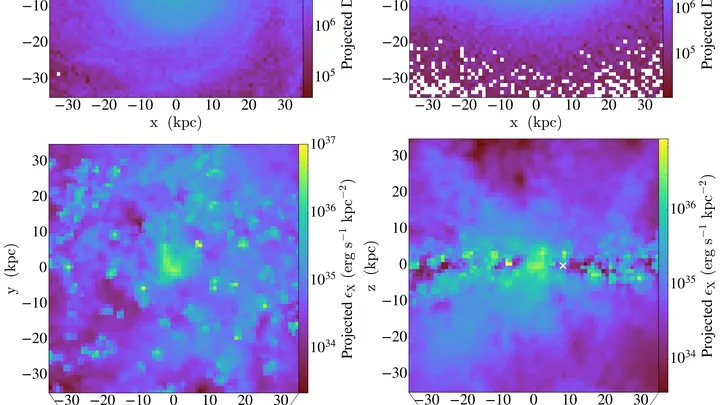
Around our Galaxy, like an invisible crown, stretches a tenuous cloud of gas heated to millions of degrees. It is called the galactic halo. Seeing this glow directly is difficult: it emits soft X-rays that are absorbed by Earth's atmosphere.
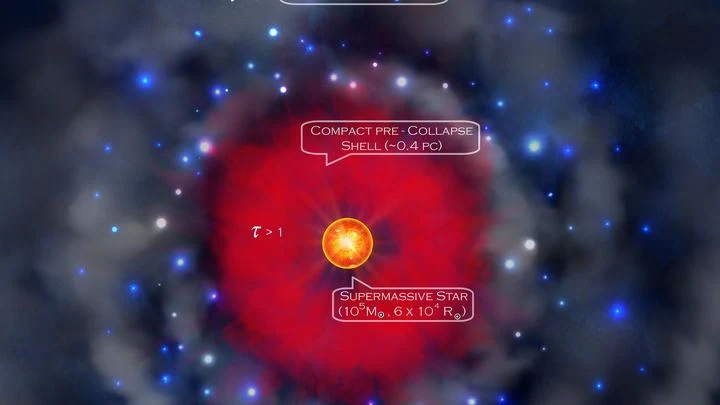
A star weighing a hundred thousand Suns lives bright and brief. Its finale is a rapid collapse into a black hole. But just before the end, it manages to wrap itself in a dense gas cocoon.
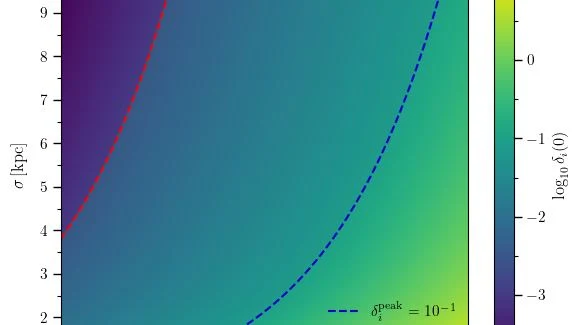
When the universe was a couple of hundred million years old, it resembled a giant kitchen where the first galaxies were being shaped from primordial 'dough'—hydrogen and helium. At their centers, black holes ignited like ovens of varying power, from light 'camp stoves' to heavy 'hearths.' But how quickly did they gain mass by swallowing surrounding gas?
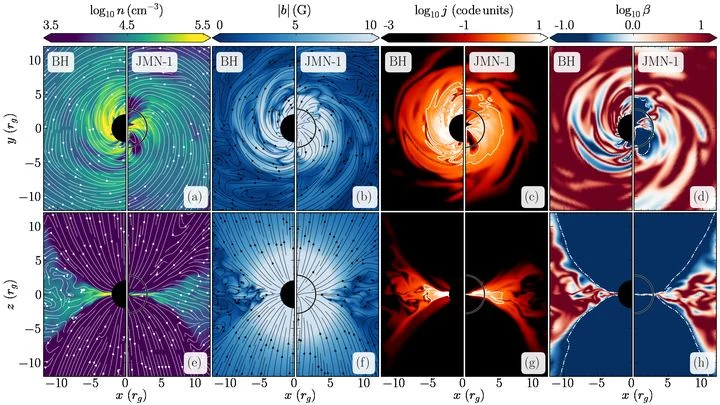
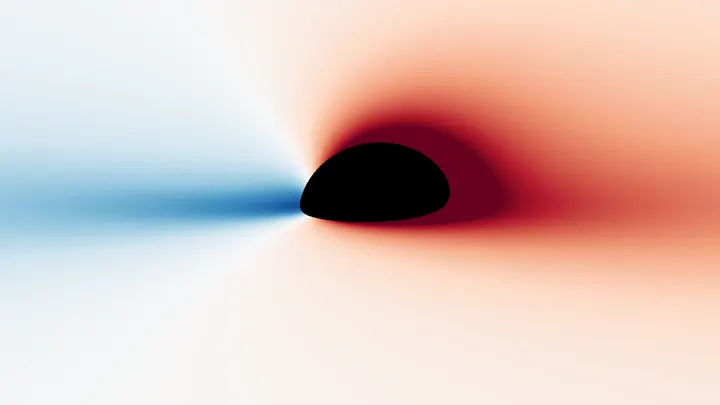
A bottomless well, but not quite. An ordinary black hole has a boundary, the event horizon, beyond which nothing returns. But what if you remove that boundary? That's exactly the kind of object, dubbed JMN-1, that astrophysicists modeled: a massive body born from stellar collapse, but without the impenetrable veil.
At the edge of the Milky Way, there are stars that move against the general flow, like cars driving in the wrong lane. Previously, it was thought that all of them were remnants of one dwarf galaxy that our Galaxy tore apart and swallowed. But new research shows that there were several such 'oncoming' galaxies.
Drop two identical pebbles from a mountain peak: one lands a centimeter to the left, and a minute later they end up in different valleys. A galaxy is the same mountain, only with billions of pebbles and a slope that stretches over millions of years. The authors of a new study simulated a disk of 40 million point-like stars and tested how quickly it forgets where it started.
On the outskirts of our Galaxy, far beyond the familiar stellar disk, the Subaru Telescope has spotted something unexpected: a scattered cloud of stars spanning an area of one hundred square degrees across the sky.
At the center of galaxy PDS 456 shines a quasar — a black hole devouring gas that glows brighter than hundreds of billions of stars. The X-ray telescope XRISM peered into this light and saw a picket fence of dark bands, like shadows cast by a fence at sunset.
Through a telescope, you can see a galaxy that looks like a giant glowing pinwheel. Its disk stretches thirty thousand light-years across — a third of the diameter of our Milky Way. But the most astonishing part: this pinwheel already existed just two billion years after the birth of the universe.
Water in a kettle, as it boils, clearly separates into liquid and steam. But under enormous pressure, the boundary vanishes: the substance enters a supercritical state — neither one nor the other, but something in between.
Black holes can do this too.
The James Webb Space Telescope has spotted ancient galaxies harboring supermassive black holes — far too massive for their young age after the Big Bang. There wasn't enough time for normal growth, so they must have formed differently.
Light from a distant quasar, the bright core of a galaxy, passes by a massive galaxy and bends, like a flashlight beam through uneven glass. If the lens and source align almost perfectly, we see not one quasar but several copies.
The James Webb telescope discovered black holes — so named by John Wheeler, and Karl Schwarzschild described them as a light trap — which, just 500 million years after the Big Bang, already weighed more than a million Suns.
The James Webb Space Telescope has spotted tiny, unnaturally bright red objects in the early universe. Their light outshines by a hundredfold what you’d expect from ordinary galaxies of that era.
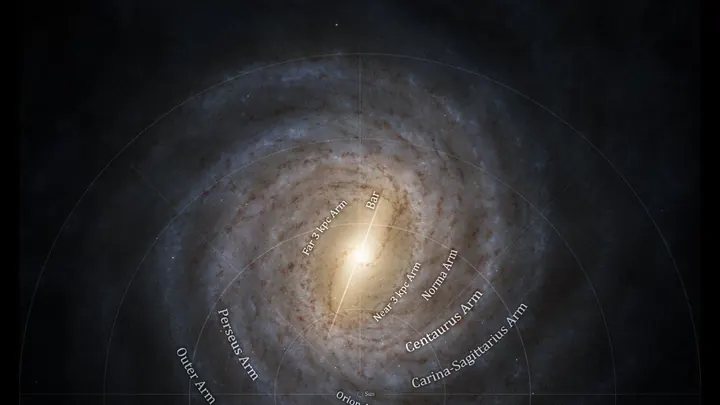
Other galaxies are just ancient snapshots, but we watch the Milky Way live. Comparing data over 30 years, scientists found that the Galaxy’s center is, like, speeding up: the supermassive black hole got heavier, swallowing the mass of a large asteroid each year; the stellar bar (a huge beam of billions of suns, like the…
The night sky looks still, but sometimes one of the stars suddenly begins to brighten. That's what happened with the system AT 2019wey: it was spotted by the TESS telescope, which usually hunts for planets around other stars, but happened to be imaging that patch of sky every half hour.
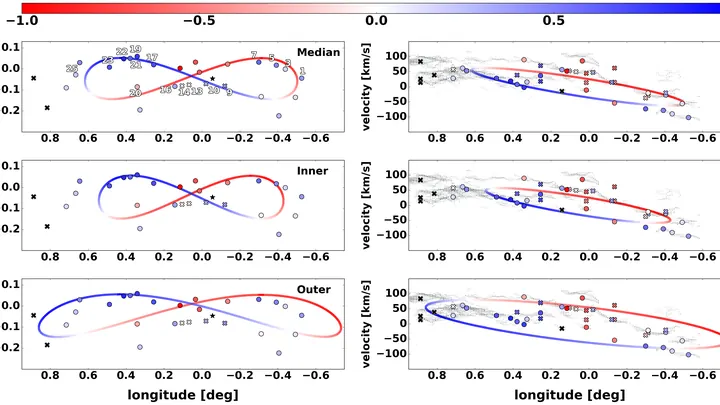
In the very center of the Milky Way, hidden behind a thick veil of dust, lies a giant accumulation of gas — the Central Molecular Zone. You can't see it with the naked eye: dust absorbs visible light, much like dense fog hides the lights of a city.
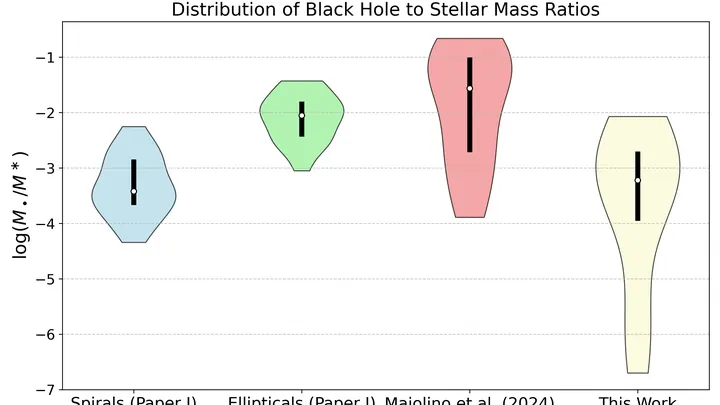
Growing a galaxy is like a dance between two partners: at the center of nearly every large galaxy sits a supermassive black hole, and they grow together. But who leads?