An elliptical galaxy is a type of galaxy with a smooth, ellipsoidal shape and no prominentspiral arms. They range from giant ellipticals, which can be trillions of times more massive than the Sun, to dwarf ellipticals. Elliptical galaxies are composed primarily of old, low-mass stars and contain very little cold gas or dust, so they have little ongoing star formation.
History
The classification of elliptical galaxies was introduced by Edwin Hubble in 1926 as part of his 'tuning fork' sequence of galaxy types.
How it works
Elliptical galaxies are thought to form through mergers of smaller galaxies. When galaxies collide, their gas is stripped or heated, and the stellar orbits become randomized, producing the smooth, featureless appearance. The lack of gas means that star formation ceases, leaving behind an aging stellar population. Their stars orbit the galactic center in all directions, unlike the ordered rotation of spiral galaxies.
In practice
Elliptical galaxies serve as important probes for studying galaxy evolution, dark matter distribution, and the growth of supermassive black holes at their centers.
Fun fact
The largest known galaxy, IC 1101, is a giant elliptical galaxy located about 1 billion light-years away, with a diameter of about 6 million light-years — over 60 times the size of the Milky Way.
An old city gains new suburbs. In the center, narrow streets where life has nearly stopped, while on the outskirts construction is booming. That is what a spiral galaxy looks like when its core stars have long aged and new stars are still being born in the outer disk.
In a distant galaxy, light from hot gas should reveal its composition. The James Webb Telescope split that light into a spectrum, and astronomers saw: oxygen lines too weak.
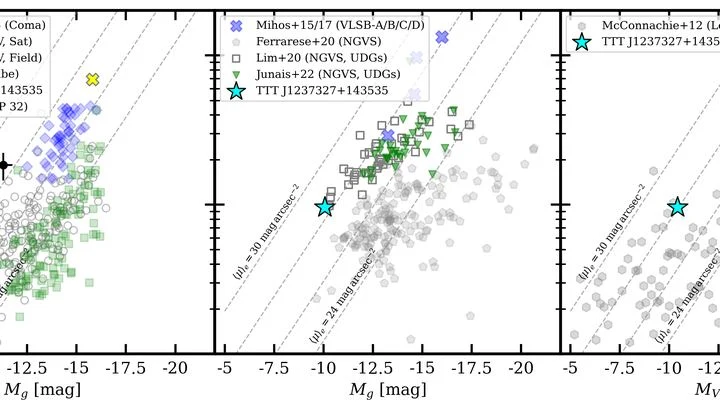
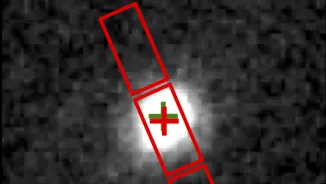
The night sky only looks black: telescopes reveal millions of galaxies, but some are so dim they blend into the background. Astronomers caught just such a "nearly invisible" one by chance while observing the Virgo Cluster with the two-meter telescope at Teide Observatory.
The galaxy is named TTT J1237327+143535.
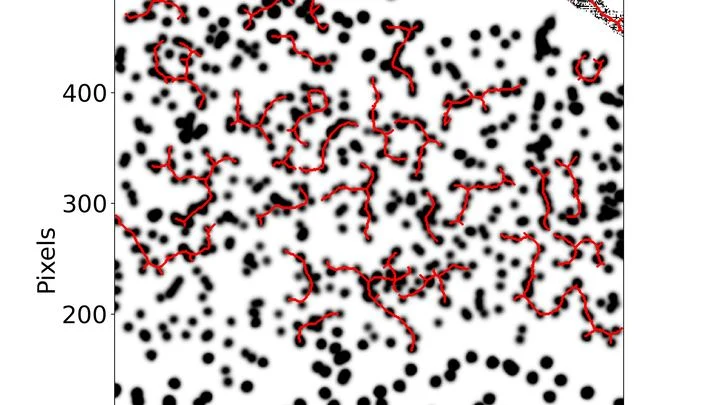
Imagine a pot of boiling water. Toss in a handful of pasta, and it quickly overcooks and clumps into a sticky mess. But in a huge restaurant kettle where the pasta floats freely, each piece stays separate.
In the quiet of cold molecular clouds, where interstellar gas under gravity condenses into dense clumps, the birth of massive stars is one of the great puzzles of astrophysics.
An ordinary black hole is surrounded by a thin photon sphere — a place where light can loop around before falling in or escaping. In the new work, this region has puffed up into a whole layer packed with massless particles that zip around at nearly the speed of light and don't press against the walls.
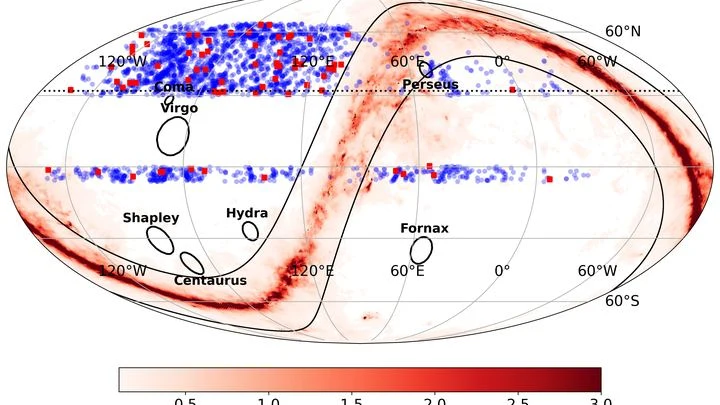
The night sky sometimes throws up riddles that take your breath away. One of them is a ring of galaxies stretching across a third of the horizon. Astronomers have named it the “Giant Ring on the Sky”: a cluster of galaxies stretched into a thin filament and closed into a circle about 400 megaparsecs in diameter.
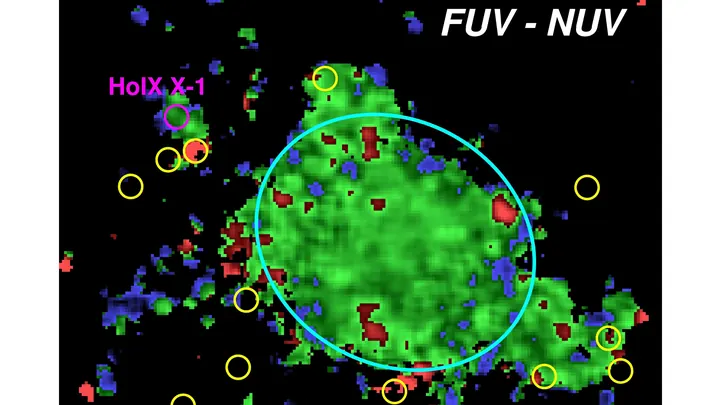
The galaxy Holmberg IX is like a city where construction of new houses suddenly stopped, even though building materials are everywhere. Astronomers peered into it with various telescopes and saw a strange picture: plenty of gas and heavy elements, but almost no dust. Usually, where there's gas, new stars are born, but here it's different.
Light from a distant quasar, the bright core of a galaxy, passes by a massive galaxy and bends, like a flashlight beam through uneven glass. If the lens and source align almost perfectly, we see not one quasar but several copies.
Seven hours: that's how long a year lasts on TOI-4552b. It whips around its star faster than some moons orbit Earth. The star is a dim red dwarf, four times smaller than the Sun, but the planet is so close that it receives hundreds of times more heat than we do.
In the constellation Cetus, 65 million light-years from Earth, three dwarf galaxies nestle: DF2, DF4, and DF9. All have been declared “galaxies without dark matter” — the mysterious invisible substance that usually holds stars together.
The light of every star is its unique passport, but the entries are written in the language of spectra and colors. For old giants, such documents are almost indistinguishable: their spectra overlap, and deciphering the details by hand was practically impossible.
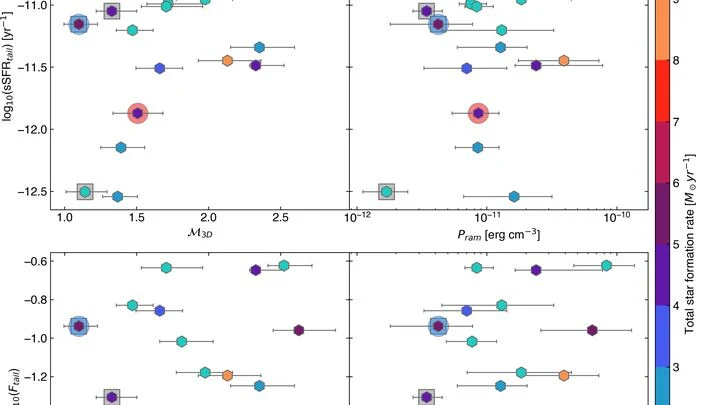
A galaxy plunges into a dense cluster like a runner into a crowd. The oncoming gas, known as the intracluster medium, strips away its own gas, stretching it into a long, glowing tail. Astronomers call these galaxies jellyfish: they have a body and flowing tentacles of stripped material. But only in a few do new stars ignite within those tentacles.
A galaxy is like a city where no new houses are being built. Stars are no longer born there, and the old buildings tell you when construction was bustling. Astronomers peered into 14 such 'ghost towns' on the edge of the visible universe: their light has been traveling to us for 11–12 billion years.
The galaxy CEERS2-588 flared up like a bonfire fed with an armful of wood all at once. Just 400 million years after the Big Bang, it had already built up a mass of a billion suns and ignited countless stars. But then the fuel ran out, and over the last 10 million years, star formation in it has almost completely ceased.
For 39 years, astronomers have been recording how the star BE Lyn brightens and dims. Its light pulsates with a rhythm of several hours, like a lighthouse that never stops blinking. But there is a glitch in this rhythm: sometimes the flashes came a little early, sometimes a little late. The star was moving closer to Earth and then farther away, as if something were dragging it in a circle.
The night sky seems full of stars, but between them lurk clouds of gas where not a single star has ever ignited. Such objects are called dark galaxies: they contain enough gas, but it is too diffuse and cold to collapse into stars.
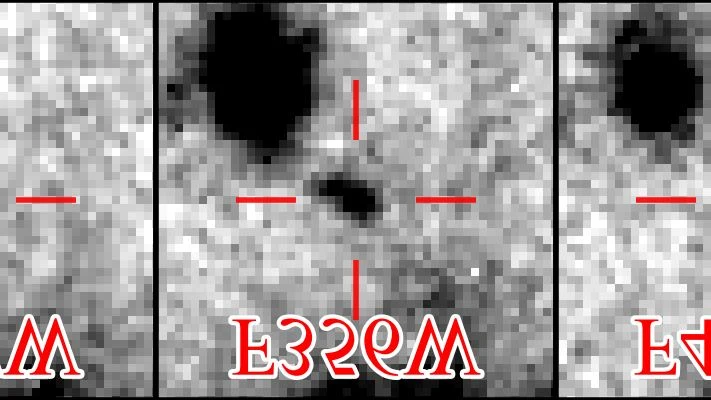
Astronomers have found an invisible object in the Universe weighing just a million Suns — for cosmic scales, that’s a mere trifle, a hundred times lighter than anything they’ve been able to “weigh” at such distances. The object itself doesn’t shine, but it gave itself away by bending the light from an even more distant galaxy.
The light from a distant galaxy split into two, then three, then four, and in the center a fifth ghost appeared. That is HerS-3: a young galaxy full of dust and newborn stars, whose light passed through a gravitational lens, a massive object that bends rays like a magnifying glass bends light.