Who's Raising Whom: The Galaxy or Its Black Hole express
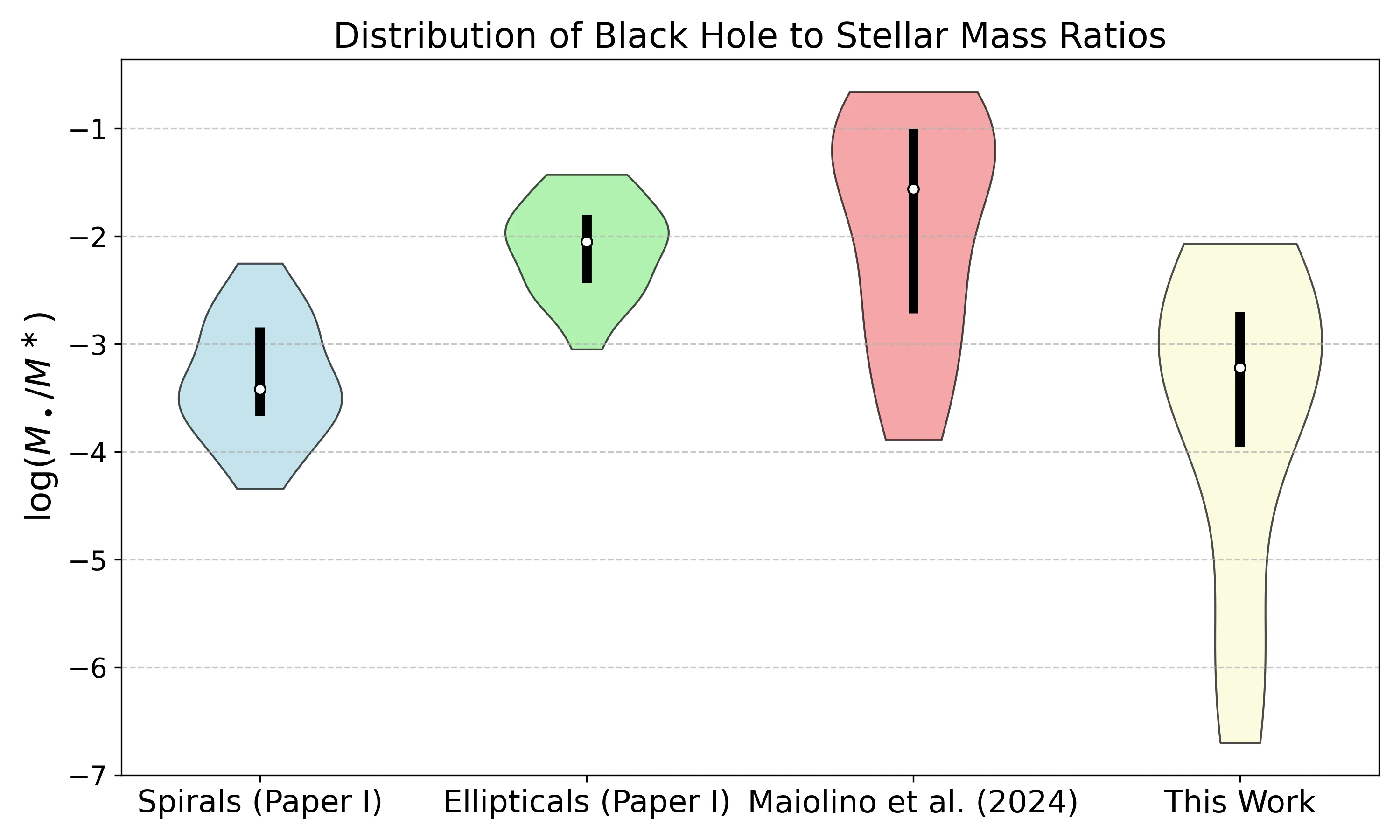
Growing a galaxy is like a dance between two partners: at the center of nearly every large galaxy sits a supermassive black hole, and they grow together. But who leads? Observations of real galaxies give a contradictory answer: in spirals like our Milky Way, the black hole seems to pull the galaxy's growth along, while in ellipticals (bloated, ball-like galaxies) it merely tags along.
To sort this out, researchers ran the NIHAO computer simulation — a virtual universe where you can trace every galaxy's fate from birth to the present. They compared the black hole's mass to the velocity dispersion of stars in the galaxy's center: the faster the stars jitter, the more massive the black hole. And here's the curious bit: before the star-formation peak, when the galaxy is churning out stars like hotcakes, the galaxy grows first, and the black hole catches up. After the peak, the roles reverse — now the black hole piles on mass and dictates what the galaxy will become.
This flip has an unexpected consequence for distant galaxies we see in the young universe. If you apply the old formulas, their black holes look bloated — hundreds of times heavier than they should be. But new estimates that account for cause and effect show that ancient black holes were more modest, and there's no mass discrepancy at all.
The supermassive black hole at the Milky Way's center weighs as much as four million suns, but compared to the galaxy, it's a grain of sand, just one ten-thousandth of a percent of the galaxy's mass.