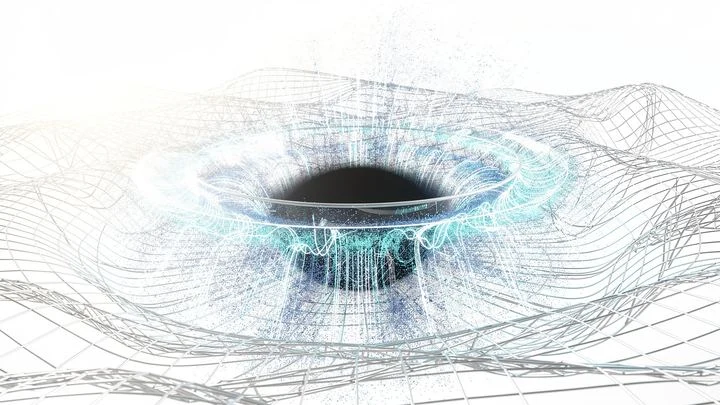
Quasar feedback is the process by which the supermassive black hole at the center of a galaxy injects enormous amounts of energy and momentum into its surroundings, profoundly shaping the galaxy's evolution. When matter falls toward a black hole, it forms a hot, luminous accretion disk that can outshine all the stars in the galaxy — this is a quasar. The intense radiation and powerful outflows, or jets, from this region push and heat the surrounding gas, regulating how much new star formation can occur and even driving gas out of the galaxy entirely. This mechanism explains why galaxies with the most massive black holes often have little ongoing star formation, and why the masses of black holes and their host galaxies are so tightly correlated.
History
The concept emerged in the late 20th century, with key theoretical work in the 1990s and early 2000s by researchers such as Joseph Silk and Martin Rees, who proposed that quasar outflows could explain the observed relationship between black hole mass and galaxy properties.
How it works
As gas spirals into a supermassive black hole, gravitational energy is converted into radiation and kinetic energy. Some of this energy is released as relativistic jets — narrow beams of plasma moving at near-light speed — while broader, slower winds also blow outward from the accretion disk. These outflows collide with the interstellar gas in the galaxy, compressing some regions (which can trigger star formation) but more often heating and dispersing the gas, which suppresses star formation. Over cosmic time, this self-regulating cycle links the growth of the black hole to the evolution of the galaxy: when the black hole feeds vigorously, feedback shuts off its own food supply by clearing out the surrounding gas.
In practice
Quasar feedback is a crucial ingredient in modern cosmological simulations of galaxy formation, helping researchers predict how galaxies evolve and how the first massive black holes formed in the early universe.
Fun fact
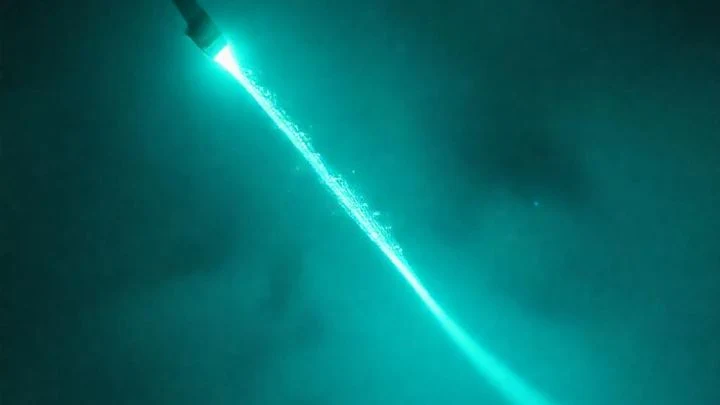
The jet from the microquasar SS 433, a stellar-mass black hole in our own galaxy, precesses like a spinning top and has been observed to directly influence star formation in a nearby gas cloud.
A little monster hides in a dwarf galaxy, and its neighbor feeds it. The satellite galaxy is slowly merging with a massive companion, and gas from the outer regions falls toward the center, where a black hole sits. By cosmic standards, it is not large: only 800 to 5000 solar masses, but its appetite is ferocious.
At the center of an ultra-compact dwarf galaxy, a very dense stellar system spanning tens of light-years, there is a vacuum cleaner at work. But instead of dust, it sucks in gas shed by dying stars. This gas does not fly off in all directions; instead, it spirals into a funnel, a rotating disk that gradually settles onto the black hole.
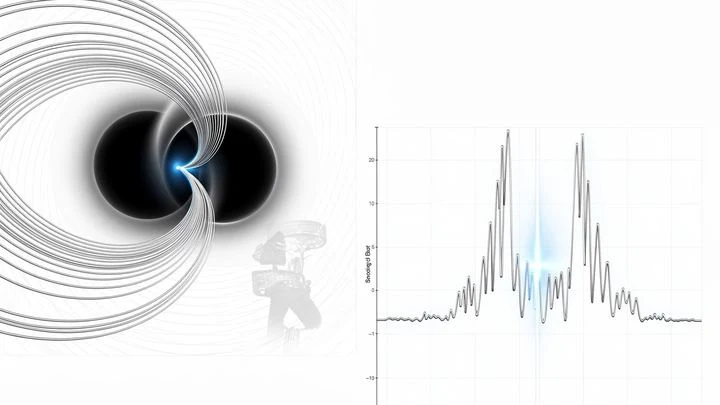
Drop a pebble into a pond, and ripples spread across the water. Something similar happens when a black hole merges with another: it emits gravitational waves that resemble the fading ring of a bell.
When you blow up a balloon too quickly, its surface starts to quiver. Something similar happened to space in the first moments after the Big Bang: the universe expanded rapidly, and the very fabric of space began to ripple.
A black hole isn't just a cosmic vacuum cleaner. If it rotates, it can amplify waves around it, much like a mountain echo repeats sound. For ultralight dark matter (particles billions of times lighter than an electron), this effect, called superradiance, can create a huge cloud.
A black hole is not just an abyss. It is a seething cauldron whose temperature rises as it evaporates. The authors of the study found that when the heat reaches a critical threshold, the hole seems to boil. It emits superheavy particles — the very ones that exist on a scale where any theory of gravity collapses.
A black hole is not a perfect vacuum cleaner. It is surrounded by a swarm of particles and fields, and this swarm alters its fate. In a new study, astrophysicists examined how a massive vector field, a hypothetical form of dark matter, behaves near a rotating black hole.
295 000 meters per second. Not even particles in solar coronal ejecta move that fast. But at the center of the galaxy cluster H1821+643, hot gas does exactly that. The quasar at its heart takes a breath, and its breath stirs everything around for 60 thousand light-years.
Eight hundred million years after the Big Bang, and at the heart of a young galaxy a monstrous engine is already throbbing. A black hole with a mass of ten billion suns devours matter so greedily that its radiation should outshine everything around it. But outside, silence.
A swarm of tiny invisible particles, like a cloud of pollen, drifts through space. A black hole sits in its path. Some particles fall in and vanish forever; others swing around the trap and fly away. The physicists built a map showing exactly how much matter gets swallowed and how much survives.
The event horizon's edge is never calm. Quantum vacuum boils there, and particles sometimes burst out of this foam: that is how Stephen Hawking in 1974 discovered black hole radiation, forever linking gravity with quantum field theory.
In the heart of a dense star cluster, a true forge reigns: here stars, like glowing blanks, collide and merge under gravity, and these mergers are not a catastrophe but an opportunity. Each strike of the stellar hammer transfers spin to the future black hole.
A black hole is not just a vacuum cleaner. It glows faintly, emitting particles — this idea was proposed by Jacob Bekenstein, who connected the hole's temperature to its degree of disorder. Detecting such radiation in space is incredibly difficult.
A detective story unfolded in the GWTC-5 catalog. Hundreds of signals from merging black holes, captured by the detectors of Rainer Weiss and his colleagues, held the secret to the origin of the most massive and rapidly spinning stellar-scale objects.
A figure skater spins on the ice, gradually spiraling inward. Similarly, a small star or black hole orbiting a massive black hole loses energy. It emits gravitational waves — ripples in spacetime that detectors on Earth pick up.
But the dance of this pair is more intricate than it seems. The small companion isn't just a point.
In the centers of distant galaxies, X-ray 'beacons' sometimes light up. They don't flash randomly but on a strict schedule: every few hours or days. These bursts are called quasi-periodic eruptions (repeating at nearly regular intervals).
A tiny star spirals around a giant rotating black hole. Slowly, it moves closer in a spiral, and this dance lasts thousands of years. All the while, waves ripple through space, like ripples on water, but these are gravitational waves. They can be "heard" with special detectors.
A classical black hole has a temperature and other thermodynamic properties. When physicists began accounting for changes in the cosmological constant, the energy of empty space, a strange coupling emerged in the equations.
The heart of many galaxies is a supermassive black hole. It doesn't just sit at the center; it occasionally flares brightly as it swallows surrounding gas.
At the center of a galaxy, a huge black hole is shrouded in an invisible cloud — a swarm of ultralight particles that it itself spawned. Into this cloud dives another black hole, about the size of a star, and begins a long spiral dance. The approach takes millions of years, but the most dramatic events unfold right at the horizon.
At the center of a distant galaxy, a supermassive black hole is surrounded by a flat, rotating disk of gas and dust — a giant cosmic funnel of matter. A small compact object, such as another stellar-mass black hole, may find itself in this disk.
Two black holes circle in a slow dance, gradually drawing closer. Their motion perturbs spacetime itself, like two heavy balls rolling on a stretched sheet, making it tremble. These tremors are what we call gravitational waves.
A blob of cold helium swoops dangerously close to a black hole. But this isn't just a blob: it's a dead star the size of Earth, yet with a mass comparable to the Sun's.
A black hole is not an eternal vacuum cleaner. Left alone in the void, it slowly disappears, radiating energy like a puddle drying on asphalt. This process, predicted by Stephen Hawking, is called evaporation.
A black hole is like a pot that slowly boils away. Its surface emits particles, a process known as Hawking radiation. The hotter the pot, the faster it empties. But what if the pot is not ordinary, but has a double bottom — capable of turning into a passage to another place?
Cosmic black holes at the centers of galaxies are like giant banyan trees: their aerial root‑filaments stretch for kiloparsecs to harvest nourishing matter. For decades astronomers have debated: how does cooling gas from cluster atmospheres fall into the sphere of influence of a supermassive hole?
If you squeeze a handful of sand, it gets denser, but at some point the grains press against each other: there's no more room to compress. Some theorists think space behaves similarly at ultra-small distances: it has a limit to divisibility, a kind of 'grain.' In this new study, that principle was applied to the birth of black holes in the early universe — the very ones that…
Drop a stone into a pond, and ripples spread outward. Something similar happens inside compact clumps of dark matter when they encounter a special medium — a scalar field. This field, which pervades everything around us, can spontaneously intensify in the depths of such objects, much like ripples on water growing ever taller and more pronounced.
A giant black hole tore apart a star, leaving behind a lopsided disk of scorching gas — like a vinyl record warped by the heat. Now a tiny black hole (or a star) zips around and repeatedly pierces that disk. Each puncture is a bright X-ray flare.
In the early Universe, primordial black holes emerged — objects no larger than an atom but with the mass of a mountain. They gradually evaporate and, before disappearing, should produce gravitational waves — ripples in spacetime. If they were all identical, they would pop simultaneously, like popcorn kernels: the roar would be deafening.
A tiny black hole the size of an atomic nucleus but with the mass of a mountain emerged in the first moments after the Big Bang, when random clumps of energy collapsed into such objects.
Two black holes fly toward each other and collide head-on. In the familiar picture, their horizons (the surfaces from which not even light can escape) stretch toward each other like water droplets and merge into one smooth shape. But calculations show otherwise: before merging, a sharp beak, a cusp, extends from each horizon.
In the seething cauldron of the early universe, the vacuum, like a supercooled liquid, could boil with bubbles of a new phase. For a long time, physicists pinned their hopes on these bubbles as a source of primordial black holes (PBHs)—ideal candidates for dark matter.
The cosmos is full of mimicry. The clearwing moth wears a wasp's mask, a harmless fly buzzes like a bee. And in the world of gravity, the role of impersonator is perhaps played by boson stars — colossal clumps of scalar field, indistinguishable from black holes.
A dying star is not just fading away. In its final moments, the core, starved of fuel, collapses into itself at colossal speed. Classical gravity leaves no choice: if the mass is large enough, a black hole is born — a region from which not even light can escape.
Gravitational waves — ripples in spacetime predicted by Einstein — have exposed an abyss: black holes with masses between 60 and 120 solar masses are almost never born.
A swing swings higher and higher if you push it in rhythm. A similar mechanism kicks in when a dead star orbits a massive black hole shrouded in a cloud of ultralight particles. These particles are candidates for dark matter — the invisible substance that keeps galaxies from flying apart.
Two black holes, orbiting each other, behave like a boat rowing with stars. Each passing star is flung away, like a stroke of an oar, and transfers momentum to the pair. For a long time, it was thought this simply brings the black holes closer. But new analysis has shown: by flinging stars unevenly, the system pushes itself sideways, spins, and tilts the orbit.