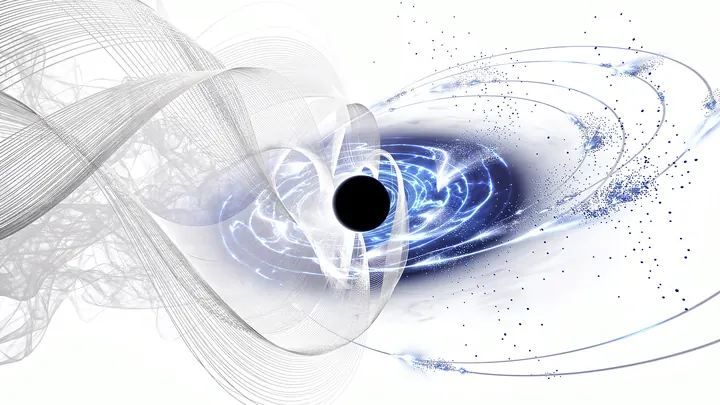
Supermassive black hole growth addresses the question of how black holes with masses millions to billions of times that of the Sun formed and grew, particularly in the early universe. Observations show that quasars powered by such black holes existed less than a billion years after the Big Bang, which poses a challenge: standard accretion processes are too slow to build such massive objects from stellar-mass seeds in that time. Several pathways have been proposed, including direct collapse of massive gas clouds, mergers of smaller black holes, and accretion with super-Eddington rates.
History
The problem of early supermassive black hole formation has been studied since the discovery of quasars in the 1960s, but the specific challenge of their rapid growth in the early universe became prominent with deep surveys in the 2000s. Theoretical models have evolved to include various seed formation scenarios.
How it works
The growth mechanisms involve either 'heavy seeds' formed from the direct collapse of primordial gas clouds, which can produce black holes of ~10^4–10^5 solar masses, or 'light seeds' from the deaths of the first stars, which then grow via accretion and mergers. Accretion of gas can be enhanced if the black hole is embedded in a dense environment, and mergers with other black holes or stars can add mass. The presence of magnetic fields and the geometry of the accretion disk also influence how efficiently matter falls into the black hole.
In practice
Understanding supermassive black hole growth helps interpret observations from telescopes like the James Webb Space Telescope, which is discovering more early black holes, and informs models of galaxy evolution.
Fun fact
Some proposed 'dark stars'—powered by dark matter annihilation—could grow to be thousands of times the Sun's mass before collapsing into black holes, providing a potential seed for supermassive black holes.
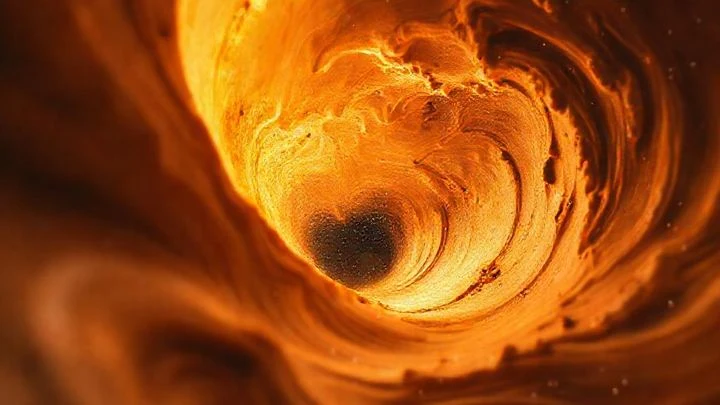
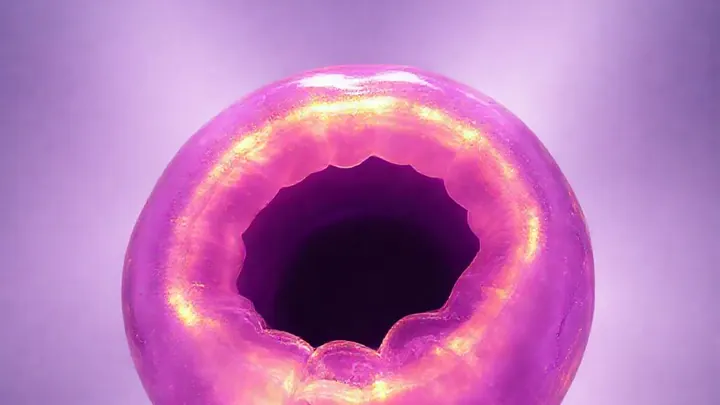
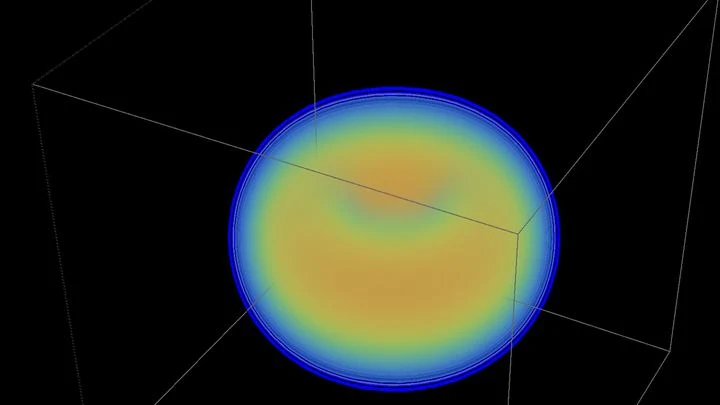
At the center of an ultra-compact dwarf galaxy, a very dense stellar system spanning tens of light-years, there is a vacuum cleaner at work. But instead of dust, it sucks in gas shed by dying stars. This gas does not fly off in all directions; instead, it spirals into a funnel, a rotating disk that gradually settles onto the black hole.
Around a just-ignited star swirls a vortex of dust and gas. This vortex, the protoplanetary disk, grows by accreting material from the surrounding cloud.
A marathon lasting 13 billion years started with different weights. A hundred solar masses — lighter than some gas clouds. A hundred thousand — gravitational dominance, comparable to an elephant among kittens. That's what black hole seeds looked like, ones that by our time should have turned into supermassive giants.
Eight hundred million years after the Big Bang, and at the heart of a young galaxy a monstrous engine is already throbbing. A black hole with a mass of ten billion suns devours matter so greedily that its radiation should outshine everything around it. But outside, silence.
The early universe at redshift z>7 was an arena of rampant growth: black holes with masses up to a billion solar masses already blazed as quasars, devouring gas at monstrous rates. How these giants managed to grow in such a short time is one of astrophysics' sharpest puzzles.
When we peer deep into space, we see the past. Edwin Hubble’s law turns redshift into a time machine: light from galaxy UDS 12999 traveled to us for 7.6 billion years — more than half the age of the Universe.
A detective story unfolded in the GWTC-5 catalog. Hundreds of signals from merging black holes, captured by the detectors of Rainer Weiss and his colleagues, held the secret to the origin of the most massive and rapidly spinning stellar-scale objects.
In a recent study, astrophysicists showed how pre-recombination physics, particularly early dark energy, affects the spectral running $$α_s$$ and, consequently, the viability of scenarios forming primordial black holes from an ultra-slow-roll (USR) phase during inflation.
Observations by James Webb showed: already 500 million years after the Big Bang (at redshifts z~10), the Universe was aglow with black holes with masses of billions of solar masses. This baffles theories of gradual growth: matter would not have time to 'feed' the seeds at the required rate.
Imagine a spotlight: if you look at it from the side, it glows dim red, but if you stare straight into it, it blinds you with white-blue light. That, according to new data, is exactly what the mysterious 'little red dots' in the early universe look like. They are giant black holes, objects with gravity so strong that even light cannot escape, turned edge-on to us.
At the center of a distant galaxy, a supermassive black hole is surrounded by a flat, rotating disk of gas and dust — a giant cosmic funnel of matter. A small compact object, such as another stellar-mass black hole, may find itself in this disk.
A field sown with seeds. Some seeds are large and sprout at the slightest rain; others are finicky, requiring special soil and rare conditions. Which seeds fall into the ground determines what kind of forest will grow years later. Astrophysicists think about the birth of black holes in the early universe in much the same way.
A giant baby planet is still pulling in leftover building material from its surrounding cloud. That's the scene the Hubble Space Telescope captured when it aimed its cameras at an object catalogued as SR 12 c. This companion planet orbits a young star at a wide distance — farther out than Neptune is from the Sun.
Heir to the ideas of Edwin Hubble, the James Webb Space Telescope has peered back to an era when the expansion of the universe was still picking up speed. At redshifts z>4, it spotted bizarre objects—"Little Red Dots" (LRDs).
The stellar halo of the Milky Way is a galactic palimpsest: an ancient manuscript where earlier layers lie hidden beneath the visible text. For a long time, the Gaia-Sausage-Enceladus (GSE) structure was thought to be the final entry in this manuscript, the scar of a single catastrophic merger.
The James Webb Space Telescope has spotted astonishing objects in the depths of space — tiny red dots that shine so brightly it's as if a spotlight were hidden inside a small bulb. These dots are not stars or galaxies in the usual sense, but rather 'cocoons' around supermassive black holes greedily gulping down surrounding gas.
Just a few hundred million years after the Big Bang, in the ocean of invisible dark matter, giant black holes were already taking shape. They were born from the matter itself — without any help from stars. This mechanism, based on the equations of Lemaître, explains their early appearance.
The city has long been asleep: not a single lit window, not a single new house. Only in the very center, in one lone building, someone forgot to turn off a spotlight. That's what a galaxy looks like when stars are no longer born, yet its central black hole still shines.
Drop a stone into a pond, and ripples spread outward. Something similar happens inside compact clumps of dark matter when they encounter a special medium — a scalar field. This field, which pervades everything around us, can spontaneously intensify in the depths of such objects, much like ripples on water growing ever taller and more pronounced.
A pot of boiling porridge, where instead of grains there are layers of oxygen and silicon, and the fire beneath is about to go out, and the star will collapse in on itself. Until now, astrophysicist cooks have used a simplified recipe: they assumed that bubbles and eddies in the porridge obey one and the same average temperature throughout the depth.
A sponge thrown into a bucket of water eagerly soaks up moisture and swells before your eyes. But if you keep adding water and squeeze and release the sponge, absorption becomes harder and takes longer. That's roughly how tiny black holes behaved at the very beginning of the universe.
Two black holes, orbiting each other, behave like a boat rowing with stars. Each passing star is flung away, like a stroke of an oar, and transfers momentum to the pair. For a long time, it was thought this simply brings the black holes closer. But new analysis has shown: by flinging stars unevenly, the system pushes itself sideways, spins, and tilts the orbit.
Drop a stone into a pond — ripples spread across the water. The most visible ripple comes from the strongest splash. That's roughly how physicists picture the growth of perturbations around a black hole: if a system has an instability, its 'loudest' component, the one that grows fastest, should show up first.
A balloon is being inflated faster and faster. At first, it stretches smoothly, but at some point, the pump stutters — the speed drops, then picks up again. During this brief respite, tiny bubbles appear on the rubber. As inflation resumes, they turn into dense knots.
Something similar happened to the universe itself right after the Big Bang.
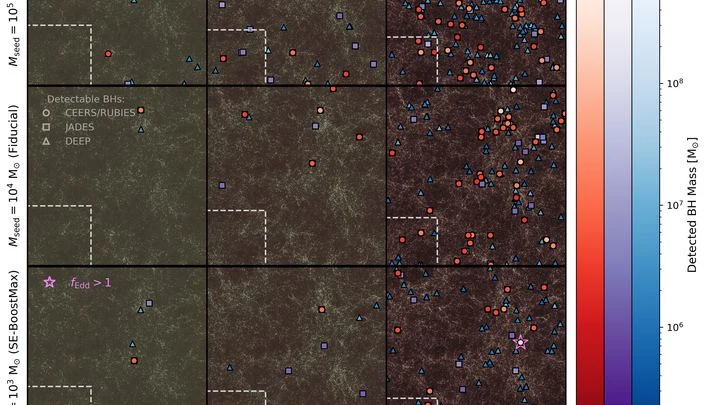
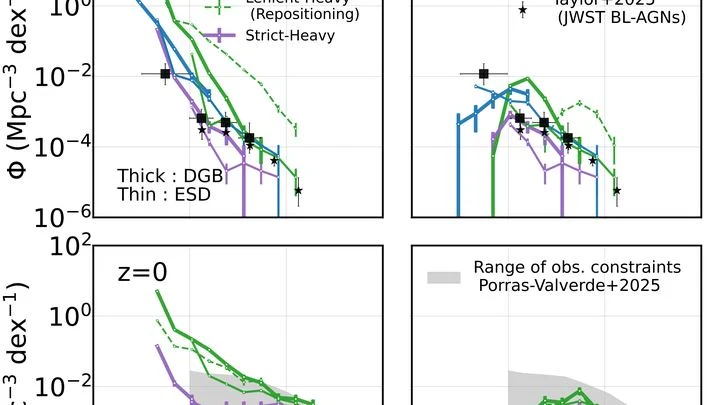
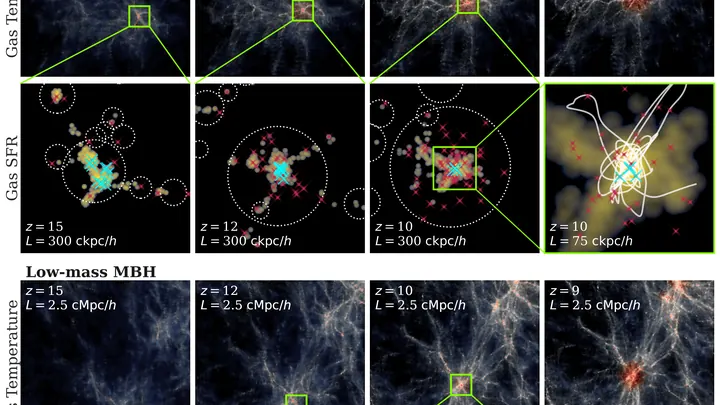
When the universe was a couple of hundred million years old, it resembled a giant kitchen where the first galaxies were being shaped from primordial 'dough'—hydrogen and helium. At their centers, black holes ignited like ovens of varying power, from light 'camp stoves' to heavy 'hearths.' But how quickly did they gain mass by swallowing surrounding gas?
A tiny black hole the size of an atomic nucleus floats in the hot soup of the early universe. Normally, such a little one should quickly evaporate, releasing energy like a drop of water on a hot skillet. But if space is more complex than it seems and contains hidden dimensions, everything changes.
The James Webb telescope discovered black holes — so named by John Wheeler, and Karl Schwarzschild described them as a light trap — which, just 500 million years after the Big Bang, already weighed more than a million Suns.
The James Webb Space Telescope has spotted tiny, unnaturally bright red objects in the early universe. Their light outshines by a hundredfold what you’d expect from ordinary galaxies of that era.
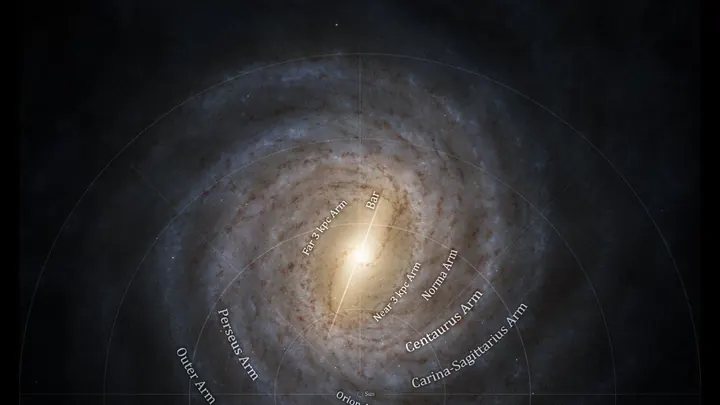
Other galaxies are just ancient snapshots, but we watch the Milky Way live. Comparing data over 30 years, scientists found that the Galaxy’s center is, like, speeding up: the supermassive black hole got heavier, swallowing the mass of a large asteroid each year; the stellar bar (a huge beam of billions of suns, like the…
The mystery of how black holes grew so fast in the early Universe might be solved by quasi-stars. These are giant gas cocoons with a black hole tucked inside. Matter falling into the hole heats up and blasts out so much light that it prevents the cocoon from collapsing. Such an object weighs thousands of Suns and outshines an entire galaxy.
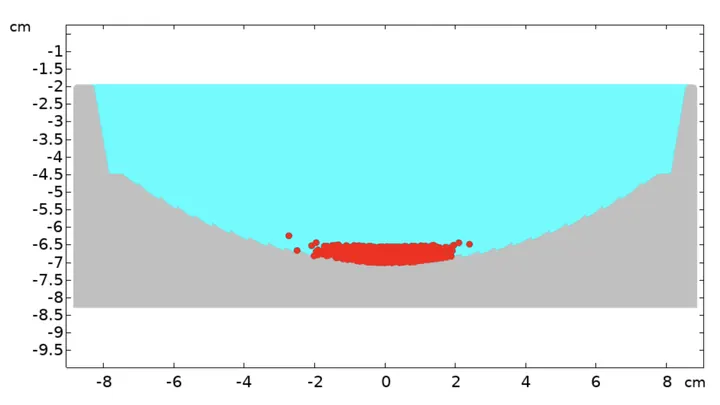
4 billion years ago, the young Earth was mercilessly bombarded by meteorites, leaving behind impact craters. Rains filled them with water, forming shallow ponds where lipid bubbles accumulated. These bubbles, like soap bubbles but with a double-layered lipid membrane (just like modern cells), formed spontaneously when water mixed with fat-like substances.
Growing a galaxy is like a dance between two partners: at the center of nearly every large galaxy sits a supermassive black hole, and they grow together. But who leads?
Black holes are cosmic drains, gravitational funnels that pull in matter from their surroundings. This process, called accretion, doesn't always go smoothly: some of the infalling gas can be ejected back as narrow relativistic jets — jets.
Imagine a city where a skyscraper and a huge park are being built at the same time. The skyscraper grows upward, and the park expands outward. Both processes are fast and get in each other's way, but in the end they are meant to become a single whole. That's the situation in galaxy GNz7q: a black hole grows at the center while new stars burst to life around it.
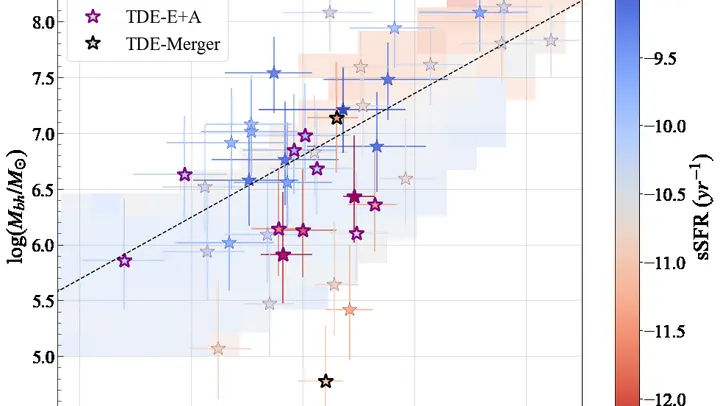
You can't see a black hole until a star wanders too close. Then tidal forces stretch the star like a cook rolling out dough, and some of the material falls into the hole, flaring up as a final goodbye. Such events, called tidal disruptions, are a rare chance to weigh a black hole that would otherwise remain invisible.
The James Webb telescope peered into the early universe and saw a multitude of mysterious red dots. Their glow didn't resemble familiar galaxies or stars. The answer was unexpected: these are growing black holes, born without a stellar stage.
A spinning black hole acts like a cosmic generator: its rotation pumps energy into an invisible scalar cloud — a prime candidate for dark matter. A scalar field is like temperature: at every point in space it's just a single number, with no arrows or vectors. The cloud grows until it overflows.
In the early Universe, just a few hundred million years after the Big Bang, special 'seeds' were born in dense gas clouds — supermassive black holes. Computer modeling showed that these embryos were ten times heavier than previously thought: each weighed a million Suns.
Around each seed, a gas disk spun rapidly.
By analyzing color indices — the ratio of brightness in different spectral bands in images from the James Webb Space Telescope, astronomers have identified galaxies whose light cuts off sharply in the ultraviolet.