The Hubble flow is the large-scale, uniform expansion of the universe in which galaxies recede from each other at speeds proportional to their distance. This relationship, known as Hubble's law, is a direct consequence of space itself stretching, rather than galaxies moving through a static space. The expansion is observed as a systematic redshift of light from distant galaxies, with more distant galaxies appearing to recede faster.
History
Edwin Hubble's 1929 observations of galaxy redshifts and distances established the linear relationship, building on earlier theoretical work by Georges Lemaître and Alexander Friedmann.
How it works
The expansion of space stretches the wavelength of light traveling through it, causing a redshift proportional to the distance traveled. On top of this smooth expansion, galaxies have additional 'peculiar velocities' from local gravitational interactions, which can slightly shift their observed redshift. The Hubble flow provides the cosmic backdrop against which these local motions are measured, allowing astronomers to separate the universe's overall expansion from the gravitational dance of individual galaxies.
The Hubble flow is so uniform that after subtracting local gravitational effects, galaxies in the distant universe recede with a precision that allows cosmologists to measure the expansion rate to within a few percent.
A drop of ink spreads in a glass of water: its edges move faster than its center, and the drop's shape changes. Likewise, a clump of dark matter collapsing under its own gravity expands unevenly, with different shells flying apart at different speeds. Previously, astrophysicists could accurately describe only the simplest case, a uniform sphere with a sharp boundary, which has a single expansion rate.
The night sky looks smooth, but it's actually clumpy — vast communities of galaxies that bend light from distant objects like lenses. When a short, powerful radio burst goes off somewhere in the universe, its path to an Earth telescope can pass near such a clump.
A bright lantern in thick fog seems dim, while a weak flame in clear air can be seen a kilometer away. A similar oddity baffled astrophysicists almost half a century ago.
In a distant galaxy about 290 million light-years away, the object HLX-1 lies hidden. It once flared brighter than hundreds of billions of suns, but now it has quieted down. From 2018 to 2022, the Hubble, Chandra, and Swift space telescopes tracked its fading.
The cosmological principle – the notion that the Universe is homogeneous and isotropic on large scales – has guarded our understanding of the world since the time of Edwin Hubble and Georges Lemaître, whose ideas formed the basis of the Big Bang model.
In a recent study, astrophysicists showed how pre-recombination physics, particularly early dark energy, affects the spectral running $$α_s$$ and, consequently, the viability of scenarios forming primordial black holes from an ultra-slow-roll (USR) phase during inflation.
At the center of a tiny galaxy lies a dense clump of stars and dark matter. This clump, called a soliton, is not frozen in place: it quivers and oscillates like jelly on a plate.
Picture a tightrope walker balancing over an abyss. Every step changes the rope's tension, and the slightest shift in center of gravity can prove fatal. That's roughly what the dance of an ordinary sun-like star around a black hole of ten solar masses looks like when the orbit is highly elongated.
Cosmology is experiencing a tectonic rift. Cepheid-calibrated supernovae, measured by Adam Riess’s team, point to a rate of about 73 km/s per megaparsec.
If you turn on a lamp in a room, it illuminates the walls. But if you place the same lamp in a vast hall, the light barely reaches the corners. Similarly, radiation from young stars affects gas in a galaxy: it knocks electrons out of hydrogen atoms, making the gas glow.
Toss a handful of sand on the floor: there are few large grains, many medium ones, and even more tiny ones. This skew, where small events are common and large ones are rare, is described by a power law. It shows up in city sizes, earthquake magnitudes, and citation counts of scientific papers.
Light from distant stars, as it travels through cosmic dust, loses some of its energy. Dust grains absorb and scatter light, and the way they do so at different wavelengths reveals their composition and size. Astronomers call this the dust extinction curve.
If you look at a map of distant galaxies, it is not perfectly uniform: on one side of the sky there are slightly more, on the other — slightly fewer. This lopsidedness has been noticed in several sky surveys, and it does not look like a random fluke. Usually, it is explained by the fact that our Galaxy itself is flying somewhere, making distant objects appear shifted.
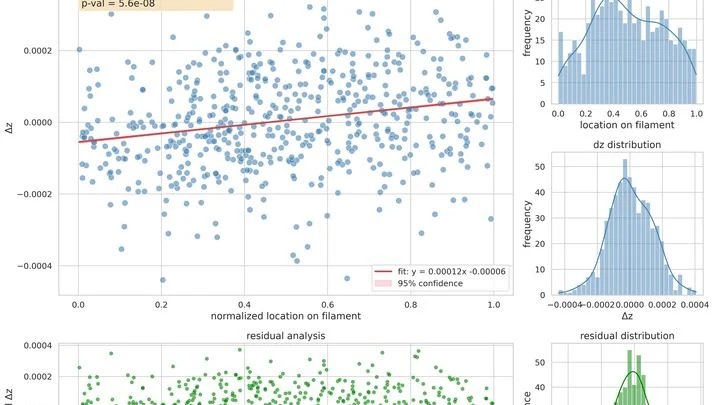
The Universe looks like a giant spiderweb: galaxies aren't scattered randomly but are gathered into knots and along filaments. Inside the filaments, there's plenty of gas, and that's where new stars most often flare up. But how has this changed over time? Scientists compared data from a computer model with real observations of thousands of galaxies.
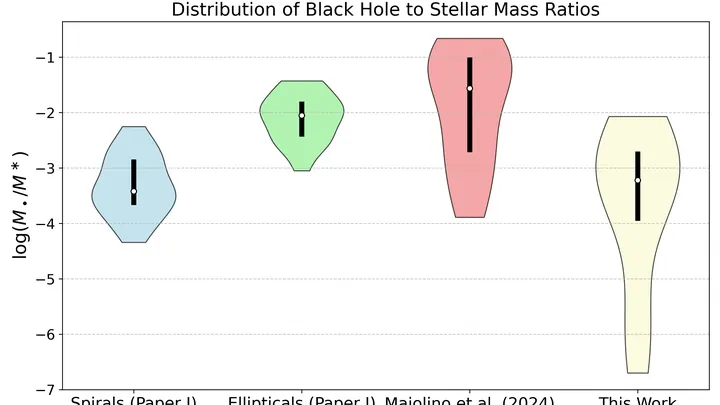
Growing a galaxy is like a dance between two partners: at the center of nearly every large galaxy sits a supermassive black hole, and they grow together. But who leads?
The diffusion equation, a mathematical tool describing how particles spread out in space, has long painted a paradoxical picture: a disturbance, like ripples on Water, instantly engulfs the entire universe. This challenged the theory of relativity, which holds that nothing can move faster than light.
On large scales, the universe resembles a giant spiderweb: bright galaxy clusters are connected by long filaments of galaxies, gas, and dark matter. Previously, it was thought that matter flows along these filaments like water through pipes, heading toward the clusters.
A river of stars (not a cluster, but a distinctly elongated, glowing ribbon) crosses the outskirts of a distant galaxy. Such a stream was spotted in data from the first survey by the Vera Rubin Observatory. It stretches along the minor axis of the galaxy LEDA 751050, like a scarf streaming from the galactic disk.
The stream is enormous: 130 by 15 kiloparsecs.
The galaxy NGC 1560 is a modest island of stars and gas ten million light-years away. Its rotation curve, first measured in 1991, became an icon for those seeking an alternative to dark matter. The plot of rotation speed versus radius shows bends that seem to exactly mirror the bends in the distribution of ordinary matter.