How to Protect Quantum Memory: A Hybrid Approach express
Quantum information is fragile: the slightest noise can destroy it. That's why two protection methods have been devised. The first is dynamical decoupling: rapid pulses are applied to qubits to average the noise to zero. It's like shaking a box of fragile items so they don't bump against the walls. The second is quantum error correction: information is encoded in multiple qubits, and then special checks are measured to detect errors without destroying the data itself.
But you can't simply combine these methods: dynamical decoupling can disrupt the code space, and error correction works with the errors that remain after decoupling. The authors proposed doing decoupling logically: that is, using operations that preserve the code space. They derived formulas showing when such a hybrid outperforms each method individually.
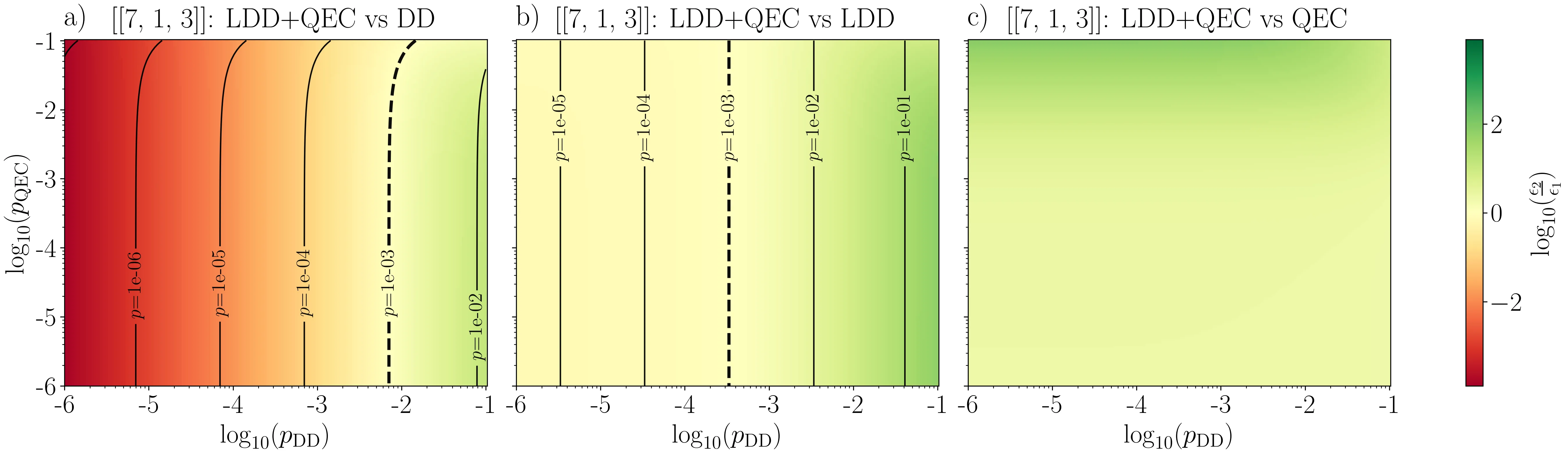
For the Steane code [[7,1,3]] and the code [[13,1,3]], they numerically found parameter regions where the hybrid is better. This shows that the code, decoder, and decoupling group should be designed jointly, not separately.
Original abstract
as written by the authors arXiv:2602.19042
Quantum error correction/detection (QEC/QED) and dynamical decoupling (DD) are tools for protecting quantum information. A natural goal is to combine them to outperform either approach alone. Such a benefit is not automatic: physical DD can conflict with encoded subspace, and QEC performance is governed by the errors that survive decoding, not just those DD suppresses. We analyze a hybrid memory cycle where DD is implemented logically (LDD) using normalizer elements of an $$[[n,k,d]]$$ stabilizer code, followed by a round of syndrome measurement and recovery (or, in the detection setting, postselection on a trivial syndrome). In an effective Pauli model with physical error probability $$p$$, LDD suppression factor $$p_{DD}$$, and recovery imperfection rate $$p_{QEC}$$ (or $$p_{QED}$$), we derive closed-form entanglement-fidelity expressions for QEC-only, QED-only, LDD-only, physical DD, and the hybrid LDD+QEC protocol. The formulas are expressed via a small set of code-dependent weight enumerator polynomials, making the role of the decoder and the LDD group explicit. For ideal recovery LDD+QEC outperforms QEC-only iff the conditional fraction of uncorrectable Pauli errors is larger in the LDD-suppressed sector than in the unsuppressed sector. In the low-noise regime, a sufficient design rule guaranteeing hybrid advantage is that LDD suppresses at least one minimum-weight uncorrectable Pauli error for the chosen recovery map. We show how stabilizer-equivalent choices of LDD generators can enforce this condition. We supplement our analysis with numerical results for the $$[[7,1,3]]$$ Steane code and a $$[[13,1,3]]$$ code, mapping regions of hybrid-protocol advantage in parameter space beyond the small-$$p$$ regime. Our work illustrates the need for co-design of the code, decoder, and logical decoupling group, and clarifies the conditions under which the hybrid LDD+QEC protocol is advantageous.
The Steane code is one of the most famous quantum codes that corrects a single error. It uses 7 qubits to protect one logical qubit.
In the series 'The Expanse', quantum computers are protected from noise using complex codes — exactly what is explored in this work.