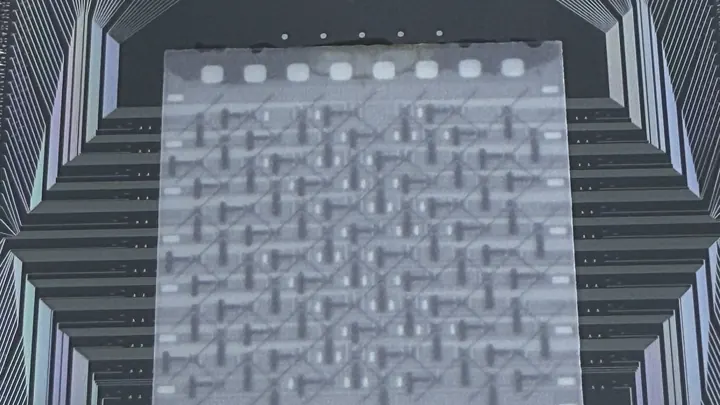
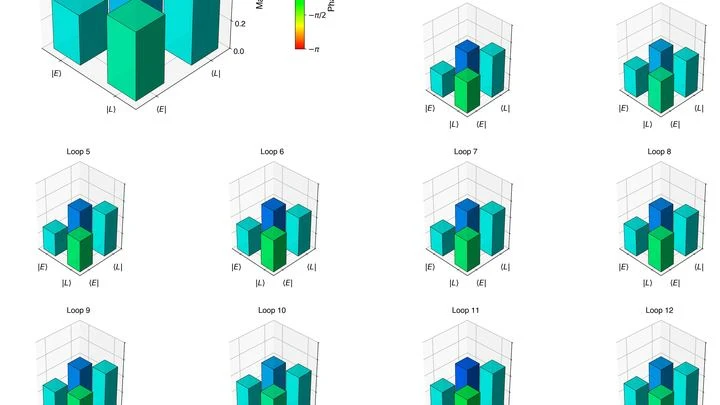
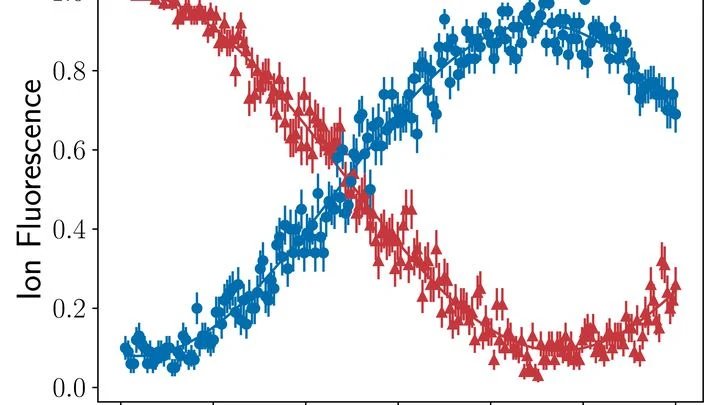
A logical qubit is a unit of quantum information that is protected from errors by being encoded across multiple physical qubits. In real quantum computers, individual qubits are fragile and prone to decoherence and operational errors. A logical qubit uses redundancy and entanglement to detect and correct these errors, allowing quantum computations to proceed reliably. This is the foundational concept behind fault-tolerant quantum computing, where information is stored in a way that errors can be identified and fixed without disturbing the actual quantum state.
History
The concept of quantum error correction and logical qubits was introduced by Peter Shor and Andrew Steane in 1995, shortly after the discovery of quantum algorithms that could outperform classical ones.
How it works
The most common approach is the surface code, where many physical qubits are arranged on a lattice. Data qubits store the logical information, while additional 'measurement' qubits are used to check for errors. By measuring certain parity properties of the qubits, errors can be detected without collapsing the quantum state. When an error is found, it is corrected by applying appropriate quantum gates. The logical qubit is thus a collective state of many physical qubits, and its error rate decreases exponentially as the number of physical qubits increases, provided the physical error rate is below a certain threshold.
In practice
Logical qubits are essential for building scalable quantum computers that can run algorithms like Shor's factoring or quantum simulations without errors. They are being implemented in various hardware platforms, including superconducting circuits and trapped ions.
Fun fact
In 2023, a team at Harvard demonstrated a logical qubit with 48 physical qubits, achieving an error rate lower than any of its individual physical qubits.
Picture a vast hall where thousands of janitors are sweeping the floor at the same time. Each one knows only their own patch and sweeps debris toward the nearest wall, without asking a manager. It used to be thought that such an approach was impossible for a quantum computer: too many errors, and you need a central brain that sees the whole picture.
Water in a river, flowing around a stone, changes its course: some streams press against the surface, others detach and swirl downstream. A classical computer calculates such flows by dividing the fluid into millions of tiny parcels and tracking each one.
In 1996, physicists asked: how much noise can a quantum channel withstand before it stops transmitting information? A phone call where every third word is replaced by random noise is still understandable. Up to what level of interference can the listener still grasp the meaning?
A quantum computer is like an orchestra where each instrument is a qubit and the conductor is the control processor. The conductor must not only set the tempo but also change the score on the fly if a soloist plays something unexpected.
Quantum computers make mistakes. Each qubit is like a ball balanced on the tip of a pencil: a slight tremor in the hand and it rolls off. To keep the balls from falling, you need someone to notice the wobble and correct it in time.
A washing machine sometimes tears clothes. To get a whole shirt, you wash several and then piece one together from the survivors. A quantum computer treats 'magic states'—special ingredients without which complex computations are impossible — in much the same way.
These states are extremely fragile. The slightest noise, and the magic evaporates.
Alice prepares a quantum particle in one of several states and sends it to Bob. The channel the particle travels through isn't perfect: it's noisy, scatters, interacts with the environment. Bob receives the signal and tries to figure out what Alice actually sent. This is the classic "prepare-send-measure" scheme, and there's always a risk of losing something along the way.
In the world of quantum particles, there are introverts — anyons. They are unlike familiar electrons or protons. If you swap two such introverts, they remember the maneuver, as if leaving an invisible trace.
A quantum computer is like a fragile snowflake resting on a warm palm. The slightest breath of heat or a gentle vibration, and it turns into a droplet. To keep the snowflake alive, you constantly adjust it, restoring its original shape. That's quantum error correction.
A cup of hot coffee sometimes freezes faster than cold tap water. This paradox, known as the Mpemba effect, has long been considered a curiosity of classical physics. Now its quantum counterpart has helped test and tune quantum processors — devices that may one day power supercomputers.
A quantum computer is like an orchestra where each musician-qubit easily loses the rhythm. The slightest noise, and the melody of computation turns into cacophony. To keep the orchestra playing in harmony, you need a conductor who instantly spots wrong notes and corrects them without stopping the performance.
A quantum computer based on neutral atoms is like a city where couriers, laser tweezers, physically carry packages between addresses. While one courier drags an atom across the entire chip, the others sit idle. This is slow and error-prone.
The new architecture replaces couriers with a shared radio wave.
An electrical grid stuffed with power electronics resembles a huge orchestra without a conductor. Each converter, each line adds its own note, and sometimes the instruments start playing out of tune.
Two dancers on stage must move in perfect sync, but if one hesitates, the whole routine is ruined. That's roughly how quantum computers with neutral atoms work: two atoms are entangled by putting them into a Rydberg state (as huge as a balloon compared to an ordinary atom), and then you wait for them to 'dance' their part.
Assessing image quality is a job for a meticulous inspector with a toolbox. The IQA-T1 neural network acts exactly like that: it doesn't just stare at the picture, but applies either a spectroscope or a light meter.
Neurochips work differently from conventional computers, which are built according to the blueprints of von Neumann with separate memory and processor. At the core of these chips is a network of simple cells, similar to neurons, and, like water that evenly fills containers of any shape, they easily find a solution without unnecessary steps.
A quantum computer is like an orchestra where each musician is a fragile qubit. The slightest noise, and the melody falls out of tune. To keep the harmony, you need a conductor who instantly hears the false notes and brings the instruments back into line.
A quantum computer is like an orchestra where every musician must hit their note exactly. If one plays off-key, the melody falls apart. The musicians here are qubits, storing information.
A quantum computer is like a finicky musical instrument: the slightest change in temperature, humidity, or string tuning, and the melody sounds different.
Quantum computing suffers from 'false notes' — errors that arise from the slightest inaccuracy. Now they are eliminated with the precision of tuning a concert grand piano. The idea traces back to the dreams of pioneers — David Deutsch and Peter Shor — of flawless operations.
Quantum computers make mistakes. Each step of a computation introduces a tiny inaccuracy, and if left uncorrected, the result degenerates into noise. One of the main challenges is rotating a phase by an arbitrary angle. The standard approach is to assemble the desired rotation from a set of simple operations, like a mosaic.
Data on the internet travels at the speed of light through fiber optics. In classical networks, delays aren't critical, but for quantum communication, perfect synchronization is essential: particles of light with encoded information must converge at the detector in the same instant.
Tuning a quantum processor is monotonous work: you need to calibrate each qubit — a quantum cell — much like a watchmaker adjusting dozens of tiny gears. Humans get tired and make mistakes.
Two pendulums hang from the same crossbar. A push, and they start swinging, gradually falling into and out of sync. In a topological qubit, Majorana particles, special excitations that can store quantum information, play the role of these pendulums.
A lithium battery is like a tiny city: lithium ions are the residents who move between electrode neighborhoods, generating current. But to understand how much energy the city can deliver, you need to know not only the street layout (the material's structure) but also how residents interact with neighbors, transportation, and even the weather.
Erasing even a single bit means releasing heat. This discovery by Rolf Landauer hinted that information is neither material nor illusory. Imagine that every event casts a shadow: that is information, the collection of all unrealized possibilities.
In the 1990s, philosopher John Searle devised a thought experiment: a person sits in a room and, without knowing Chinese, follows instructions to produce correct answers in Chinese. From the outside, it seems they understand the language, but inside, it's just mechanical rule-following.
Light from an ordinary bulb seems utterly chaotic: its waves oscillate out of sync, like a crowd where everyone walks in their own direction. Such light is called incoherent. For a long time, it was believed that elegant topological structures (knots, rings, links) could only be created in coherent laser light, where all waves march in step.
An invisible trap made of laser light held 11,000 atoms — a record for quantum engineering. Previously, physicists wrestled with a few dozen of these particles; now the count runs into the thousands. Each atom becomes a qubit — a quantum bit that is both zero and one at once, like a spinning coin balanced on its edge.
A quantum computer is like an orchestra: each musician plays their own part, but the slightest noise from the audience can throw off the whole ensemble. The particles that store information easily lose their coherence from thermal jolts or stray magnetic fields.
In the ocean of bank transactions, fraud is rarer than neutron stars in space, just 0.1% of all operations. A conventional detector gets used to the clean flow and loses vigilance.
Enter Q-SYNTH, a hybrid system with a quantum generator. It creates plausible fake transactions itself, drawing on scraps of real data.
Two simultaneous interpreters sit in the same booth. The first translates from English into Russian but swallows half the words. The second goes from Russian into French, and also loses half. If you put them together, you'd expect a mess: the losses would add up, and only a quarter of the meaning would reach the listener. But what if they start correcting each other?
Quantum computers in the cloud are like a post office: you send a letter, and someone else reads the address and the contents. In ordinary computing, the server sees your data and algorithm. Blind quantum computing is an unopenable envelope: the server does the work but doesn't know what it's doing.
A quantum bit (qubit) is a delicate thing. Even a little heat destroys it, like a random nudge topples a crystal wine glass. To protect this fragile information, physicists have built a three-dimensional quantum structure resembling a Russian doll.
An ordinary battery in a phone stores energy in chemical bonds — slowly, with heat and wear. A quantum capacitor works differently: it charges not with matter but with rhythm. A swing that is pushed in time with its motion accumulates energy in the motion itself, without friction.
A quantum computer is like an orchestra where each musician plays their part, but if one hits a wrong note, the melody falls apart. Errors arise constantly: from thermal jitter, from imperfect instruments. To keep the symphony going, you need a "conductor" who hears the off-key notes and corrects them on the fly.
In the kitchen, the sequence of actions is strictly dictated by the recipe: first chop, then fry, and nothing else. In quantum physics, the role of the recipe is played by causality — one event causes another, and they cannot be swapped. But in recent years, theorists have devised clever scenarios where the order of events seems to 'hang' in uncertainty.
A drop of ink falls into a glass of water, and within a minute you can't tell where it landed. In the quantum world, it's even more dramatic: information about a local event spreads across the entire system so quickly that any point-like sensor soon stops feeling anything. This is called delocalization, and for quantum sensors, it sounds like a death sentence.
A radio picks up a broadcast through crackle and hiss. That's roughly how modern quantum computers work: the useful signal drowns in noise. The longer the computation runs, the more the interference distorts the result.
The rows of wires stretching from the warm room into the fridge holding the quantum chip look like a tangled telephone exchange from the last century. Each qubit needed its own analog channel for precise tuning, and the cables carried extra heat and got underfoot.
Now researchers have placed a digital-to-analog converter right in the cold zone, next to the qubits.