Secure communication refers to methods of transmitting information that are protected against unauthorized access or interception. In the quantum realm, this takes the form of quantum key distribution (QKD), which uses the principles of quantum mechanics to guarantee that any attempt to eavesdrop is detectable. Unlike classical encryption, which relies on computational complexity, quantum secure communication offers provable security based on the laws of physics.
History
The concept was first proposed by Stephen Wiesner in the 1970s, and the first practical protocol (BB84) was developed by Charles Bennett and Gilles Brassard in 1984. The first experimental demonstration followed in 1989.
How it works
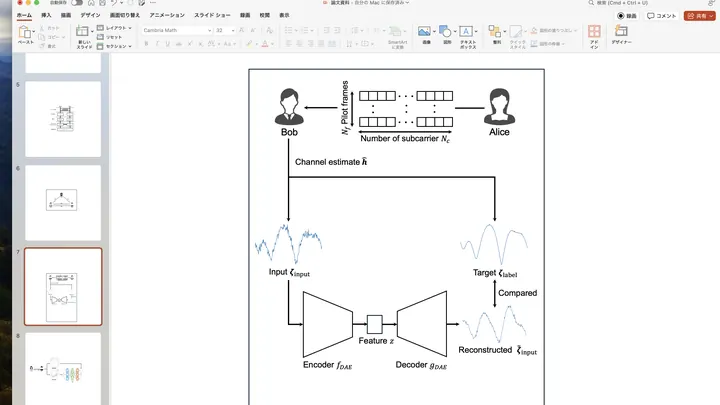
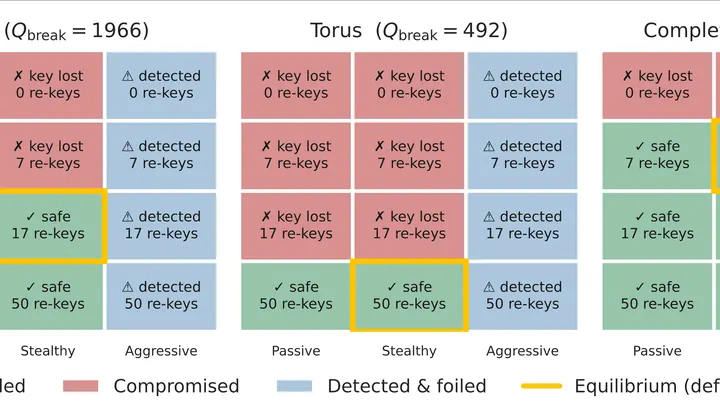
QKD typically encodes information in the quantum states of photons, such as their polarization or phase. The sender (Alice) transmits a sequence of photons, and the receiver (Bob) measures them in randomly chosen bases. Due to the no-cloning theorem, an eavesdropper (Eve) cannot copy the photons without disturbing them, introducing errors that Alice and Bob can detect by comparing a subset of their data. If no eavesdropping is detected, they can use the remaining bits to generate a secure cryptographic key. More advanced protocols, such as measurement-device-independent QKD, close additional loopholes.
In practice
Used in secure banking transactions, government communications, and increasingly in fiber-optic networks and satellite-based links for global secure key distribution.
Fun fact
In 2017, China launched the Micius satellite, which successfully demonstrated quantum key distribution over a distance of 1,200 kilometers, paving the way for a global quantum internet.
A quantum computer is like an orchestra where each musician, a qubit, plays their part but keeps hitting wrong notes. To keep the music from turning into cacophony, you need a conductor who instantly hears the off-key notes and corrects them.
A drop of ink in a glass of water spreads in intricate swirls. Similarly, a quantum particle exchanging energy with its environment changes its state in a complex and entangled manner. Describing this dance between particle and environment has long baffled scientists.
Alice prepares a quantum particle in one of several states and sends it to Bob. The channel the particle travels through isn't perfect: it's noisy, scatters, interacts with the environment. Bob receives the signal and tries to figure out what Alice actually sent. This is the classic "prepare-send-measure" scheme, and there's always a risk of losing something along the way.
A quantum computer is like a fragile snowflake resting on a warm palm. The slightest breath of heat or a gentle vibration, and it turns into a droplet. To keep the snowflake alive, you constantly adjust it, restoring its original shape. That's quantum error correction.
An electrical grid stuffed with power electronics resembles a huge orchestra without a conductor. Each converter, each line adds its own note, and sometimes the instruments start playing out of tune.
When two phones try to create a shared secret key from random properties of radio waves, interference makes their measurements imprecise. It's like two people looking at a reflection in a fogged-up window: each sees a blurry silhouette, and there's no way to make out a common picture.
A cloud service dishes out commands to a drone swarm without any knowledge of their movements. The signals are encrypted, but each maneuver leaves a barely visible trace in the cipher, like ink bleeding through paper from the pressure of a pen. Over time, these ink stains coalesce into a pattern, and the hidden data is no longer a secret.
Quantum devices are no longer lab curiosities. They are assembled, tuned, and repaired like ordinary hardware — except inside them, it's not just current but intricate tangles of particles that can exist in multiple states at once. Engineers draw schematics, programmers write code, physicists calculate effects.
A quantum computer is like an orchestra where every musician must hit their note exactly. If one plays off-key, the melody falls apart. The musicians here are qubits, storing information.
Data on the internet travels at the speed of light through fiber optics. In classical networks, delays aren't critical, but for quantum communication, perfect synchronization is essential: particles of light with encoded information must converge at the detector in the same instant.
A quantum computer is like an orchestra where each musician, a qubit, must play their part accurately and on time. Usually, musicians are seated in fixed positions and connected by conductors' consoles. But what if we let them move freely across the stage and turn the movement itself into part of the music?
When a grain of sand falls on a table, its impact is predictable. But if you squeezed it down to the size of an atomic nucleus, the familiar laws of gravity would break down — the force of gravity would grow without bound.
Training a large neural network across hundreds of compute nodes is like making soup as a team: each 'chef' tastes the dish and tells the others what to adjust.
A quantum computer is like an orchestra: each musician plays their own part, but the slightest noise from the audience can throw off the whole ensemble. The particles that store information easily lose their coherence from thermal jolts or stray magnetic fields.
The atom is like a conductor, and the light in the resonator is the orchestra. Their energy exchange, known as the Jaynes–Cummings interaction (part of the Standard Model), lets the atom use “baton” strokes to change the rhythm and timbre of the oscillations.
Two simultaneous interpreters sit in the same booth. The first translates from English into Russian but swallows half the words. The second goes from Russian into French, and also loses half. If you put them together, you'd expect a mess: the losses would add up, and only a quarter of the meaning would reach the listener. But what if they start correcting each other?
Quantum batteries harness quantum effects to circumvent the limitations of ordinary devices imposed by entropy — a measure of disorder and energy losses. Imagine a bucket under a powerful jet: filling is lightning-fast. But the bucket has holes: the environment constantly drains the energy.
In 1948, engineer Claude Shannon laid the foundations of information theory. The Nyquist–Shannon theorem gave the first answer: to avoid losing a signal, you need at least twice as many measurements as the fastest feature in the signal. In 2006, the method of compressed sensing relaxed this requirement.
Quantum computers in the cloud are like a post office: you send a letter, and someone else reads the address and the contents. In ordinary computing, the server sees your data and algorithm. Blind quantum computing is an unopenable envelope: the server does the work but doesn't know what it's doing.
A drop of ink falls into a glass of water, and within a minute you can't tell where it landed. In the quantum world, it's even more dramatic: information about a local event spreads across the entire system so quickly that any point-like sensor soon stops feeling anything. This is called delocalization, and for quantum sensors, it sounds like a death sentence.
A radio picks up a broadcast through crackle and hiss. That's roughly how modern quantum computers work: the useful signal drowns in noise. The longer the computation runs, the more the interference distorts the result.
Two mailboxes at opposite ends of a city. Drop a letter in one, and an identical one instantly appears in the other. That's roughly how quantum entanglement works: two particles behave as a single unit, even when separated by a great distance. But until recently, this connection could only be maintained within a single room or across a lab bench.
A quantum memory node is a tiny diamond with a defect that can store and emit single photons. But its light has a wavelength of 637 nanometers, the same red as a ruby, and is almost completely absorbed after just a few meters of standard optical fiber.
Light can act as a courier carrying secret messages. But to ensure the courier doesn't lose a single letter, you need to meet and check it very quickly. The new chip made from a thin film of lithium niobate is like a turnstile that opens and closes in billionths of a second, letting light pulses through at just the right moment.
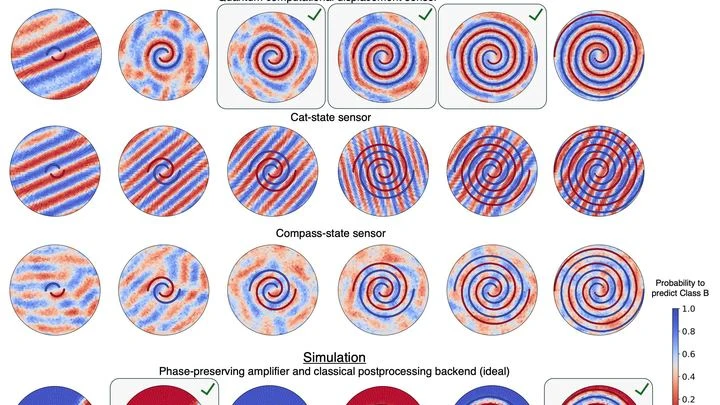
A judge walks into the courtroom but doesn't look at the evidence: he immediately delivers the verdict. That's how the new quantum sensor works: it doesn't measure the signal but directly decides which class it belongs to.
In conventional quantum sensing, it's all like a detective story: first you gather clues (measure the signal), then you analyze them.
A secret key is like a password that two parties need to know, but no one else can peek at. In quantum communication, it's sent using single photons: any attempt to intercept inevitably disturbs them and exposes the spy. Until now, such systems were assembled from many separate components — bulky and expensive.
A quantum magnetometer based on hydrogen nuclei works like noise-canceling headphones. It alternately "listens" to the field in two different ways: the noise is the same for both, but the desired signal is different. By subtracting one from the other, the device extracts the signal, reducing interference by more than 1000 times.
An ordinary laser beam carrying quantum keys trembles at the slightest movement, like a flashlight in the hand of a running person. The drone vibrates, the rover shakes, and the code falls apart. The authors figured out how to align the polarization of light (the direction of its oscillations) on both ends of the line on the fly.
An ordinary superconducting qubit is like a swing that any gust of wind can set rocking. The slightest change in electric charge nearby, and the quantum state is already spoiled.
An AI has learned to conduct the quantum orchestra. Its instruments: superconducting circuits — artificial atoms kept colder than interstellar space. This AI-conductor designs and runs entire experimental scores, not just playing notes but creating them on the fly.
In the quantum world, you cannot create a copy of an unknown particle's state – this was established by William Wootters and Wojciech Zurek in 1982, and Charles Bennett turned this prohibition into a data protection tool.
In quantum communication, a secret key is transmitted using single photons. Eavesdropping on such a channel is supposedly impossible: any interception attempt disturbs the particle and leaves a trace. But the idea has a weak spot — the real hardware, which sometimes behaves differently than theory dictates.
An ion channel in a cell membrane is a gate just a few atoms wide. Every second, millions of charged particles, sodium and potassium ions, pass through it. Classical physics said that to get through, an ion must jump over an energy barrier, like a traveler crossing a high mountain pass.
A rope braided from a hundred short strands can be twisted to the right or to the left. Each strand individually doesn't know which way the whole rope is twisted, but try to unravel it, and the difference immediately shows. That's roughly how the states physicists call symmetry-protected are arranged: locally they are indistinguishable, but globally they are different.
A quantum computer in the lab resembles an orchestra: lasers play the role of bows, and ions are the strings. To play the desired melody, powerful radio signals are sent to the lasers: they set the rhythm and pitch. But part of this "music" escapes the stage.
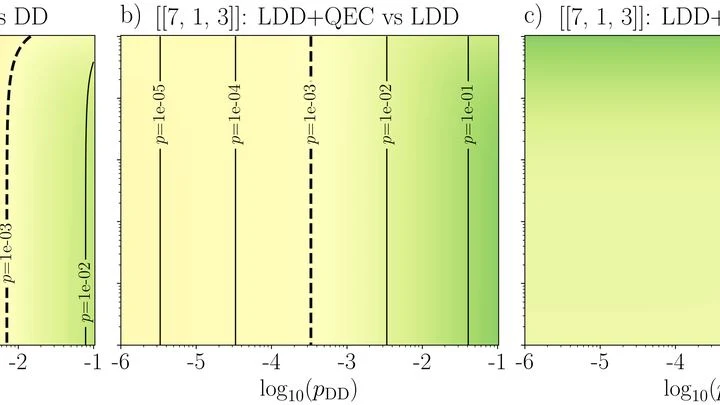
Quantum information is fragile: the slightest noise can destroy it. That's why two protection methods have been devised. The first is dynamical decoupling: rapid pulses are applied to qubits to average the noise to zero. It's like shaking a box of fragile items so they don't bump against the walls.
A bread recipe written in disappearing ink: while you read, the original fades. That's how qubits behave — any measurement changes them irrevocably. Copying them is forbidden by the 1982 theorem (Вуттерс, Зурек): a qubit contains энтропия — unknown information that can't simply be doubled.
Ordinary messages can be intercepted without anyone noticing. Physicists have come up with a way to create a shared secret that instantly breaks if someone so much as glances at it. Instead of paper, they use single particles of light. This quantum communication exploits a rule: any measurement changes a quantum object.
Two photons fly out of a tiny box, and behave like twins who always wear matching outfits. Turn one, and the other instantly turns the same way, even if they are kilometers apart. This is no magic trick but quantum entanglement: a connection between particles that defies distance.
Researchers have built a compact source of such pairs.