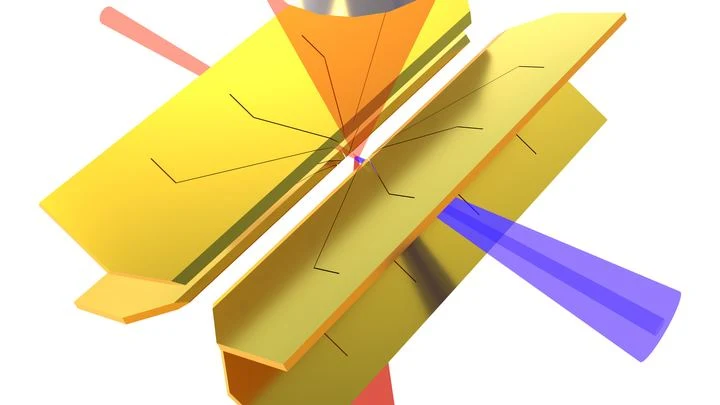
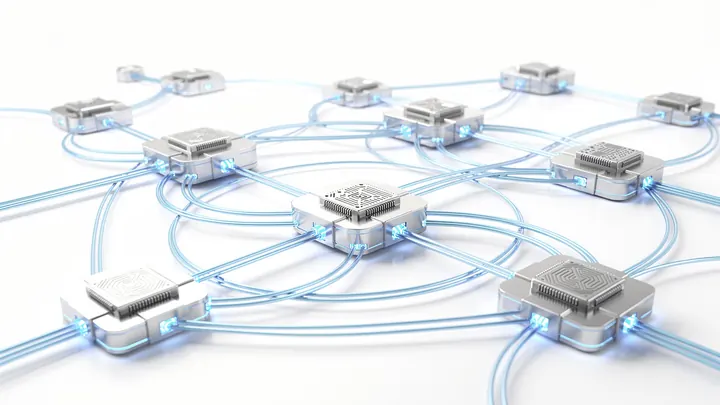
A hybrid quantum system combines different types of quantum technologies—such as superconducting circuits, trapped ions, nitrogen-vacancy centers in diamond, or photons—into a single platform. Each technology has its own strengths: superconducting qubits are fast and scalable for computation, while diamond defects have long-lived spins and interact strongly with light. By coupling them, researchers aim to get the best of both worlds: the processing power of one and the memory or sensing capability of another.
History
The concept emerged in the late 2000s and early 2010s as researchers began exploring ways to connect disparate quantum systems. No single inventor is credited; it grew from collaborative efforts in quantum engineering.
How it works
The key is to make the different components interact coherently. For example, a superconducting microwave resonator can be coupled to the spin of a nitrogen-vacancy center via a small magnetic field. The resonator stores and manipulates microwave photons, while the spin acts as a quantum memory or sensor. The coupling is engineered so that quantum information can be transferred back and forth without losing coherence.
In some hybrid setups, a single microwave photon can be used to control the quantum state of a diamond spin, effectively bridging two very different energy scales.
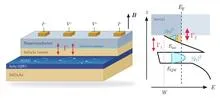
A thin layer of indium arsenide lies hidden under a superconducting film, like a voice beneath the noise of a crowd. In such a hybrid, current takes the path of least resistance and flows almost entirely through the metal, leaving the semiconductor inaudible to standard probes.
At low temperatures, many materials become superconductors — current flows without resistance. But how exactly does this happen if electrons were initially trapped in an insulator? Half a century ago, Philip Anderson suggested that the answer lies in a special quantum dance of particles.
Building a quantum network node is like teaching a dancer to balance on a carbon thread over an abyss. One leg must spring lightly from the wire, hurling photon-messengers into the external world. The other must grip the rope tightly, guarding precious quantum information.
A quantum computer is like an orchestra where each musician, a qubit, must play their part accurately and on time. Usually, musicians are seated in fixed positions and connected by conductors' consoles. But what if we let them move freely across the stage and turn the movement itself into part of the music?
Hot water sometimes freezes before cold: this is the Mpemba effect. In the quantum realm, a similar paradox appears: the more the equilibrium is disrupted, the faster it recovers. It's like fleeing from disorder (entropy) in reverse: the system rushes toward order, and a large initial imbalance only helps.
Magnetic particles are attached to the surface of the diamond by DNA strands, like puppets on strings. They constantly dance under the thermal motion of the liquid molecules. The liquid's viscosity sets the pace: in honey, the particles barely tremble; in alcohol, they dance quickly.
A typical photon source can be likened to a club entrance with a single bouncer. He tries to let people in one at a time, but occasionally couples sneak past. Physicists call this the purity problem: photons must arrive strictly solo, otherwise quantum computing breaks down.
In the ocean of bank transactions, fraud is rarer than neutron stars in space, just 0.1% of all operations. A conventional detector gets used to the clean flow and loses vigilance.
Enter Q-SYNTH, a hybrid system with a quantum generator. It creates plausible fake transactions itself, drawing on scraps of real data.
Light can be more than just a beam: it can be a precision ruler. If you take very short pulses, shorter than a fly's wingbeat, and fire them one after another, you get an optical comb: a set of colors spaced at exactly equal intervals, like the teeth of a comb. This rainbow lets you measure distances, time, and the composition of materials with unimaginable accuracy.
A quantum computer is like an orchestra where every musician-qubit must play in perfect silence. But when you have many such orchestras that want to perform together, they need a reliable conductor-communicator.
Ordinary batteries lose charge like tea cools down. A quantum battery works differently: its heart is a tiny cavity with darting photons. If you illuminate it with special photon pairs, energy flows into a chain of qubit cells instantaneously — much like a swing gets a boost from strong pushes.
Quantum networks need a mediator between storage — spin — and carrier — light. No single molecule had ever pulled off such a feat. But now physicists have found a solution. They placed a carbene molecule into a crystal and cooled it to -269°C.
An ordinary battery in a phone stores energy in chemical bonds — slowly, with heat and wear. A quantum capacitor works differently: it charges not with matter but with rhythm. A swing that is pushed in time with its motion accumulates energy in the motion itself, without friction.
An orchestra where every musician plays their own part, and the conductor tries to catch the overall melody. That's roughly how physicists view electrons in cuprates — ceramic materials that conduct electricity without resistance at temperatures above liquid nitrogen.
A spinning top, set in motion on a perfect surface, topples from the slightest tremor. Likewise, a quantum bit, created at a defect in a diamond, has its state destroyed by magnetic disorder from impurities and external interference.
Two pendulums on a stable table swing independently. If you place them on a shaky surface, vibrations synchronize their motion. The same principle worked on a silicon chip with photons.
Scientists created two sources of light that emit pairs of particles.
Niobium is a metal that, when cooled to a few degrees above absolute zero, conducts electricity without resistance. In labs, it is deposited as thin strips onto a substrate, like frosting on a cake. But during deposition, oxygen from the special mask seeps into the metal, and it spoils the superconducting properties.
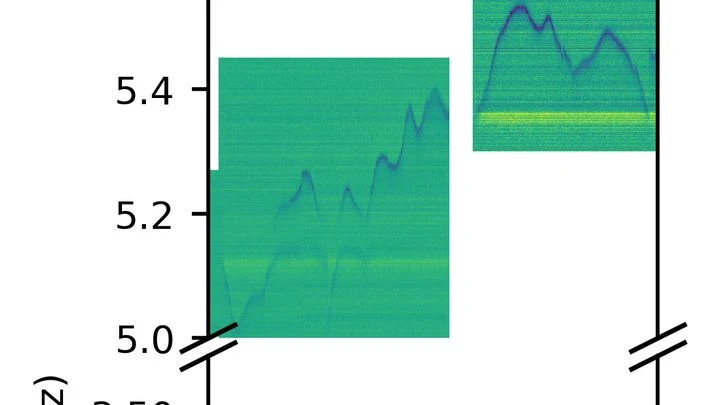
In a superconducting resonator, light doesn't just bounce around: it embraces the qubit so tightly that their joint dance can no longer be described by old textbooks. The researchers took an indium arsenide nanowire, turned it into a superconducting qubit, and placed it inside a microwave resonator.
The surface of the uranium compound UTe2 crystal looks like a frozen sea: in some places, electrons move freely; in others, they get stuck near atoms. A scanning tunneling microscope, a device that probes the surface with an atomically sharp tip and senses individual electrons, revealed that this landscape is not random.
An ion quantum computer is like a chandelier with a dozen pendants: pull one, and they all start swinging. Each ion is a qubit, but when there are many, their collective vibrations crowd the stage. Any operation on one pair disturbs the neighbors, and the computation goes awry.
A tiny diamond hangs in the air, held by an electric field like a speck of dust in a beam of light. Hidden inside are defects — places where a carbon atom is replaced by nitrogen, with a vacancy nearby. These defects behave like little magnets that can be flipped with laser and microwaves.
In two mirrored rooms, set at right angles, lives a cloud of atoms. Each atom is like a singer in a choir: on its own, it may stay silent, but when neighbors start to sing, it joins in. Here, the conductor's role is played by geometry itself: one room helps the atoms emit light together, while the other gently nudges them toward that — not directly, but through a clever detour.
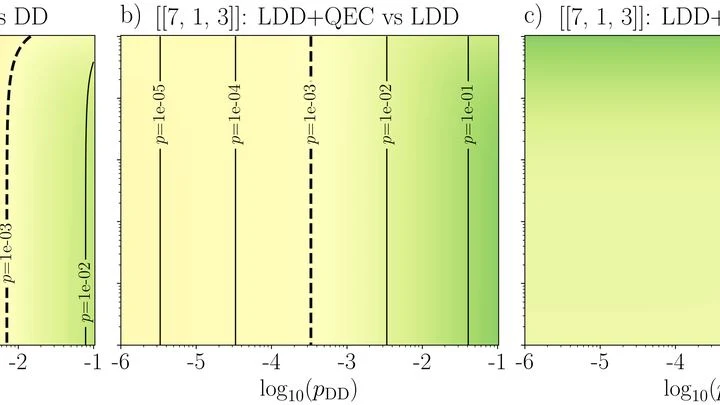
Quantum information is fragile: the slightest noise can destroy it. That's why two protection methods have been devised. The first is dynamical decoupling: rapid pulses are applied to qubits to average the noise to zero. It's like shaking a box of fragile items so they don't bump against the walls.
Qubits in a quantum computer are like musicians in an orchestra: each must hear the others, or the music falls apart. But if you wire the musicians together permanently, they start getting in each other's way: that's how unwanted interactions arise in superconducting chips, spoiling computations.
A quantum computer is like an orchestra where electrons and nuclei play different instruments. Usually, the conductor needs two batons: microwaves for electrons and radio waves for nuclei.
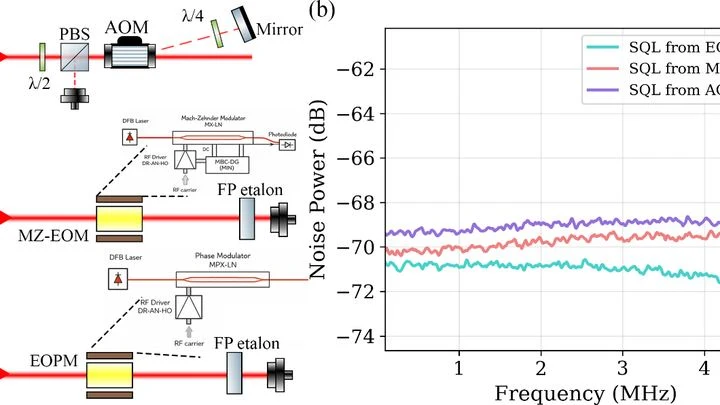
Ordinary light is a stream of photons flying every which way: sometimes more, sometimes fewer, and in that chaos, measurement precision gets lost. Physicists have learned to "tame" this stream by creating squeezed light — where the noise in one characteristic drops below the vacuum level.
A quantum computer isn't a monolith: it's more like an orchestra, where each qubit must play its part without drowning out the neighbors. In ion-based machines, two types of qubits are used: some store information, others process it. Previously, each type required its own laser, like separate batons for violins and trumpets.
A light pulse can be sliced into short time bins, like a train into carriages. If two photons are born together and their carriages are tightly linked, the arrival of one in a specific bin guarantees that the other arrives in the paired bin, this connection is called time-bin entanglement.
A conductor leads an orchestra of billions of musicians while still hearing each one individually. That's roughly the challenge physicists face when trying to make light and electron spins in solids work together.
Imagine two synthetic diamonds, each acting as a high-precision tuning fork. Inside the crystal lattice of each diamond sits a carbon-13 atom: this is a quantum bit, or qubit, the minimal unit of quantum information.
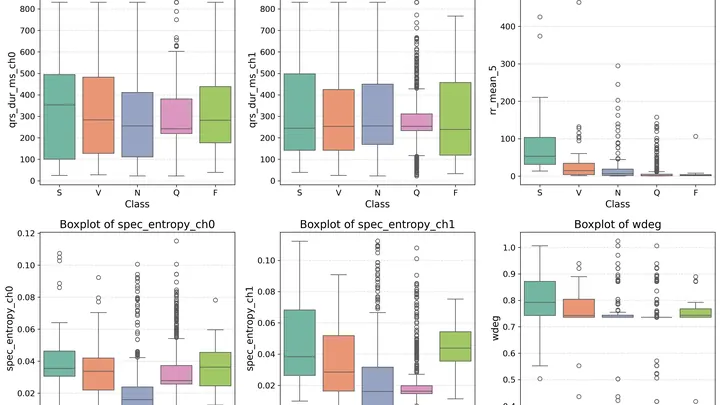
An electrocardiogram is like a musical score, where each note is a heartbeat. A doctor hears the melody and spots the off-notes — arrhythmia. But listening to the score for hours is tiring, so a smart monitor is placed by the patient's bedside.
Plants employ an army of perfect couriers to deliver energy. Each photon of sunlight is absorbed, and its energy is instantly, with almost no loss, transferred to reaction centers where nutrient synthesis occurs.
For the quantum internet, we need to learn how to hold light — much like mail is sorted at intermediate nodes. The technology is based on a thin crystal plate doped with europium ions, a rare-earth element that, incidentally, is responsible for the red glow of smartphone screens.
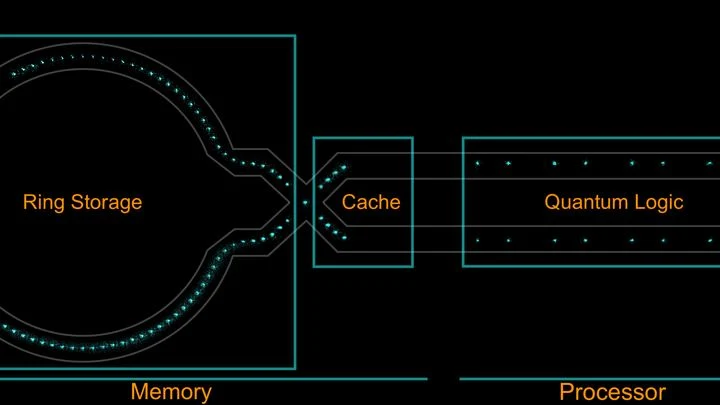
In the new Helios processor, 98 barium ions circle along a closed loop, like horses on a carousel. This architecture allows any ion to exchange data with any other, making the system flexible and powerful. Laser pulses, like a conductor's baton, issue commands at the speed of light.
Ordinary wires: electrons jostle, lose energy, and heat up: that's resistance. In superconductors, some electrons pair up in sync, like dancers swirling without collisions. But these pairs hide: you can't see them directly, only infer their presence from flawless coordination.
Regular quantum communication is like a postal service that sends letters strictly one at a time. If the route is long, you have to wait an indecently long time for a reply. Physicists sped up the process by dispatching ten 'postal trucks' — light pulses — into a single optical fiber, but in different time windows.
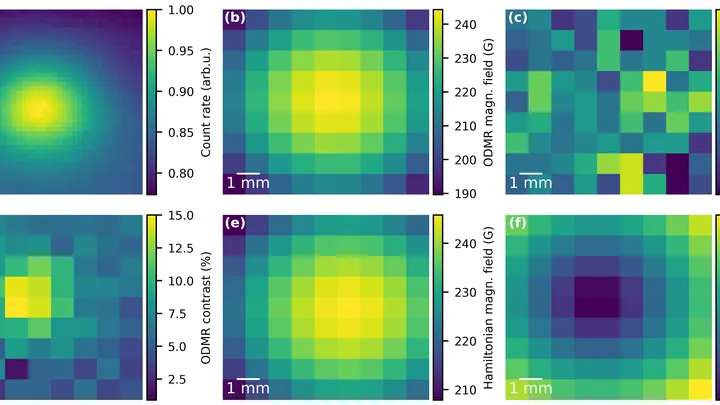
On a two-by-two-millimeter diamond plate, an entire orchestra of forty-nine violins fits. Each string is tuned to its own note, its own DNA fragment. When the right melody enters the hall, the string responds, and the conductor hears a clean sound. That conductor is a quantum sensor hidden within the diamond itself.
A beam of visible light enters a cloud of billions of rubidium atoms cooled to near absolute zero, and emerges on the other side already in the telecom range.
Quantum computing promises a revolution, but its real power will only unfold in a network. The best “brains” — superconducting qubits — communicate at microwave frequencies. The ideal “couriers” — optical photons — fly at hundreds of terahertz. A direct hookup is impossible.