How to Protect Quantum Memory: A Hybrid Approach express
Quantum information is fragile: the slightest noise can destroy it. That's why two protection methods have been devised. The first is dynamical decoupling: rapid pulses are applied to qubits to average the noise to zero. It's like shaking a box of fragile items so they don't bump against the walls. The second is quantum error correction: information is encoded in multiple qubits, and then special checks are measured to detect errors without destroying the data itself.
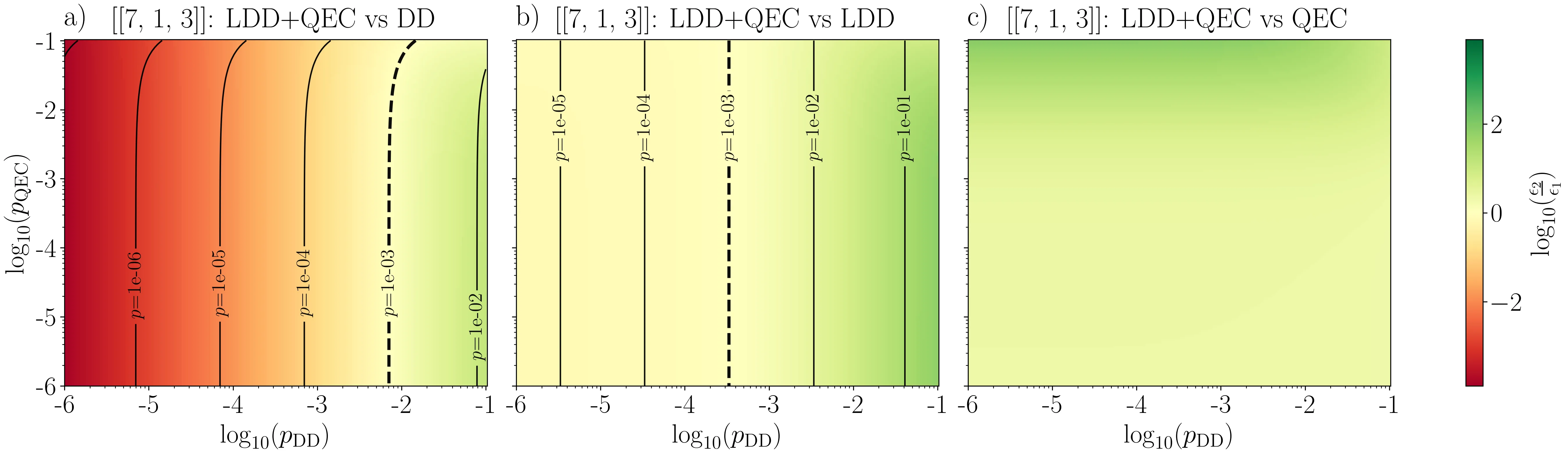
But you can't simply combine these methods: dynamical decoupling can disrupt the code space, and error correction works with the errors that remain after decoupling. The authors proposed doing decoupling logically: that is, using operations that preserve the code space. They derived formulas showing when such a hybrid outperforms each method individually.
For the Steane code [[7,1,3]] and the code [[13,1,3]], they numerically found parameter regions where the hybrid is better. This shows that the code, decoder, and decoupling group should be designed jointly, not separately.
The Steane code is one of the most famous quantum codes that corrects a single error. It uses 7 qubits to protect one logical qubit.
In the series 'The Expanse', quantum computers are protected from noise using complex codes — exactly what is explored in this work.