A delay differential equation (DDE) is a type of equation used to describe systems where the rate of change at any moment depends not only on the present state but also on the state at some earlier time. This 'memory' effect makes DDEs fundamentally different from ordinary differential equations, which assume the future depends only on the immediate present. DDEs arise naturally whenever there is a time lag between cause and effect, such as in biological systems where a response takes time to develop, or in control systems where signals travel with finite speed.
History
The study of DDEs began in the 18th century with work on the tautochrone problem, but systematic mathematical treatment emerged in the early 20th century, notably through the contributions of Richard Bellman and Kenneth Cooke in the 1960s.
How it works
In a DDE, the derivative at time t is a function of the variable at time t and also at time t−τ, where τ is a fixed delay. Because of this, the initial condition is not a single point but an entire interval of history — you must specify the state over a time window of length τ to start the solution. This historical dependence can lead to richer behavior than ordinary equations, including oscillations that persist without external forcing and even chaotic dynamics.
In practice
DDEs model population dynamics with gestation delays, neural networks with signal transmission times, and feedback control systems in engineering.
Fun fact
A single DDE with a constant delay can produce chaotic behavior even though the underlying equation is deterministic and has no noise.
Two runners start a race on a course with changing incline. One starts earlier, the other later, and the judge measures their speeds without knowing about the staggered starts. So it is with virus variants: data arrive with delays, and if those delays are unequal, estimates of competitive advantage can be badly wrong.
When two atomic nuclei smash together, a tiny fireball is born. It lives for an instant, but inside, entire epochs pass: compression, heating, expansion. Physicists have learned to eavesdrop on this process, and their "microphone" is the pairs of electrons and positrons that fly out of the ball at different stages.
In the new work, two scenarios were compared.
Many natural processes are described by differential equations, but scientists often have only fragmentary data — a sort of torn map. The new computational method works like a cartographer who reconstructs a complete map of the terrain from a few landmarks.
Einstein’s cosmological constant — a blunder or a boomerang insight? The universe’s acceleration caught physicists off guard: ΛCDM works, but why is the vacuum energy so absurdly tiny? Imagine an ocean heaving with quantum fluctuations, yet on the surface only a microscopic ripple.
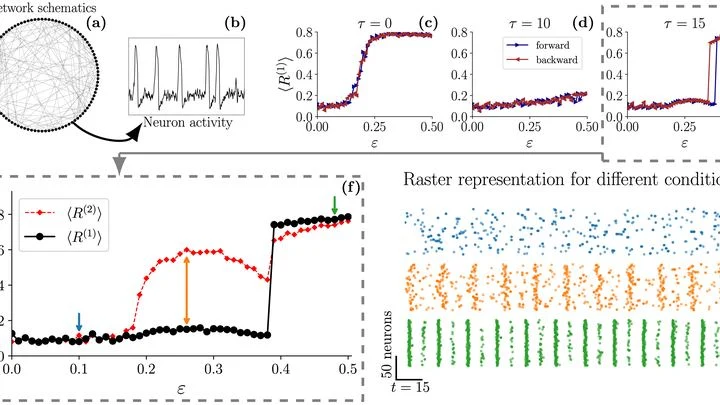
A neuron sends a signal to its neighbor. The neighbor doesn't respond immediately — the impulse travels along the process at a finite speed, like a letter delayed in transit. Usually, such a delay is considered a nuisance, but in this new work, it becomes the conductor.
When two excitable neurons are connected with a delay, a rhythm spontaneously emerges between them.
A black hole rips apart a star, and we see a dazzling flare. Then, a couple of years later, when everyone has forgotten about it, radio telescopes suddenly pick up a new signal, like an echo from the past.
A photographer tries to capture light interference, but has only one lens and the ability to change exposure time. A similar challenge faces cosmologists studying quantum imprints in the cosmic microwave background — the afterglow of the Big Bang.
Your hand rests on the table, and two short vibrations arrive at your wrist — one after the other. You need to say which is stronger. The task seems simple, but the answer depends on which vibration came first. If the first is weak and the second is strong, the difference feels larger than when they are swapped.
Two phones with identical batteries: one charges in a basement with a weak signal, and the process goes slower. The battery percentage here plays the role of a clock hand. Physicists applied the same logic to the quantum world. Their clock is a microscopic battery that stores energy. The charging rate depends on a hidden quantum 'mode'—like a switch.
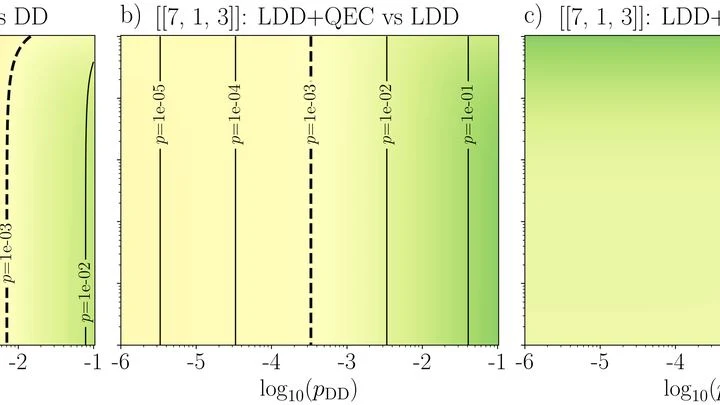
Quantum information is fragile: the slightest noise can destroy it. That's why two protection methods have been devised. The first is dynamical decoupling: rapid pulses are applied to qubits to average the noise to zero. It's like shaking a box of fragile items so they don't bump against the walls.
An epidemic is like a forest fire: the flames race toward where there are more dry branches. Similarly, a virus spreads faster where people live in closer quarters. But old mathematical models described infection as an ink blot spreading evenly across paper.
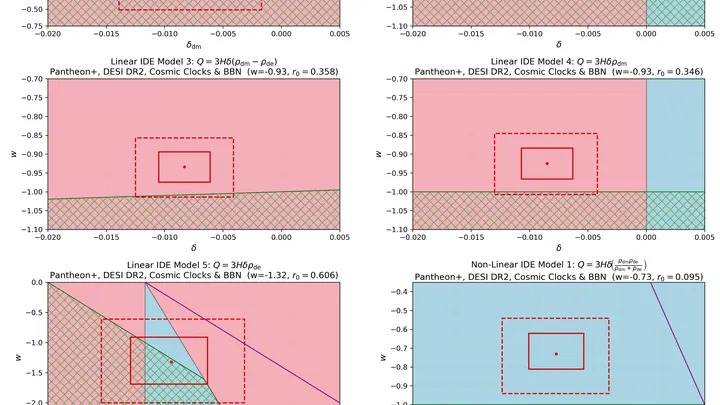
In the cosmic dance, dark energy and dark matter exchange energy. For a long time, dark energy was thought to be a constant force accelerating the universe — an insight that earned the Nobel Prize for Riess, Perlmutter, and Schmidt.
Two glasses of water: one scalding hot, the other just warm. The warm should cool first — but in the 1960s, a student from Tanzania noticed that hot ice cream freezes faster. This paradox was named the Mpemba effect. Recently, physicists found its quantum analog.
A quantum system, once born, does not forget it. Even after dozens of lifetimes, a trace of the initial state remains in its decay: a slowly decreasing power-law tail. For two fluorescent dyes, erythrosine B and eosin Y, this tail has been observed for the first time in two spectral channels simultaneously.
An orchestra without a conductor plays a complex piece. The listener hears the overall music but wants to understand who leads the melody and who merely echoes it in unison.
The Pacific Ocean remembers. Water warmed off the coast of Peru drifts slowly westward, and six months later its heat returns to South America. Scientists call this six-month journey the delay. It turns a simple climate model into a maze where the route depends not only on your current position but also on where you were half a year ago.
The ocean doesn't always stick to the same schedule. Sometimes the warm El Niño current strengthens, sometimes it weakens, and each regime dictates its own reaction speed to the past. These hidden regimes are like shifts in currents that remember their path with different depths.
The ocean remembers its past. Heat given to the water off the coast of Norway does not vanish without a trace: it embarks on a long journey across the Atlantic, only to return decades later and alter the temperature at those same shores once again.
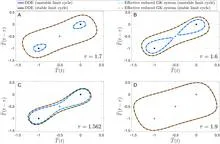
A wave travels westward, reflects off the coast, and returns six months later to alter temperatures along the eastern Pacific. This journey of Rossby and Kelvin waves Mori-Zwanzig formalism turns into an equation with memory. Previously, climatologists added delays to El Niño models by intuition, relying on physical insight.
The conductor of an orchestra gradually loses control of the tempo. First, the second violins fall slightly behind, then the cellos speed up, and soon every musician is playing in their own rhythm, even though a minute ago they all followed the same melody.