SS 433's Jets: A Dance with a Glitch express
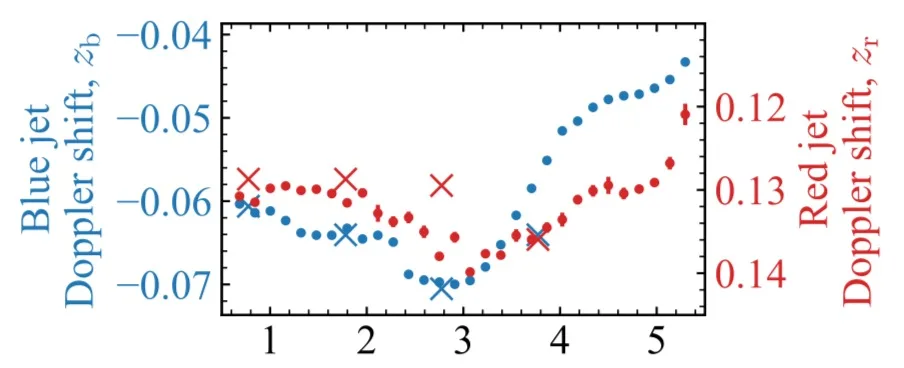
The binary system SS 433 ejects two thin jets of gas at nearly the speed of light. One flies toward us, the other away from us. In April 2024 and March 2025, three instruments watched them simultaneously: the X-ray telescope XRISM, ordinary optical telescopes, and a near-infrared camera.
When comparing how fast the jets move in X-rays versus visible light, a shift was noticed: the optical emission seems to lag a step behind. Like a translator who hears a phrase and only a moment later speaks it aloud. Perhaps the light is born a bit farther from the center than the X-rays, and it takes time to reach our instruments.
The jet speed wasn't constant. In 2024, it oscillated around 26% of the speed of light; in 2025, it was already about 30%. It varied with a period of roughly 6.3 days. This resembles a rhythm with which the system wobbles — the so-called nutation cycle. But the phase shift was about minus 90 degrees: the jet reaches its peak speed not when you'd expect from the wobble.
Visible-light flares lasted about 400 seconds in 2024 and 1600 seconds in 2025. Brightness jumped by up to 15%. But the X-rays stayed quiet during that time — no noticeable flares. The infrared channel also saw nothing similar. So flares are born only in visible light, while X-rays remain calm.
These observations are like three different witnesses to the same event. Each sees their own thing, and only together do they form the full picture. In the future, XRISM will continue to watch SS 433, and then perhaps it will become clear why the optical light lags and where these flares come from.
SS 433's jets move at about 26–30% of the speed of light: that's roughly 80,000 kilometers per second. In one second, such a jet would cross the Atlantic Ocean eight times.