Infrared radiation is electromagnetic radiation with wavelengths longer than visible light, typically from about 700 nanometers to 1 millimeter. It is emitted by all objects with a temperature above absolute zero, making it a universal probe of warm matter. In astronomy, infrared observations are crucial because dust particles in space absorb visible light and re-emit it in the infrared, allowing astronomers to see through dusty regions and study the early universe, star formation, and the centers of galaxies.
History
Infrared radiation was discovered in 1800 by William Herschel, who used a prism to split sunlight and measured the temperature increase beyond the red end of the spectrum. Astronomical infrared observations began in the 1960s with ground-based telescopes, and space-based missions like IRAS (1983) and Spitzer (2003) revolutionized the field.
How it works
Infrared radiation arises from the thermal motion of atoms and molecules: as they vibrate and rotate, they emit photons in the infrared range. In space, dust grains heated by starlight radiate in the infrared, and this emission can penetrate the dust clouds that block visible light. Infrared detectors, such as those on the James Webb Space Telescope, are cooled to very low temperatures to reduce their own thermal noise, enabling them to detect faint infrared signals from distant objects. The atmosphere absorbs much of the infrared, so many observations are done from space or high-altitude sites.
In practice
Infrared technology is used in night-vision devices, thermal imaging cameras for medical and industrial diagnostics, remote controls, and fiber-optic communications, as well as in astronomy to study star formation, exoplanet atmospheres, and the early universe.
Fun fact
Infrared radiation is what makes a warm object visible to a thermal camera: even in complete darkness, a person emits enough infrared light to be imaged clearly.
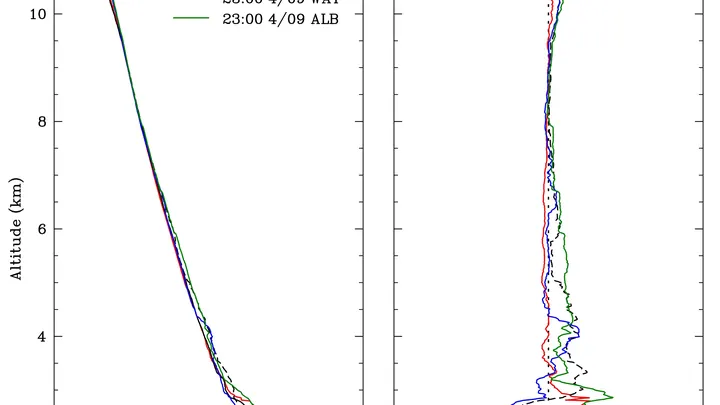
Every second, thousands of passenger aircraft in the sky transmit radio signals: that's how air traffic controllers track where each flight is. These signals don't travel in a straight line: air of varying humidity bends them like a lens. If you can measure that bending, you can work out where the air is drier and where it's more humid.
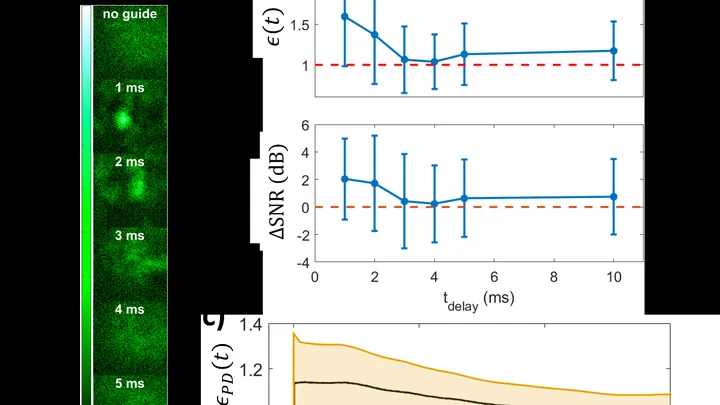
An ordinary flashlight shines in all directions, and after just a couple of dozen meters its beam fades so much it barely lights a wall. The atmosphere scatters light, and wind and heat currents distort it even more. But if you lay an invisible pipe for light right in the air, the beam will travel through it like water through a hose.
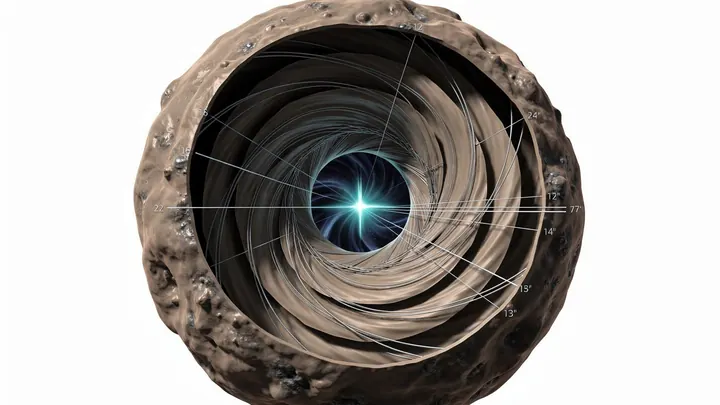
Every morning, a janitor sweeps leaves into a pile. The Sun, as it travels through the galaxy, does something similar: its gravity gathers diffuse interstellar gas into an invisible cone — a giant funnel.
Ten billion years ago, the universe was speckled with strange crimson sparks. The JWST spotted them in images at distant redshifts — compact sources blazing like entire galaxies yet no larger than a tiny central region. Astronomers nicknamed them “little red dots.” Their nature long defied explanation.
In quantum field theory, there is a long-standing mystery: infrared divergences. Usually they are seen as an annoying technical nuisance that must be carefully 'papered over' in calculations. But what if this is not a bug, but a feature?
The Universe is less than a billion years old, yet at its centers already sit black holes with masses of a billion suns. According to the conventional picture, they grew by voraciously devouring matter, but calculations show that 'feeding' must have been almost continuous, while visible quasar flares last only a few million years. So where does all the accreting fuel go?
When two neutron stars, the ultra-dense cores of dead stars, collide, a kilonova is born: an explosion a thousand times brighter than a typical nova. This is the universe's true smelting works. In the scorching cloud racing outward at near-light speeds, a furious flux of neutrons transmutes atomic nuclei into gold, platinum, osmium.
The universe is a vast orchestra playing the score of expansion. Galaxies race apart to the beat of inaudible music of dark energy. But here's the trouble: the conductor's baton held by Edwin Hubble, Adam Riess, and Vera Rubin sets two incompatible tempos.
When the James Webb Space Telescope turned its gaze deep into time, astronomers expected to see familiar galaxies. Instead, the images were dotted with a scattering of bright, incredibly compact red dots.
A bonfire that no one sees, but everyone feels the warmth: that's how astronomers found a flare in a distant galaxy. Not by its light, but by the infrared radiation of heated dust. The galaxy SDSS J010320.39+140152.5 caught attention when its center suddenly blazed in the infrared, as if someone had thrown logs onto an invisible fire.
A regular rangefinder sends a single light pulse and waits for it to return — like a person shouting into the void and listening for an echo. But if you use multiple sources that glow in unison, and analyze not the volume but the rhythm of the echo of reflected flashes, the picture becomes sharper.
The cosmic microwave background is the afterglow of the Big Bang, which we see at millimeter wavelengths. But it also has a long-wavelength tail extending into the radio range.
Neutron stars are the ultra-dense remnants of stars, where matter is compressed to the limit described by Subrahmanyan Chandrasekhar. Magnetars are a type of neutron star with a magnetic field a quadrillion times stronger than Earth's.
A galaxy is like a glowing pancake studded with stars. If you look at it face-on, you see everything at once — both the bright spiral arms and the dark dust lanes. But tilt the pancake, and the picture changes: layers overlap, light blends together. This very effect, it turns out, creates the illusion of a tight link between radio and gamma-ray emission in distant star systems.
Gas is nearly invisible, but it has a temperature, and you can read it from how the gas 'shadows' the thermal background. In the experiment, a camera looks at a warm screen through a jet of carbon dioxide. If the gas is cooler than the background, it appears as a dark spot; if warmer, it appears bright.
The night sky is no longer as quiet as it used to be. Thousands of satellites are whizzing overhead, and each one can accidentally emit radio waves, interfering with astronomers trying to listen to distant galaxies. To make sense of this noise, scientists pointed the 21CMA radio telescope in China at Starlink satellite passes.
The universe is held together by an invisible scaffolding of dark matter. Part of it could be dark photons, ghostly copies of light that pass right through matter. The Dandelion experiment turned a spherical mirror into a super-sensitive ear: it gathers dark photons and translates them into the language of radio waves.
The solar corona, the Sun's outer atmosphere, stretches millions of kilometers, yet it's visible only during a total eclipse or with specialized instruments. Typically, we gauge the corona's density by how it scatters white light, but that method relies on simplifications that can skew the results.
An aging star sheds its outer layers, leaving behind a dense, hot core the size of Earth — a white dwarf. If remnants of planets, asteroids, or comets orbit nearby, they heat up and begin to glow in the infrared. That extra light is like a warm spot on a cold floor.
A distant red object usually means one thing: we're seeing a dust veil over a scorching disk falling into a black hole. But when the James Webb split its light into shades, a shadow appeared inside — just like steam from boiling water intercepts rays.
A boiling cauldron: steam rises, water churns, and the temperature varies from point to point. So it is in space: the gas clouds around young stars are not smooth spheres but a seething mixture with vortices and density fluctuations. Astronomers long treated such clouds as homogeneous, but this simplification can skew conclusions.
The night sky glows not only with stars. Between them lies a faint microwave radiance that astronomers have noticed for three decades but couldn't explain. One idea: the culprits are polycyclic aromatic hydrocarbons — molecules like tiny soot flakes that spin in space and, like miniature antennas, emit radio waves.
In a particle accelerator, electrons race around a ring at nearly the speed of light. When such an electron collides with a photon, a particle of light, the photon bounces off like a ball hitting a moving truck and flies away with much greater energy.
Astronomers nicknamed them 'little red dots' — distant galaxies where a giant black hole hides at the center, wrapped in a thick layer of hydrogen. This packaging isn't just camouflage; it's a natural cannon. The black hole sucks in matter, but some of it is spat back out in narrow jets.
Any device, from a toaster to a smartphone, heats up when operating. This is the inevitable result of energy conversion — there's always a heat trace left, like a hot stove burner after cooking.
Two houses with identical facades but different interior layouts: from the outside the V-shaped spectrum looks the same, but inside there are different light sources and different amounts of dust. That is exactly how the two populations of distant galaxies that astronomers have long confused appear.
At the center of the supernova remnant SN 1987A, 168,000 light-years from Earth, hides an object that astronomers have been seeking for 37 years. This is the closest supernova to have exploded in front of modern telescopes, and the only one where the compact remnant has yet to be seen directly.
The RATAN-600 radio telescope is a ring of hundreds of aluminum panels on a mountainside in Karachay-Cherkessia. In the spring of 2018, its mirror caught radio waves from sixteen red dwarfs — small, dim, but very long-lived stars.