Phase shift is the change in the phase of a wave—the position of its cycle relative to a reference point—after it interacts with a medium, reflects off a surface, or travels a certain distance. It is measured in degrees or radians, where a full cycle is 360° or 2π radians. Phase shifts are fundamental to wave phenomena: they determine interference patterns, the operation of lenses and prisms, and the behavior of light in optical fibers. In physics, phase shifts are not just a curiosity; they encode information about the medium a wave has passed through, such as its thickness, refractive index, or even the presence of a gravitational field.
History
The concept of phase was formalized in the early 19th century by Augustin-Jean Fresnel and Thomas Young, who used phase differences to explain interference and diffraction. The phase shift on reflection was experimentally demonstrated by Fresnel in 1823.
How it works
When a wave passes through a material, its speed changes, altering the wavelength while the frequency stays constant. This causes the wave to emerge with a phase that differs from what it would have in vacuum. For example, light passing through a glass plate is delayed, and its phase shifts by an amount proportional to the plate's thickness and refractive index. Reflection can also introduce a phase shift: a wave reflecting off a denser medium (like light hitting glass from air) undergoes a 180° phase flip, while reflection off a less dense medium does not. In interferometry, two waves that have traveled different paths are combined, and their relative phase shift determines whether they add constructively (bright) or destructively (dark).
In practice
Phase shifts are exploited in interferometers for measuring tiny distances (e.g., gravitational wave detectors like LIGO), in optical coatings that control reflection, and in medical imaging techniques like phase-contrast microscopy, which visualizes transparent biological samples.
Fun fact
In the Michelson interferometer used by LIGO, a phase shift of just 10^-10 radians—a fraction of a proton's diameter—is enough to detect the ripple in spacetime caused by a passing gravitational wave.
A pebble tossed into a pond sends ripples spreading in all directions. Now imagine the pond itself suddenly turning into jelly — instantly, faster than the wave can complete a single crest. Some ripples would keep spreading but change their spacing, while others would unexpectedly turn around and run back toward the point of impact, as if time were flowing backward for them.
Light, like a shaken rope, oscillates in a specific plane. Astronomers and engineers often rotate images using a three-mirror system, the so-called K-mirror, but this inadvertently rotates the plane of oscillation as well. For precise measurements, that's a problem.
Tiny magnets on a lattice, the classic Ising model, are usually described by how neighbors influence each other. But what happens when the system is closely watched? Each measurement of a coupling energy is like a gaze that forces the magnets to 'decide' their state.
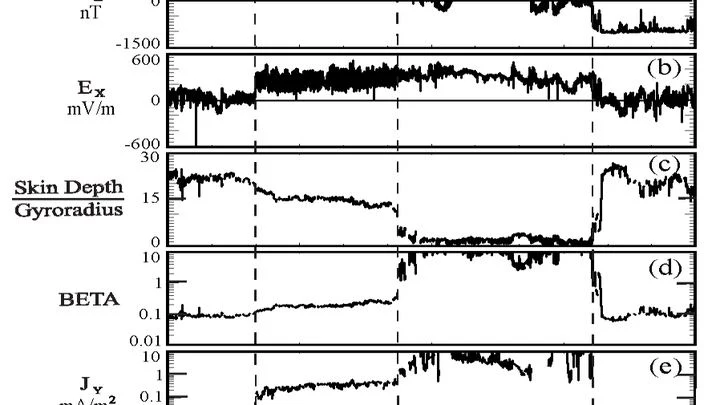
The Sun's corona looks like a shaggy dandelion: bright petal-like loops hold hot gas near the surface, while long, tenuous jets escape into space between them. These jets, the heliospheric current sheet, stretch across the entire solar system.
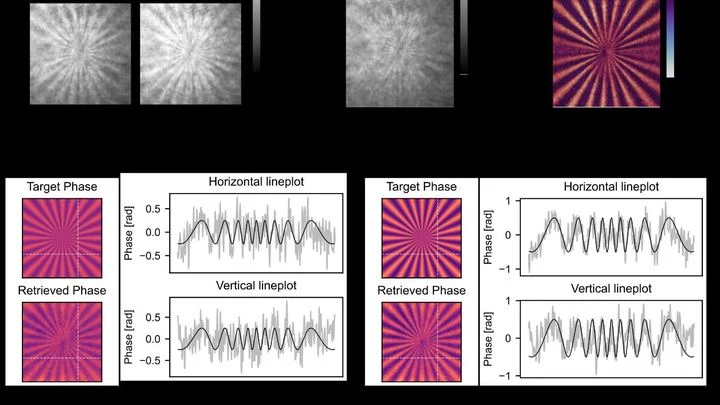
A glass marble in a glass of water is nearly invisible, but if you look through it at a checkered tablecloth, the lines behind it appear distorted. Transparent cells behave the same way: light passes through them but is slightly slowed and changes direction.
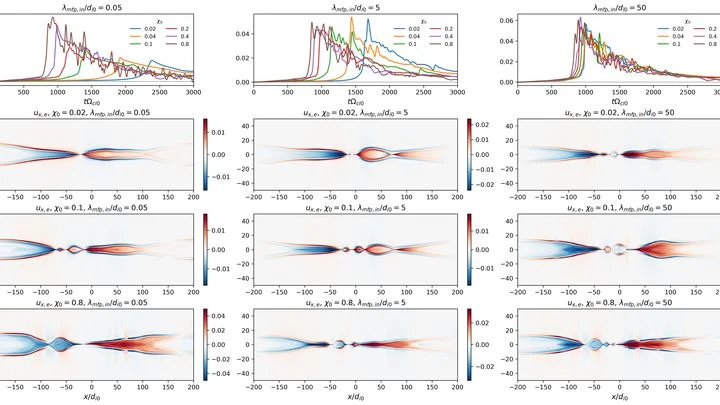
In plasma where some atoms remain neutral, magnetic field lines can rearrange at different speeds. This is like two rubber bands that are initially stuck together, then suddenly snap apart and contract, releasing energy.
A laser pulse racing through plasma is like a runner carving a path through a crowd. It shoves electrons aside, leaving behind a rarefied channel, just as the crowd parts for a sprinter. In this channel, the crest of the light wave moves slightly faster than light in a vacuum, and it is this speed that determines how efficiently the pulse transfers energy to particles.
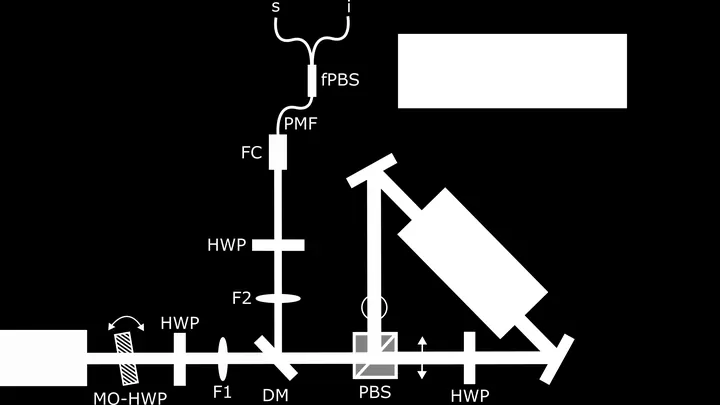
The theory of gravity by Einstein — general relativity — rarely intersects with quantum physics in direct experiments. Here, scientists built a 50-kilometer glass labyrinth on a table and sent single photons through it.