Plasma Cleans Accelerators Like Steam Scrubs a Pan express
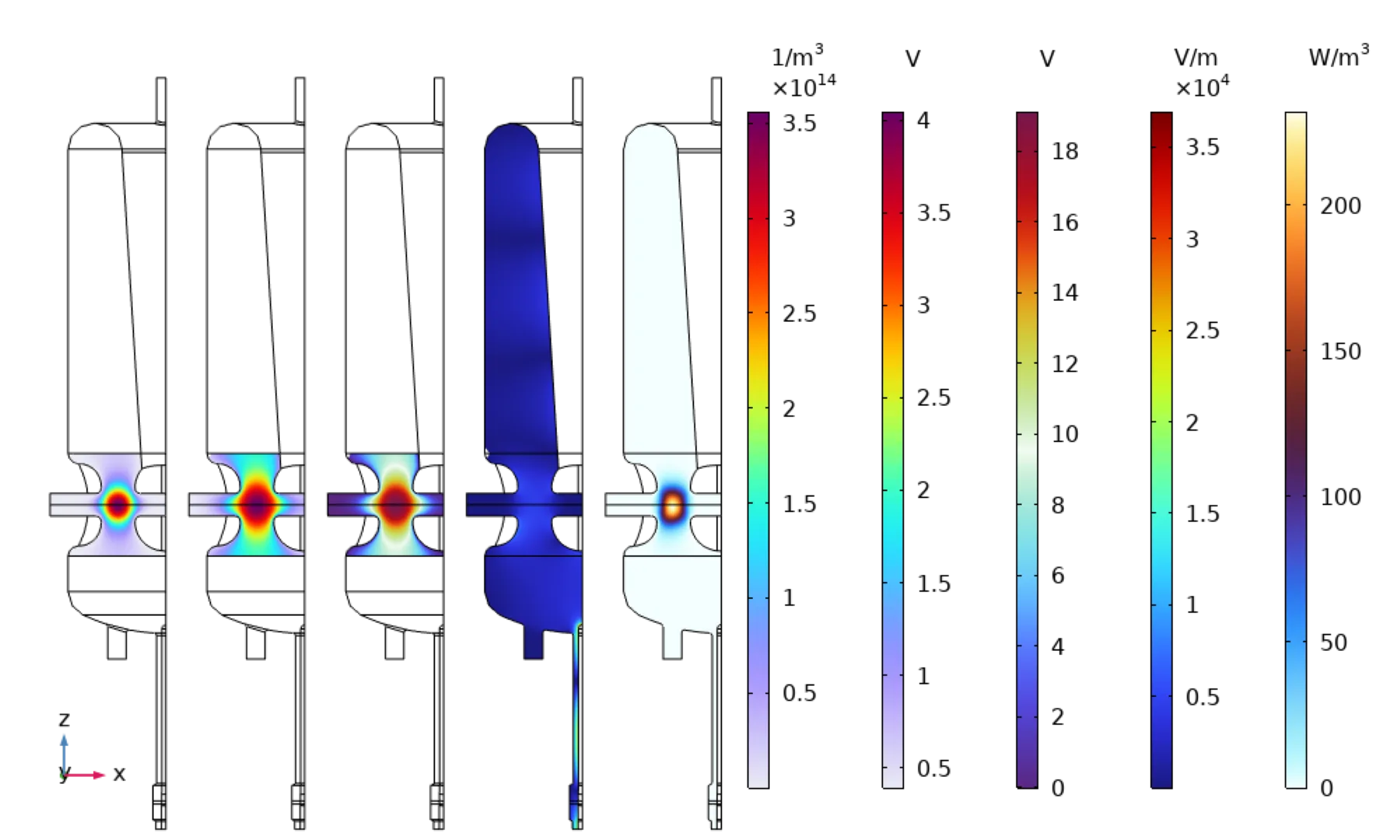
Inside large particle accelerators, there are hollow metal chambers where beams are accelerated. Over time, grime settles on their walls, like in an old pan. This grime prevents the accelerator from running at full power.
To restore the accelerator's strength, plasma, a glowing gas of argon or neon with a bit of oxygen, is sent into the chamber. In a few hours, the plasma burns off the grime, and the chamber is clean again. But until now, no one knew exactly how hot the plasma is or how quickly it removes the dirt.
In the new work, the plasma was measured with a small probe, and the cleaning rate was measured with a quartz microbalance coated with a film resembling grime. It turned out that the plasma does clean well, but conditions could be tuned even better.
Now engineers know how to tune the plasma so accelerators last longer and need less maintenance.
Original abstract
as written by the authors arXiv:2603.04052
In-situ plasma processing of superconducting radio frequency (SRF) cavities is a performance recovery technique used to mitigate the field emission limiting phenomenon. It has been proved very effective at major particle accelerator facilities such as SNS, CEBAF, FRIB, FNAL and C-ADS. This technique is based on the ignition of a noble-gas/oxygen plasma inside the cavity over several hours to remove hydrocarbon-based contamination, responsible for the parasitic field emission degradation observed after several years of operation. Despite a large experimental R\&D effort from the community, plasma parameters and cleaning rates under various experimental conditions have never been directly evaluated. In this study, plasma parameters were measured using a Langmuir probe and cleaning rates thanks to a quartz crystal microbalance (QCM) coated with an amorphous carbon film to simulate a carbon-based contamination. In this article, the main results from a large parameter space are discussed along with guidelines for improving the plasma processing effectiveness in SRF cavities. The encountered technical challenges are also discussed, as the SRF cavity is by design not intended to be a plasma reactor.
In the experiment, the quartz microbalance detected mass changes of billionths of a gram: that's like noticing a single speck of dust falling off a hair.