A microwave field is an electromagnetic field with frequencies ranging from about 300 MHz to 300 GHz, corresponding to wavelengths from 1 meter to 1 millimeter. In physics, microwave fields are used to manipulate quantum systems, heat materials, and probe molecular rotations. They occupy a special niche between radio waves and infrared, interacting strongly with polar molecules and electron spins. In modern research, microwave fields are crucial for controlling qubits in superconducting quantum computers and for studying the cosmic microwave background radiation.
History
Microwave technology was developed during World War II for radar, with the cavity magnetron being a key invention. The term 'microwave' came into common use in the 1930s–40s.
How it works
Microwave fields are generated by devices like klystrons, magnetrons, or solid-state oscillators, and are guided through waveguides or coaxial cables. They interact with matter by coupling to electric dipoles (rotational transitions in molecules) or magnetic moments (electron spin resonance). In quantum devices, resonant microwave pulses are used to drive transitions between quantum states, enabling coherent control of qubits. The field's amplitude, frequency, and phase can be precisely shaped to perform quantum gates.
In practice
Used in microwave ovens, radar systems, wireless communications (5G), and crucially in quantum computing to manipulate superconducting qubits and in electron spin resonance spectroscopy.
Fun fact
The cosmic microwave background radiation, a faint glow left over from the Big Bang, has a peak frequency of about 160 GHz, making it a natural microwave field that fills the entire universe.
Units by system: SI: volt per meter · CGS: statvolt per centimeter
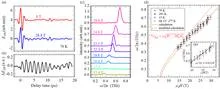
A taut string sounds higher when you pull it tighter. Magnetization in an antiferromagnet behaves similarly: the stronger the external field, the faster it oscillates. But in chromium oxide crystals, something goes awry.
In fields from 20 to 30 tesla, the resonance frequency grows more slowly than it should.
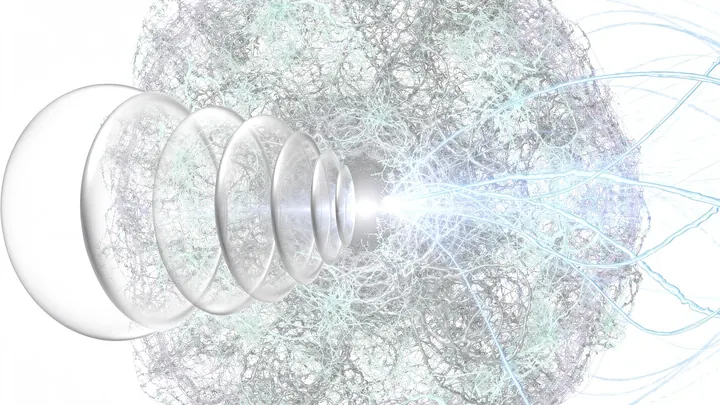
Light that never reaches the camera still leaves its mark on it. That's how the new imaging method works: you illuminate the object with one color, and the picture is assembled from another. Inside the crystal, light waves mix, and information about the invisible transfers to a visible beam.
In the experiment, they used a silver thiogallate crystal.
For three days straight, a laser blasted a jet of gas, and every second it produced a beam of electrons with the energy of a tiny lightning bolt. Previously, such beams could only be produced in huge halls where the accelerator takes up an entire building. Now the whole setup fits in a room and ran without a glitch for 72 hours.
A bell rings not from the strike but from a fleeting shudder of space. A gravitational wave, like ripples on a pond, passes through a massive magnet, and it deforms ever so slightly. That deformation can be turned into an electrical signal.
Low-frequency radio waves (from 30 to 300 kilohertz) carry information through water and earth. But catching them with an ordinary antenna is hard: the wavelength reaches several kilometers, and a small receiver barely feels such a field.
In the first moments after the Big Bang, cosmic symmetry breaking divided the hot plasma into regions with different vacuums — the lowest energy states of a field.
A laser is like a tuning fork that rings at a single note. But even in complete silence, its sound trembles slightly. Previously, it was thought that this tremor, random kicks from spontaneous emission of light by atoms inside the laser, was the main limit to precision.
Fast radio bursts — millisecond radio pulses arriving from distant galaxies — long remained a puzzle. Their colossal energy, compressed into instants, pointed to cataclysms on neutron stars, perhaps pulsars or magnetars.
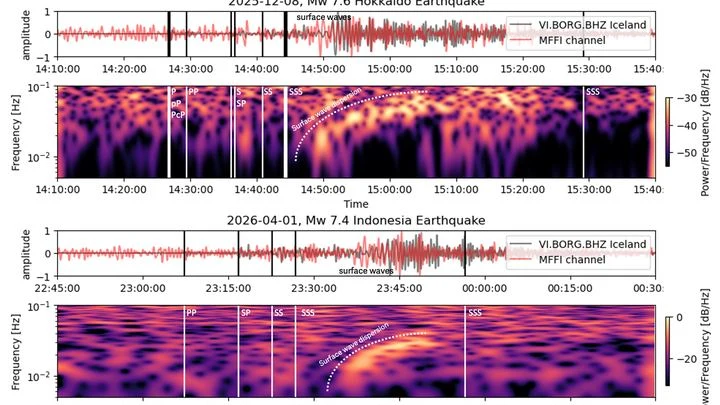
The planet-spanning web of undersea internet cables acts like a giant ear. The glass thread inside responds to water movements: currents, tides, and distant earthquakes bend the cable. Light traveling along the thread takes slightly longer: this delay is measured on shore against a reference. That’s how the speed of light reveals itself.
An ordinary laser emits narrow lines, like a string that sounds only one note. For spectroscopy, this is inconvenient: if a substance absorbs light between the lines, you might miss it.
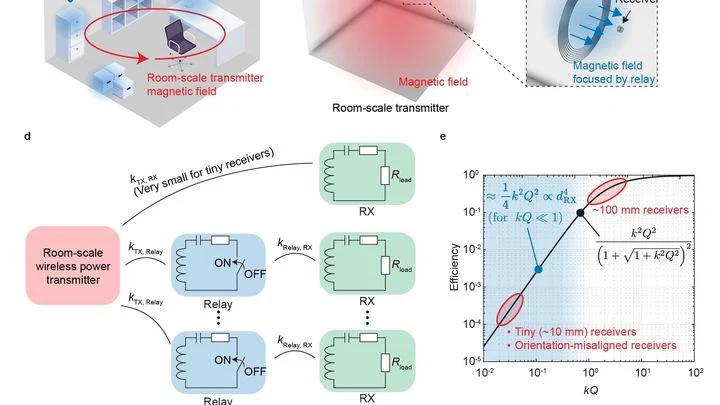
Think of wireless charging in a room as a pool where energy-water is everywhere, and tiny sensor-floats barely bob. Their induction coils are too small to efficiently scoop from this diffuse electromagnetic field. Unlike radio waves, the energy here doesn't travel at the speed of light: it lingers in the near field, waiting to be harvested.
Inside a glass capsule the size of a pea, rubidium atoms float. A laser beam puts them into a special state — Rydberg — where the electron flies far from the nucleus, making the atom extraordinarily sensitive to external fields.
Radio waves that oscillate less than once per second pass through the earth and water with almost no loss. Such signals are used to communicate with submarines and to search for minerals. But a conventional antenna for them would need to be hundreds of meters long, and its sensitivity leaves much to be desired.
Inside large particle accelerators, there are hollow metal chambers where beams are accelerated. Over time, grime settles on their walls, like in an old pan. This grime prevents the accelerator from running at full power.
To restore the accelerator's strength, plasma, a glowing gas of argon or neon with a bit of oxygen, is sent into the chamber.
You can squeeze light between two mirrors like a spring in a vise. It bounces back and forth, growing denser: that's how you get ultra-bright beams. But there's a limit: at too high a brightness, the mirrors start to shake. The light rocks them the way wind rocks a swing, and some energy leaks into that jitter.
A photon is like a car in a multi-story parking lot, where each floor is its frequency (color). Usually it gets stuck on one level, but scientists added an elevator — a programmable modulator that moves the photon between floors on command.
A sheet of graphene is a lattice of carbon atoms arranged like a honeycomb. Electrons in it zip around so fast they seem to have no mass, just like light. When a powerful laser pulse hits such a sheet, the electrons get a kick and start accelerating. Their path can be compared to a road with occasional barriers — the forbidden zones.
Diamonds sometimes have a defect: instead of two adjacent carbon atoms, there is one nitrogen atom and an empty spot. This defect acts like a tiny antenna that responds to magnetic fields. Scientists aimed a laser and microwaves at such a diamond, and the defect started spitting out electrons.
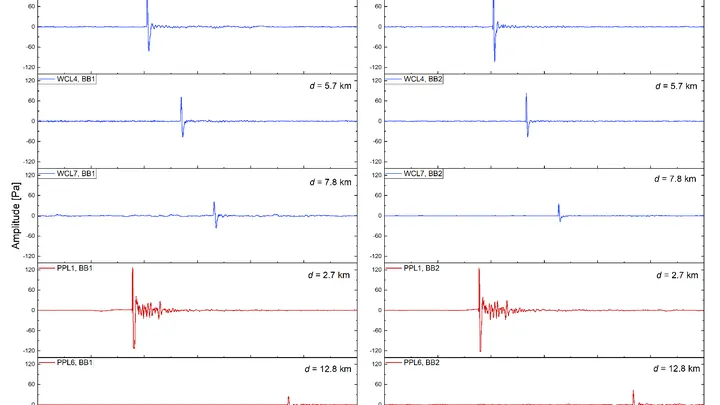
The same explosion can sound different: it all depends on which way the wind is blowing. In 2024, researchers set off charges equivalent to ten tons of TNT twice and recorded the sound with a network of 31 microphones spread over a radius of 23 kilometers. The source was identical, but the acoustic pictures turned out to be quite different.
A regular radio receiver picks up waves with a metal antenna. Here, the antenna is a single atom with an electron boosted to a distant orbit, like a satellite in a high orbit around Earth. Such atoms are called Rydberg atoms.
Pluck a guitar string, and it vibrates — the air around it carries the tremor to your ear. Spacetime vibrates differently: when a gravitational wave passes through, it stretches and squeezes slightly. Spotting such a tremor at frequencies from 10 kilohertz to 100 megahertz is the challenge that new detectors are being built for.
Two taut strings plucked at the same time sound different if they are connected by a rubber band. Energy starts to flow from one to the other, and the pitch of the combined sound shifts slightly. Two nanomechanical bridges, microscopic beams etched into a crystal, behave much the same way.
In a diamond anvil cell, pressure squeezes a material as if it were buried hundreds of kilometers deep inside the Earth. Inside this chamber, tiny diamond sensors, color centers, respond to microwaves and report on the magnetic fields and temperatures around them.
The theory of gravity by Einstein — general relativity — rarely intersects with quantum physics in direct experiments. Here, scientists built a 50-kilometer glass labyrinth on a table and sent single photons through it.