A beam is a directional stream of particles or electromagnetic radiation, such as X-rays, that travels in a roughly straight line. Beams are fundamental to many areas of physics and technology, from the light beams in optical fibers to the particle beams in accelerators. In astrophysics, beams of X-rays are emitted by some of the most energetic objects in the universe, such as neutron stars and black holes, often as jets of matter accelerated to near-light speeds. The study of beams allows scientists to probe the properties of matter and radiation in extreme conditions.
History
The concept of a beam has been used since the early studies of optics, but the modern understanding of particle beams emerged in the 20th century with the development of particle accelerators and X-ray technology.
How it works
A beam is created when particles or waves are collimated, meaning their trajectories are aligned to be nearly parallel. This can be achieved through various mechanisms, such as focusing with lenses or magnets, or by the natural geometry of the source. For example, in an X-ray tube, electrons are accelerated and directed at a metal target, producing X-rays that are then collimated into a beam. In particle accelerators, magnetic fields steer charged particles along a defined path, creating a beam that can be used for collisions or experiments.
In practice
Beams are used in countless applications, including medical radiation therapy, materials analysis, and particle physics experiments, as well as in everyday devices like laser pointers and microwave transmitters.
Fun fact
The most powerful particle beams, such as those at the Large Hadron Collider, can carry enough energy to melt a ton of copper if focused on a small spot.
A billiard ball hangs in midair. Tiny peas shoot at it from a blowgun. Each hit is barely perceptible, but if the ball is very light and barely trembles from heat, you can make out individual nudges. That's essentially the setup: a glass sphere the size of a bacterium levitates in a vacuum while a narrow beam of xenon atoms flies at it.
A regular laser beam travels straight, like the light from a flashlight. But light can be twisted into a spiral, like the thread of a corkscrew. Such a beam carries orbital angular momentum: it doesn't just illuminate, it also spins anything it encounters.
An electron is not just a point. It is a probability cloud, smeared out in space. When such a cloud collides with a powerful laser pulse, it can emit a high-energy photon — a gamma quantum. And this photon can be not just ordinary but twisted, like a corkscrew, carrying orbital angular momentum.
When an electric charge moves with acceleration, it emits electromagnetic radiation, i.e., light — a familiar phenomenon in physics. However, researchers have found that when moving along a specially chosen trajectory, the radiation acquires unusual properties.
For half a century, astronomers puzzled over the nature of the powerful X-ray emission from Gamma Cassiopeiae — a bright beacon in its constellation whose X-ray glow didn't fit models of single stars. An invisible companion was suspected, but direct evidence was lacking.
A typical accelerator is like an assembly line where electrons are the workpieces. To get the desired X-ray pulse, the workpiece is fine-tuned after it's already on the line: squeezed, filtered, corrected. In the new work, engineers decided to take a different approach — shaping the workpiece before it even hits the conveyor.
At LCLS-II, electrons are knocked out of a metal by a short laser pulse.
Above Jupiter's poles, auroras blaze as electrons are accelerated by electric fields and slam into the upper atmosphere, making the gas glow. But not all electrons head downward. Some, it turns out, get a kick in the opposite direction — away from the planet, into deep space.
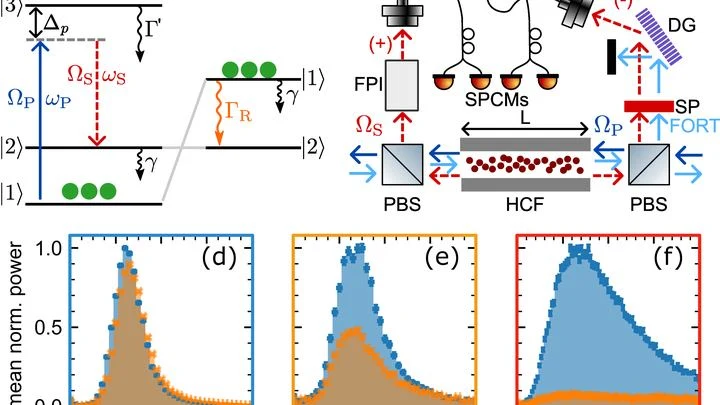
A swarm of fireflies in a night forest flashes randomly: each beetle blinks on its own, and the light scatters equally in all directions. Now imagine the fireflies agreeing to blink so that their combined light goes only north — even though they stay put and none of them turns. That's roughly what physicists did with atoms inside a thin glass tube.