How Cells Choose a Body Shape express
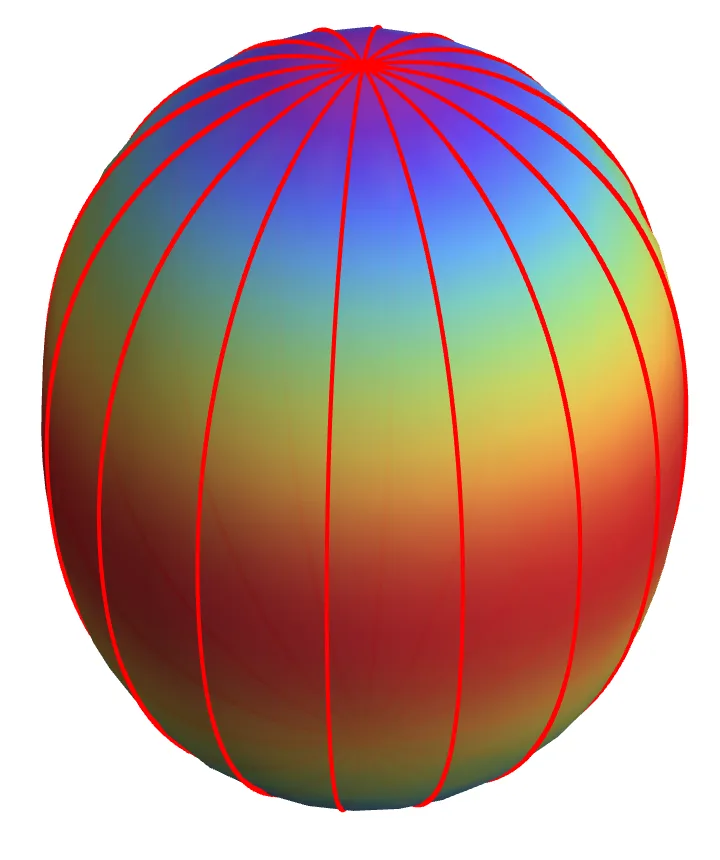
Cells on the surface of an embryo resemble grains of rice that can align in one direction. This order is called nematic. It arises when cells start acting in concert, like a school of fish swimming in the same direction. Scientists modeled this process using a spherical shell, like a balloon covered with many such "grains."
When the "grains" align, the shell loses symmetry and changes shape. If the order emerges abruptly, the shell elongates like a melon. If it emerges gradually, four points appear where the direction of the "grains" diverges, and the shape becomes more complex. The stiffness of the shell plays a key role: for a very stiff shell, the transition is always gradual, while for a soft one, it is abrupt.
This mechanism explains how the body axis appears in living beings without any external signal. It is enough that cells on the surface start acting in concert and slightly deform the shell. Thus, from a simple ball of cells, an organism with a distinct front and back can emerge.
Original abstract
as written by the authors arXiv:2603.07082
The emergence of nematic order on deformable closed surfaces plays a pivotal role in the morphogenesis of active biological matter, such as the regeneration of Hydra. In this work, we present a continuum model that couples the two-dimensional Landau-de Gennes order tensor, describing in-plane nematic ordering, with the mechanics of a mass-conserving, deformable spherical shell. By investigating the isotropic-to-nematic phase transition driven by a reduction in temperature, mimicking the natural induction of nematic order in actomyosin fibres, we perform both linear and weakly non-linear bifurcation analyses. The onset of nematic ordering spontaneously breaks spherical symmetry, yielding distinct equilibrium morphologies governed by the shell's deformability. Axisymmetric configurations, featuring two +1 defects at the poles, emerge via a discontinuous bifurcation, resulting in a globally stable prolate shape, alongside a metastable oblate shape. Non-axisymmetric configurations, featuring four +1/2 defects arranged in a square, arise via a continuous bifurcation. Shell softness drives the first-order character of the transition, while in the limit of infinite stiffness all bifurcations become continuous. Integer defects strongly couple with local mass redistribution, manifesting as shell thinning or thickening, whilst half-integer defects induce no such local deformation. These findings provide a purely mechanical framework for understanding body-axis formation and defect-mediated morphogenesis in biological vesicles.
In hydra, during regeneration, a complete body with a head and foot is re-formed from just a few hundred cells — all thanks to cells on the surface aligning in one direction.