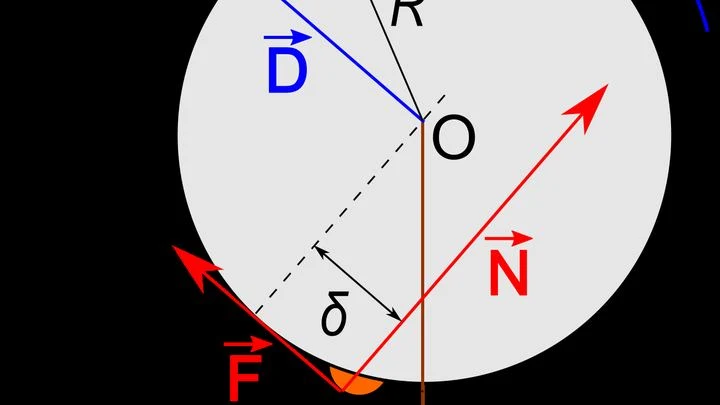
Archimedes of Syracuse, according to legend, discovered his principle in the bath, shouting 'Eureka!'. The principle itself: a body submerged in a fluid or gas experiences a buoyant force equal to the weight of the displaced medium. This force arises from the pressure difference: the pressure is greater at the bottom than at the top, and this difference creates a lifting force. Buoyancy is determined by the density ratio: if the density of the body is less than that of the fluid, it floats.
History
Archimedes (287–212 BC) formulated the principle in his treatise 'On Floating Bodies'. Legend says he discovered it while solving the problem of the authenticity of Hiero II's golden crown. Archimedes realized that the volume of displaced water allows measuring the volume of an irregularly shaped body and calculating its density.
How it works
Applied in shipbuilding, design of underwater vehicles, balloons, densitometers and flow meters. Limits of applicability: the law is valid for statically resting fluids and gases. In non-inertial systems or with accelerated fluid motion, corrections are needed.
In practice
Archimedes' principle explains the buoyancy of ships, the operation of hydrometers, and the behavior of submarines during diving and surfacing.
Fun fact
The Dead Sea is so salty (density 1.24 kg/L versus 1.00 for fresh water) that a person effortlessly lies on the surface without sinking.
In 1934 Jean Leray proved that the Navier–Stokes equations always have solutions "in a generalized sense". Whether a solution stays smooth or can break down into a singularity he could not tell, and nobody could for ninety years. In 2000 the Clay Institute made the question one of its seven Millennium Prize problems.
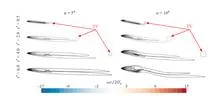
An airplane wing, like a skier on a ski jump, remembers its acceleration. Change the angle of attack sharply, and the lift does not immediately reach its new value. It builds up gradually, as if the wing is not yet sure the maneuver is for real.
This effect was discovered by engineer Herbert Wagner in 1925.
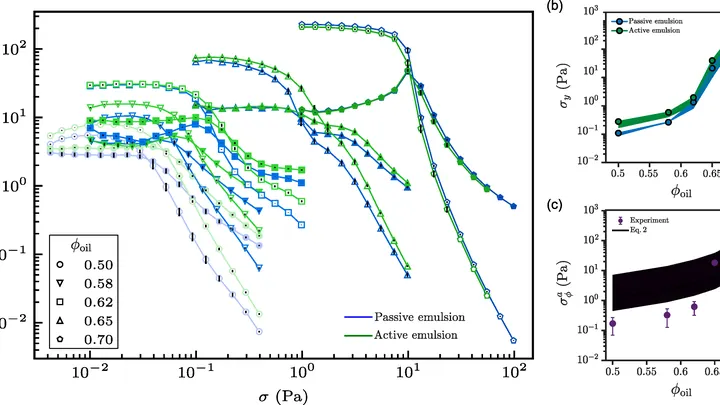
An oil droplet in water is like a ball in a crowd. When the crowd is sparse, the balls move apart freely. But if there are many people, each is squeezed by its neighbors, and the whole mass behaves like a single body. That's roughly how an emulsion works — a mixture where oil droplets float in water or vice versa.
Swimming season opens when the water feels tolerable. But everyone has their own threshold: one person shivers at twenty degrees, another swims comfortably at fifteen. Scientists decided to figure out where this difference comes from.
They compared a swimmer's body to a house trying to keep heat in while a cold wind blows outside.
A raindrop falls on glass and flattens into a pancake. Add a bit of polymer to the water, and it becomes elastic, like jelly. You'd think such a jelly would spread differently.
A cluster of glowing dots drifts through the darkness, now compressing into islands, now spreading out in waves. These are not fish or birds: this is a mathematical model of active matter, where each particle spends its own energy on movement, and also is born, dies, and competes with neighbors for space.
In a world where Reynolds numbers are minuscule, water turns into thick syrup, and the swimming tricks we know stop working. Here reigns the insidious scallop theorem: reciprocal motions produce no net displacement. Microorganisms found a way out: they grow polymer tails.
Table salt is one of the most studied substances in medicine. For decades, students were taught Arthur Guyton's model: eat something salty — blood dilutes, volume temporarily increases, kidneys promptly excrete the extra water, and everything returns to square one. A neat scheme, like a float valve in a toilet tank.
A geometer runs a finger along an invisible surface, and by how the geodesics bend, lifts its fingerprint. That fingerprint can be the maximum normal curvature κ(F): the largest curvature among all geodesics passing through a point of the immersed manifold.
In the new model, each active particle has an internal rhythm: it spins either left or right. Chirality is key: some twirl clockwise, others counterclockwise. But when such a particle bumps into an obstacle or a neighbor, it flips its spin, like a figure skater who, after touching the board, explodes into a reverse pirouette.
In the watery environment, vortices batter the mechanical fish. The AI agent, like an experimental chef, ran simulations, tried out 'recipes' of movements, and improved the program. Each experiment was like spectroscopy: the agent broke down behavior into elements, uncovering patterns. At first, the fish only paddled in one direction.
Imagine two immiscible liquids, such as oil and water. Under normal conditions, they tend to separate, forming a clear interface. But introduce microscopic swimmers (bacteria, whose basis is carbon) and the picture changes dramatically.
At the heart of an active galaxy, where interstellar gas spirals into a dazzling accretion disk around a supermassive black hole, a boundary is born through which even sound cannot break. This acoustic horizon was long considered frozen ripples on water.
A ship gliding through water constantly rubs against it, like a palm against a rough surface. This friction eats fuel and slows progress. One way to reduce it is to blow air under the hull: water stops sticking to the hull, and drag drops. But air is finicky: sometimes it helps, sometimes it hurts.
A plastic heart rests on the water and doesn't tip over, no matter how you turn it. It freezes in any position, as if the water were holding it by invisible strings. This trick is possible thanks to the Zindler curve — a shape in which all lines that divide the area in half have the same length. The Zindler curve is a closed curve where any chord that bisects the area has the same length.
Water is the only common liquid that doesn't immediately contract when cooled. Ice melts, and water becomes denser, but only up to 4 degrees Celsius. Beyond that, with further cooling, it expands again. This quirk explains why fish survive in freezing ponds: the densest water sinks to the bottom, while a lighter cold layer stays on top and turns into ice.
Water deep within the Earth is compressed more than a thousandfold compared to the surface. Even there, it continues to flow, but its internal structure changes. Researchers measured how water resists flow and compression as pressure rises from zero to 1.6 gigapascals — equivalent to placing a 16-ton weight on every square centimeter.
A branching network, like a river delta or a tree crown, is built on the principle of economy. The classic law, derived back in 1926, stated that the cube of the parent vessel's diameter equals the sum of the cubes of the daughter diameters. This rule worked beautifully for ideal tubes, but real arteries stubbornly gave a different exponent — around 2.7 instead of 3.
The authors of the new study found the reason.
Cells on the surface of an embryo resemble grains of rice that can align in one direction. This order is called nematic. It arises when cells start acting in concert, like a school of fish swimming in the same direction.
The layer of cells lining internal organs is like a crowd in a packed subway: everyone stands shoulder to shoulder, but sometimes the crowd starts to flow, and people slip past each other. Biologists call this behavior a transition from a jammed, solid state to a fluid one.
The lymphatic system is like a city's network of canals, through which water slowly moves, carrying away waste from tissues. But it has no single pump-heart. Instead, along the vessels are placed small station-locks — lymphangions. Each such lock squeezes itself like a fist and pushes fluid onward. How they coordinate their work has long remained a mystery.
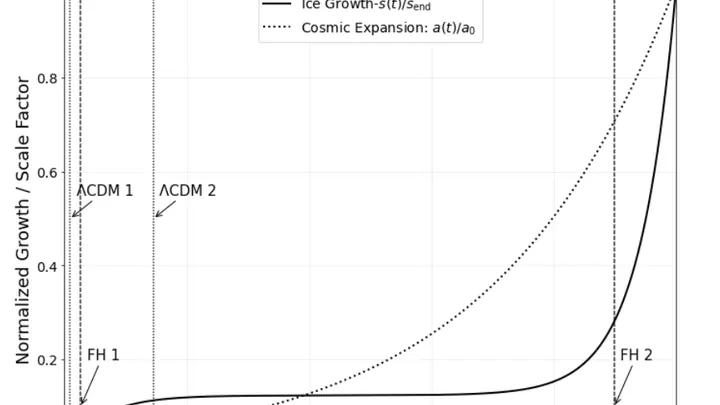
In winter, a lake freezes over, and this simple process turns out to be a living model of an expanding universe. Ice thickness grows according to the same mathematical law as the distances between distant galaxies.
The secret lies in the movement of water beneath the ice crust.
Deep beneath us, hundreds of kilometers down, lies a layer that can absorb water like a sponge. The minerals there, wadsleyite and ringwoodite, can hold up to 1–2% water by weight within their crystal lattices.
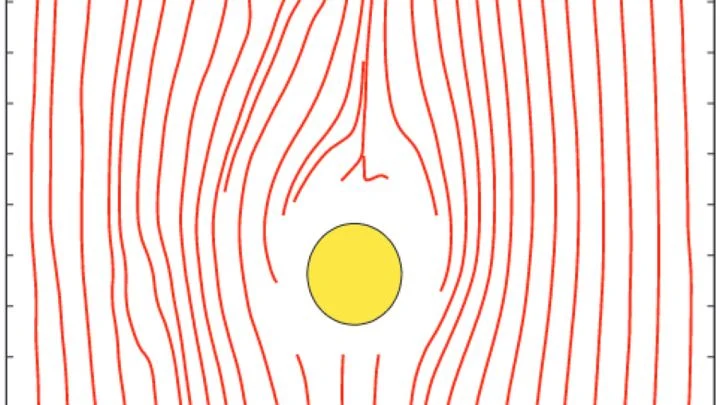
Liquid helium cooled to near absolute zero behaves like two fluids at once: a normal viscous part and a superfluid part that flows without friction. When such a flow hits a cylinder, vortices are born behind it. But sometimes vortices appear in front of the cylinder — where classical laws say they shouldn't be.
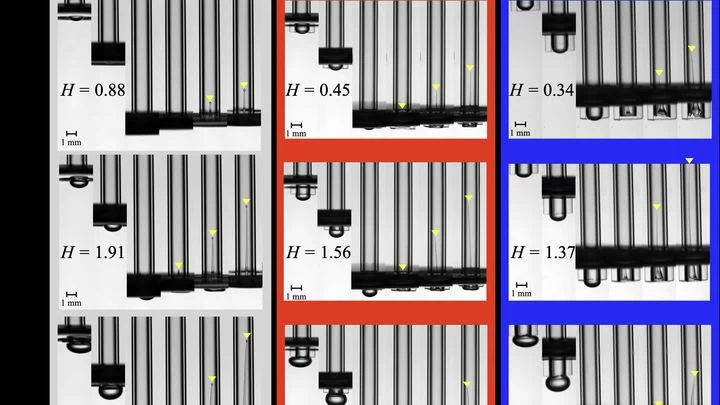
A drop falls into a glass, and a tiny jet, a thin fountain, shoots up from the surface for an instant. Something similar happens with a bubble stuck to the wall of a tube when you yank the tube downward. Water around the bubble rushes in, and a jet fires from its top. The speed of this jet depends on the bubble's shape — how much it bulges, like an umbrella dome.
A stone drops into a pond — ripples spread across the water. Do short waves outrun long ones? No, in deep water it's the opposite: long waves overtake short ones. In metal, sound of one pitch travels at one speed, another pitch at another.
A sheet of paper released from a window flutters, tumbles, and sometimes pauses flat for a second. Until now, to honestly predict such behavior, you had to run millions of equations on supercomputers for every drop of air. That's like simulating every atom of a cash register to count change at a store.
The new approach is smarter.
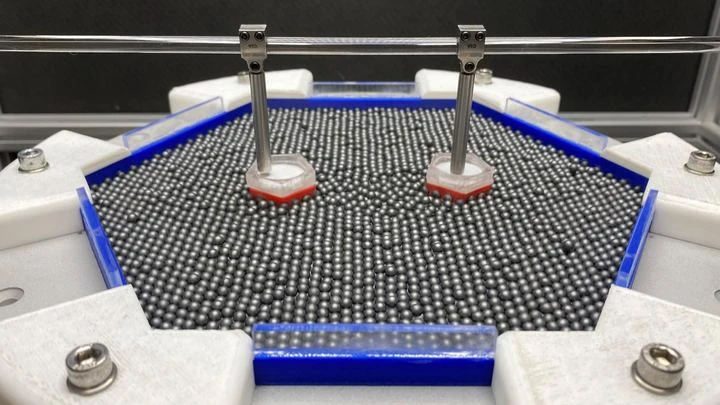
Shake a jar of sand and marbles, and you'll see large objects float or sink depending on their size. But if you shake it cleverly, you can make the marbles gather into pairs and chains, as if glued together. It's this kind of 'invisible glue' that physicists from India and Germany have now caught and measured for the first time.
Water in a glass settles down once you stop stirring it. Oil in an engine dampens vibrations. It seems viscosity is always about damping. But in some flows, it's the opposite: add friction, and waves start to grow as if from nowhere.
Physicists have found a simple explanation.
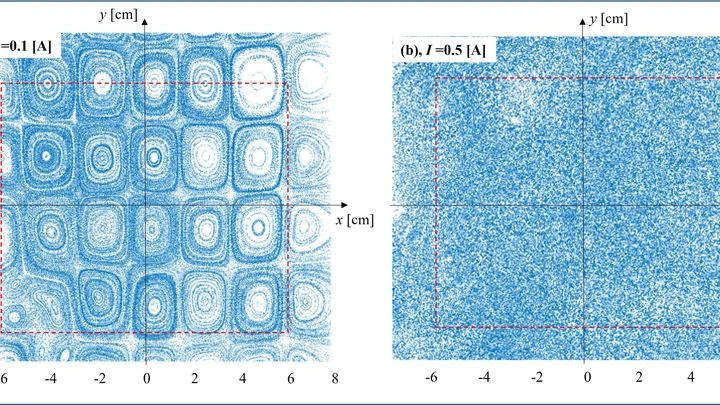
Water in a puddle after rain swirls differently than in a deep lake. A thin layer of fluid feels the bottom, and that changes the nature of its vortices. Scientists created such a layer in the lab: they poured in an electrolyte, ran a current and a magnetic field, and the fluid began to move.
A thin stream of water flows down a cold inclined board and, before your eyes, turns into an ice ridge. At first, the water paves itself a straight icy path, as if reinforcing its own banks. Then the trickle starts to meander, and the ice quickly spreads sideways. Finally, the ridge stops growing outward and begins to thicken, smoothing out irregularities.
The law discovered by Wolfgang Pauli forbids identical particles from occupying the same spot. Hence, in cold matter, a Fermi sea is born: particles, like water, fill energy levels from bottom to top. The shape of the sea's surface — including 'islands' of emptiness — dictates the properties of the whole system.