How Cells Choose a Body Shape express
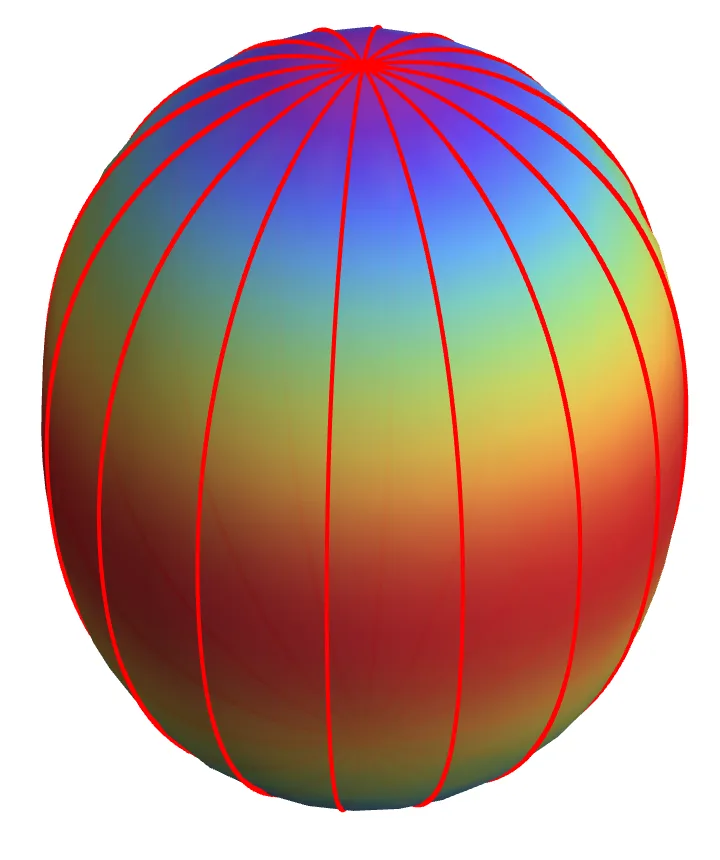
Cells on the surface of an embryo resemble grains of rice that can align in one direction. This order is called nematic. It arises when cells start acting in concert, like a school of fish swimming in the same direction. Scientists modeled this process using a spherical shell, like a balloon covered with many such "grains."
When the "grains" align, the shell loses symmetry and changes shape. If the order emerges abruptly, the shell elongates like a melon. If it emerges gradually, four points appear where the direction of the "grains" diverges, and the shape becomes more complex. The stiffness of the shell plays a key role: for a very stiff shell, the transition is always gradual, while for a soft one, it is abrupt.
This mechanism explains how the body axis appears in living beings without any external signal. It is enough that cells on the surface start acting in concert and slightly deform the shell. Thus, from a simple ball of cells, an organism with a distinct front and back can emerge.
In hydra, during regeneration, a complete body with a head and foot is re-formed from just a few hundred cells — all thanks to cells on the surface aligning in one direction.