Pear-Shaped Echo in Neighboring Nuclei
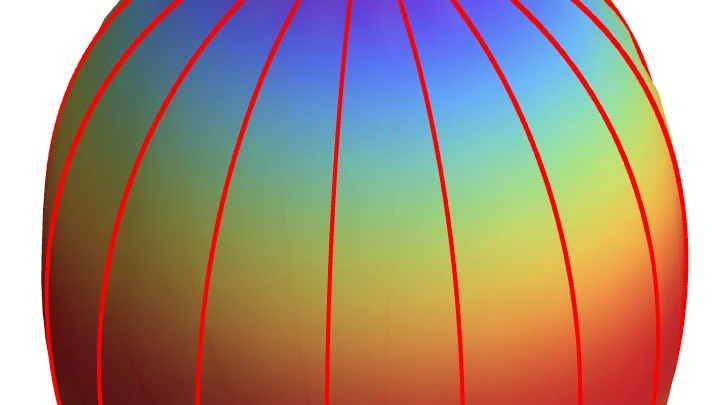
The atomic nucleus isn't always round like a billiard ball. Some nuclei stretch out like a rugby ball, while others become pear-shaped — with one end thicker than the other.
The geometric form of a nucleus, such as elongated, flattened, or spherical, determined by its internal configuration.The shape of an atomic nucleus is not fixed but emerges from the complex interplay of protons and neutrons inside. While many nuclei are roughly spherical, others are elongated like a rugby ball, flattened like a pancake, or even pear-shaped. This geometric variety is a direct consequence of the internal quantum configuration of nucleons, and it profoundly influences nuclear stability, reactions, and how nuclei interact with their surroundings.
The concept of nuclear deformation was introduced in the 1930s by Niels Bohr and Fritz Kalckar, and later developed by Aage Bohr and Ben Mottelson in the 1950s, who linked collective rotations and vibrations to the shell model.
Nuclei are governed by quantum mechanics, where protons and neutrons occupy discrete energy levels. When these levels are partially filled, the collective motion of nucleons can deform the nucleus into non-spherical shapes, lowering its overall energy. The specific shape depends on the balance between the attractive nuclear force, which favors compactness, and the repulsive Coulomb force between protons, which can push the nucleus toward elongation. Vibrational and rotational modes of these deformed shapes give rise to characteristic energy spectra that physicists can measure.
Understanding nuclear shapes is essential for predicting the behavior of heavy elements in nuclear reactors and for interpreting experiments in nuclear structure physics, such as those probing exotic isotopes.
Some nuclei, like tin-116, can exist in multiple shapes at nearly the same energy, effectively 'choosing' between spherical, oblate, and prolate forms.