Topological phases are states of matter whose defining properties are global, geometric features that remain unchanged under smooth deformations. Unlike ordinary phases distinguished by local order parameters like density or magnetization, topological phases are characterized by invariants such as the Chern number or winding number. These invariants are quantized and robust against local perturbations, meaning that small disturbances like impurities or defects cannot easily alter them. This robustness makes topological phases fundamentally different from conventional states and opens pathways for applications where stability is critical.
History
The concept emerged in the 1980s with the discovery of the integer quantum Hall effect by Klaus von Klitzing, who found that the Hall conductance is quantized to extraordinary precision. The theoretical explanation by David Thouless and collaborators in 1982 linked this quantization to topological invariants. Later, the idea expanded to topological insulators and superconductors in the 2000s.
How it works
The mechanism relies on the mathematical concept of topology, where objects are classified by properties preserved under continuous transformations. In a topological phase, the quantum wavefunction of the system acquires a global structure—like a twist or a hole—that cannot be undone without crossing an energy gap. For example, in the quantum Hall effect, electrons in a magnetic field form edge states that conduct without dissipation because the bulk has a nonzero Chern number. The edge states are a direct consequence of the bulk's topology, a principle known as bulk-boundary correspondence.
In practice
Topological phases are used in quantum computing research, particularly for topologically protected qubits that are resilient to decoherence, and in the design of dissipationless electronic devices.
Fun fact
The 2016 Nobel Prize in Physics was awarded for theoretical discoveries of topological phase transitions and topological phases of matter.
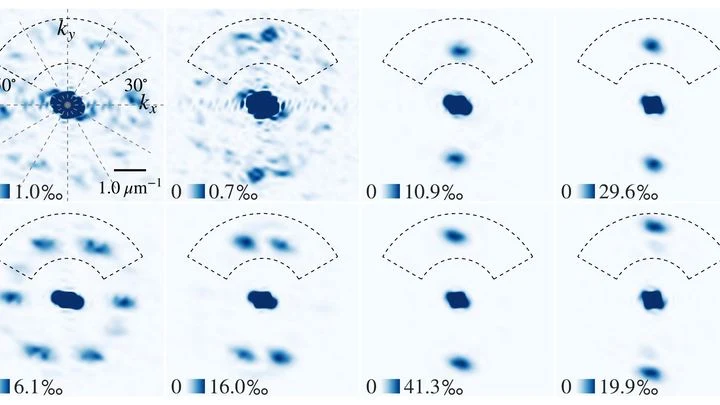
Two dancers on one stage: the triangle and the stripe. In a quantum gas of dysprosium atoms cooled to 62 nanokelvin, these two spatial structures have met for the first time in a single experiment. The gas is held in a trap shaped like a surfboard, and its atoms are among the most magnetic in the periodic table.
In the quantum world, particles fall into two irreconcilable camps: bosons love to pile into the same state (like light in a laser), while fermions are individualists that never occupy the same spot. You'd think one neural network couldn't learn both personalities at once.
Two cities with the same average population density. In one, a neat grid of blocks; in the other, a maze of narrow alleys and unexpected squares. On a global map they look like twins, but life inside flows quite differently.
Electrons in a solid usually either run freely (metal) or are locked in place (insulator). But sometimes strong mutual repulsion locks them into a halfway state: charges stand still, while spins, tiny magnetic arrows, continue to live their own life. This is called a Mott insulator.
In the new model, each active particle has an internal rhythm: it spins either left or right. Chirality is key: some twirl clockwise, others counterclockwise. But when such a particle bumps into an obstacle or a neighbor, it flips its spin, like a figure skater who, after touching the board, explodes into a reverse pirouette.
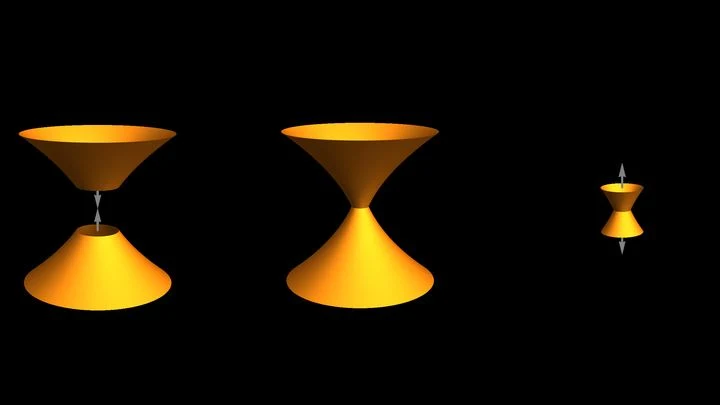
A neutron star is a city squeezed to the size of a metropolis, where matter is packed to the limit. At the very center of such a city, a redevelopment may begin: familiar neutrons and protons give way to quark plasma — free quarks, the building blocks of almost everything around us.
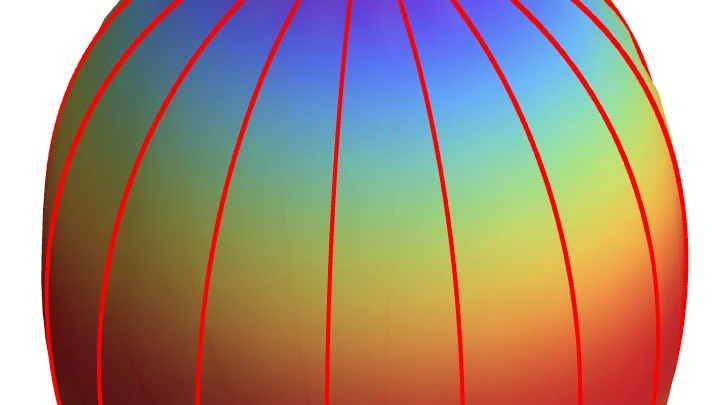
Some materials are internally like a Möbius strip: their electronic states are twisted in a special way. Such topological properties are usually manipulated with a powerful magnetic field, as if trying to flatten the strip with a sledgehammer. A group of researchers has found a more delicate tool.
Usually, a wormhole is imagined as a tunnel in space, whose walls are held open by something unusual — matter with negative energy. Like the supports in a mine that keep the ceiling from collapsing. But in this work, the physicists did without supports.
A person hunting for keys mentally runs through places where they might be. A bird that tucked hundreds of seeds into crevices in autumn retrieves them flawlessly in winter. How can a brain hold so many addresses when all birds have roughly the same number of neurons? The answer lies in geometry.
Water churns behind a rock in a river, air swirls behind an airplane wing: it seems like completely random motion. But the authors of the study found a rigid kitchen recipe in this chaos.
They decomposed the fluid's rotation (angular momentum) into two independent parts.
Water can be ice, liquid, or steam. Physicists call these states phases. In theory, each phase has its own measure — a way to describe how likely it is. But not every measure you can imagine occurs in nature. Some phases are real, while others are just mathematical illusions.
Scientists have found a simple criterion that separates reality from mirage.
If you keep chocolate at the wrong temperature, it turns gray and crumbly. It all comes down to how cocoa butter molecules pack together. At different temperatures, they form six different crystal forms, and only one of them, form V, gives a glossy bar that snaps crisply and melts in your mouth. The other forms are that white bloom and crumbliness.
The quantum world loves order, but reality often brings disorder. In this work, physicists study one-dimensional chains of spins — tiny magnetic arrows that can point up or down. Usually, topological phases (stable states protected by symmetry) are defined for pure states, where each arrow is precisely known.
The crystal changes its internal geometry like a building frame that slightly twists during an earthquake. In the manganese-gallium alloy (Mn₃Ga), at around 485 Kelvin (about 212°C), a magnetic transition occurs: the atoms align into an antiferromagnetic order, where neighboring magnetic…
Cells on the surface of an embryo resemble grains of rice that can align in one direction. This order is called nematic. It arises when cells start acting in concert, like a school of fish swimming in the same direction.
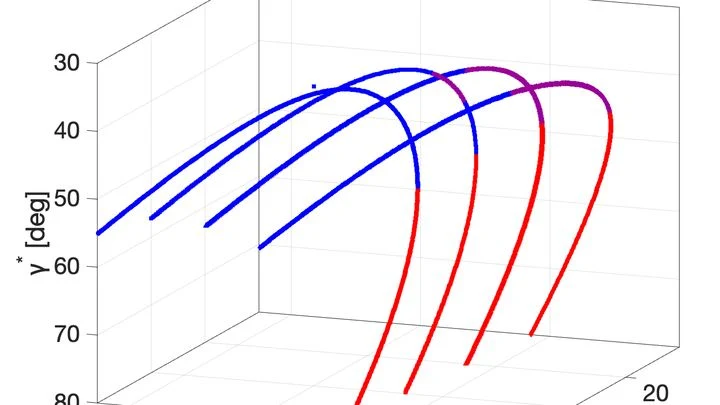
A lizard falling from a branch doesn't just tumble: it catches the air with its body and turns the fall into a glide. Engineers have long borrowed tricks from such feats, but until now there was no common language to compare the gliding of a snake, a lizard, and a man-made wing. The new study introduces such a language: a three-dimensional map of velocities that shows where any motion inevitably ends up.
A quantum computer weaves a kind of thread from qubits, where each node is a particle and the connection between them is an entanglement. When a physicist measures a qubit, the thread changes: it breaks somewhere, gets sewn together somewhere else, and sometimes a twist appears on it.
The law discovered by Wolfgang Pauli forbids identical particles from occupying the same spot. Hence, in cold matter, a Fermi sea is born: particles, like water, fill energy levels from bottom to top. The shape of the sea's surface — including 'islands' of emptiness — dictates the properties of the whole system.