A Single-Celled Lens: How an Alga Confuses Light and Shadow express
The tiny green alga Chlamydomonas spends its life rowing with two flagella toward light, like a swimmer heading for shore. It senses light with a photoreceptor protein, and behind it lies a red spot — the 'eyespot'—which casts a shadow and helps the cell figure out where the light is coming from. But in mutants lacking this spot, the behavior flips: they swim away from light even though the protein is still there. Why?
Ten years ago, researchers noticed that the cell's spherical body itself acts like a magnifying glass. Light passing through the cell is focused into a bright point behind it, like a sunbeam from a glass marble. In normal algae, the eyespot blocks this point, but in mutants it hits the photoreceptor directly from behind. The result is two signals: a weak direct light from the front and a strong focused one from the back. As the alga rotates around its axis, these signals alternate.
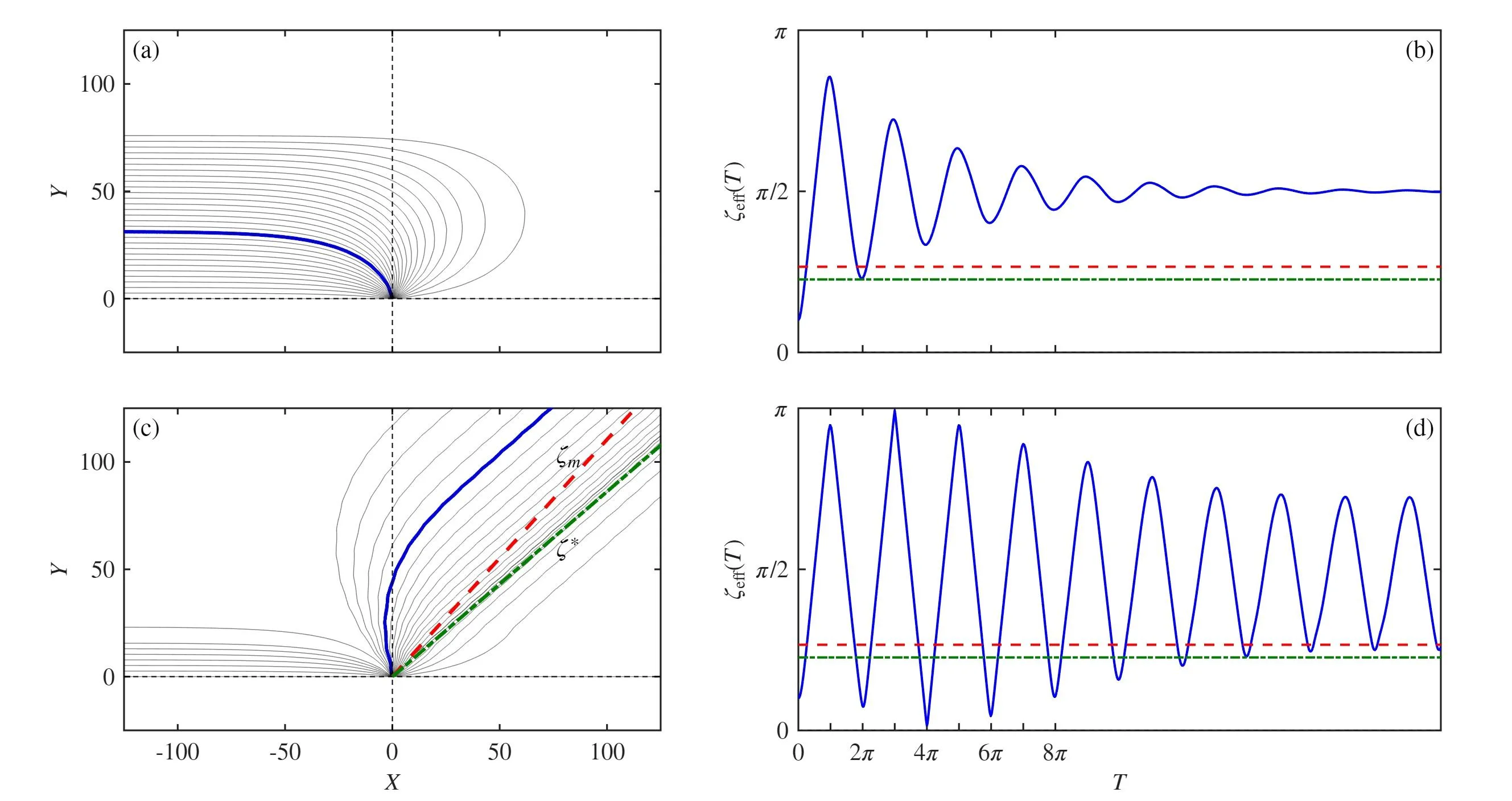
The cell doesn't respond to light intensity but to the rate of change, like a person who flinches at a sudden rustle rather than a steady hum. The sharp focused signal overrides the smooth direct one, and the flagella get the command 'row away from the light.' So the mutant without an eyespot swims in the opposite direction. The model also predicts something else: under certain conditions, the alga may oscillate between two directions, like a pendulum, unable to decide which way to go. This can be tested by tracking individual cells under a microscope.
Thus, a simple lens inside a living cell becomes a behavioral switch. A mistake in a single pigment spot, and the whole navigation goes haywire, like a compass with north and south swapped.
Original abstract
as written by the authors arXiv:2603.10986
Phototaxis of many species of green algae relies upon directional sensitivity of their membrane-bound photoreceptors, which arises from the presence of a pigmented "eyespot" behind them that blocks light passing through the cell body from reaching the photoreceptor. A decade ago it was discovered that the spherical cell body of the alga $$Chlamydomonas~reinhardtii$$ acts as a lens to concentrate incoming light, and that in "eyeless" mutants of $$Chlamydomonas$$ the consequence of that focused light reaching the photoreceptor from behind is a reversal in the sign of phototaxis relative to the wild type behavior. We present a quantitative theory of this sign reversal by completing a recent simplified analysis of lensing [Yang, et al., Phys. Rev. E 113, 022401 (2026)] and incorporating it into an adaptive model for $$Chlamydomonas$$ phototaxis. This model shows that phototactic dynamics in the presence of lensing is subtle because of the existence of internal light caustics when the cellular index of refraction exceeds that of water. During each period of cellular rotation about its body-fixed axis, the photoreceptor receives two competing signals: a relatively long, slowly-varying signal from the direct illumination, and a stronger, shorter, rapidly-varying lensed signal. The reversal of the sign of phototaxis is then a consequence of the dominance of the flagellar photoresponse to the signal with the higher time derivative. These features lead to a quantitative understanding of phototaxis sign reversal, including bistability in the direction choice, a prediction that can be tested in single-cell tracking studies of mutant phototaxis.
Chlamydomonas is one of the fastest swimmers among single-celled organisms: it can cover a distance ten times its own length in a single second.