Chlorophyll is the green pigment found in plants, algae, and cyanobacteria that captures light energy and converts it into chemical energy throughphotosynthesis. It is the molecule responsible for the green color of leaves and plays a central role in the Earth's biosphere by producing oxygen and organic matter. The seed definition highlights its role as a light absorber, but chlorophyll also participates in the initial steps of energy transfer within the photosynthetic apparatus.
History
Chlorophyll was first isolated and named by Pierre Joseph Pelletier and Joseph Bienaimé Caventou in 1817. The understanding of its role in photosynthesis developed over the following century, with key contributions from Richard Willstätter and Hans Fischer, who determined its structure.
How it works
Chlorophyll molecules are embedded in the thylakoid membranes of chloroplasts. When a photon strikes a chlorophyll molecule, its energy excites an electron to a higher energy level. This excited electron is then transferredthrough a chain of other molecules in the photosystem, ultimately driving the synthesis of ATP and NADPH, which are used to fix carbon dioxide into sugars. The specific structure of chlorophyll, with a porphyrin ring and a long phytol tail, allows it to absorb light most efficiently in the blue and red parts of the spectrum, while reflecting green light, which is why plants appear green.
In practice
Chlorophyll is used in solar cell research as a model for biomimetic light-harvesting systems, and it is also a common ingredient in nutritional supplements and natural food colorings.
Fun fact
Chlorophyll is so similar in structure to hemoglobin, the oxygen-carrying molecule in human blood, that the only difference is the central metalatom: magnesium in chlorophyll, iron in hemoglobin.
A slice of eucalyptus a tenth of a millimeter thick is placed under a polarized light microscope, and the wood suddenly blooms: blue, yellow, and pink bands twist into spirals, forming rings and swirls. This is not paint but the play of light: the cellulose fibers that make up cell walls transmit light differently depending on their orientation.
The lifetime of the entangled triplet pair in the protein is about 60 picoseconds, which is eight times longer than in solution.
Sunlight is like a continuous stream of balls flying at a wall.
A sunbeam hits a leaf, and inside, a relay race begins. Energy hops from one molecule to the next until it reaches its goal. In photosystem II (a protein complex that kicks off photosynthesis), the runners are pigment molecules: chlorophylls and pheophytins.
Imagine an artist whose canvas is an entire planet, and whose palette is molecules drinking starlight. His brush is billions of years of evolution, and his painting is a spectral portrait visible even from another star system.
Imagine a carousel with two types of seats: some spin clockwise, others counterclockwise. If you push all of them at once, the carousel jerks but stays in place. That's how a Weyl semimetal crystal works: electrons are born in pairs—'left' and 'right'—and their contributions to current cancel each other, like two identical motors running in opposite directions.
When the light of a distant planet is split into colors, it suddenly jumps at the boundary between red and invisible infrared, as if someone flipped a switch. This is how the vegetation red edge manifests itself: chlorophyll is transparent to near-infrared radiation, and the leaf, to avoid overheating, reflects it away.
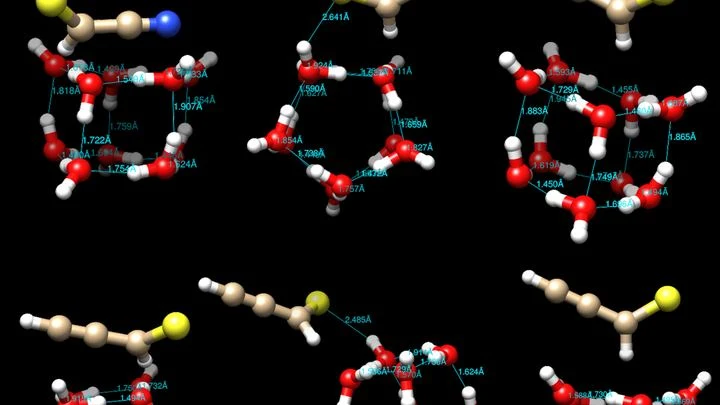
In a cold cloud of gas and dust that astronomers call TMC-1, two sulfur-bearing compounds were recently found: one smells like bitter almonds, the other like rotten eggs. But such a cloud contains less sulfur than it should. Where does it go? It seems to hide in tiny icy pockets on the surface of dust grains.
Space ice is not like a skating rink. It is fluffy, like snow, and full of crevices and hollows.
Inside every cell, there are tiny power stations — mitochondria. They burn nutrients and store energy. Two helper molecules, NADH and FAD, oversee this process. Previously, they were detected by their faint glow, but it was dim, and signals from different molecules overlapped.
The new microscope works differently.
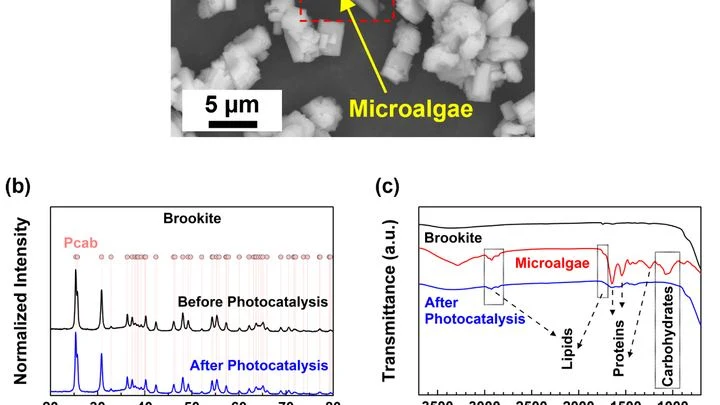
Conventional solar panels convert light into electricity, but here light splits water into hydrogen and oxygen. Hydrogen is a clean fuel, but the process is slow. To speed it up, helper substances that donate electrons are added. Often this is alcohol, but it's a shame to waste it.
The tiny green alga Chlamydomonas spends its life rowing with two flagella toward light, like a swimmer heading for shore. It senses light with a photoreceptor protein, and behind it lies a red spot — the 'eyespot'—which casts a shadow and helps the cell figure out where the light is coming from.
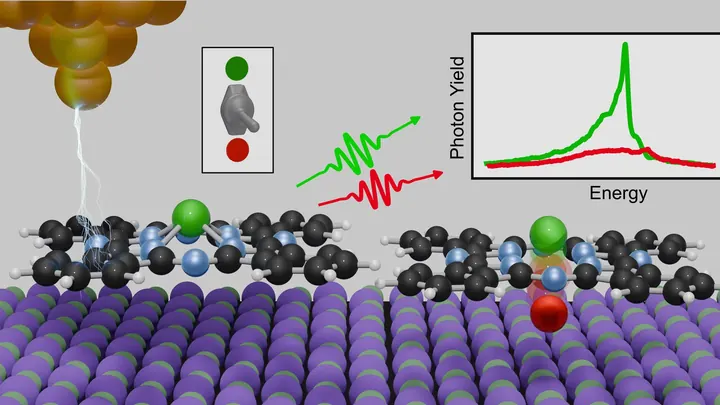
A glowing dot the size of a molecule. Run a current through it, and it flashes like a tiny lightbulb. That's what the experiment with dye molecules on a thin salt film looks like.
When current enters a molecule, one electron hands it energy. The molecule immediately gives that energy back, as light. It's like a swing: give it one push, and it rocks and then stills.
When a sunbeam hits a leaf, a relay race begins inside it. The energy of light passes from one chlorophyll molecule to the next until it reaches the reaction center — the place where the chemistry of life kicks off. This relay runs with astonishing accuracy: nearly every quantum of light finds its way.
An ordinary solar cell does one thing: when the sun shines, current flows. Here, when the sun shines, the current flows differently depending on which side you bring the magnet.
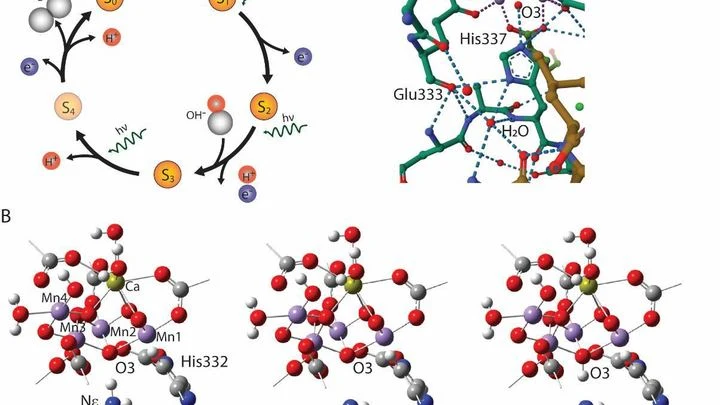
In every leaf, in the light, a factory works that splits water into oxygen and hydrogen. The oxygen goes into the air we breathe, and the plant uses the hydrogen for food. The heart of this factory is a protein complex with four manganese atoms and one calcium atom.