A light sensor is a device that converts incoming light — from visible photons to infrared or ultraviolet — into an electrical signal. This conversion allows electronic systems to 'see' their environment, measure brightness, detect motion, or even decode data transmitted as light pulses. The principle is central to everything from smartphone auto-brightness to astronomical observatories and optical communication.
History
The first practical light sensor, the photoelectric cell, was developed in the late 19th century following Heinrich Hertz's discovery of the photoelectric effect in 1887. Albert Einstein's 1905 explanation of the effect earned him the Nobel Prize and laid the theoretical groundwork for modern semiconductor-based sensors.
How it works
Most light sensors rely on the photoelectric effect or photoconductivity: photons striking a semiconductor material (like silicon) knock electrons loose, creating a measurable current or changing the material's resistance. The sensor's output is proportional to the light intensity, and with additional optics or filters, it can be tuned to specific wavelengths or directions. Some advanced designs use quantum effects, such as single-photon detection, to achieve extreme sensitivity.
In practice
Light sensors are ubiquitous: they control camera exposure, street lighting, and smartphone displays; they enable optical data transmission in fiber-optic networks; and they are essential in scientific instruments like spectrometers and telescopes.
Fun fact
Some light sensors can detect a single photon, a capability used in quantum cryptography to ensure secure communication.
A globe sits on a table, and a ruler lies beside it: one is curved, the other straight. X-ray telescopes have lived with this mismatch for years. Their mirrors gather light onto a curved surface, like the globe, while the detectors that catch that light have been flat, like the ruler.
Light in an optical fiber is like a stream: it flows inside a glass thread and doesn't spill out. A thick thread carries many streams at once, a thin one only one. Astronomers often need to pour light from a thick fiber into several thin ones to split it into colors.
Gravitational-wave detectors are like extremely sensitive ears: they pick up the trembling of space when black holes or neutron stars collide somewhere in the universe. But even the most sophisticated "ears" cannot hear everything. The new LIGO A# project is like replacing the eardrum with a thinner, more sensitive membrane.
A light field, like a neat waffle iron, presses a regular pattern of bright and dark regions into space. Atoms get stuck in the brightest spots as if in tiny dimples: that's an optical lattice. It's a favorite tool for physicists who want to study quantum behavior of matter in its pure form.
Usually, light does not turn an insulator into a conductor: that requires powerful laser pulses that break the material's structure. But in twisted bilayer graphene at the magic angle, things are different.
Low-frequency radio waves (from 30 to 300 kilohertz) carry information through water and earth. But catching them with an ordinary antenna is hard: the wavelength reaches several kilometers, and a small receiver barely feels such a field.
In the silent ocean of the Galaxy, mature civilizations have likely long chosen an unexpected strategy: instead of loud beacons, they scatter quiet fireflies — autonomous interstellar laser beacons, drifting in the void and dropping microsecond flashes. These 'seeds of contact' are not tied to their home stars and do not drown in their glow.
Dozens of copper coils in an MRI scanner pick up the faint response from tissues, like microphones trying to catch a whisper in a noisy hall. Each microphone drags a thick bundle of wires behind it. The wires press on each other, create electrical interference, heat up, and add risk for the patient.
In absolute silence, you need to hear a feather drop. But someone keeps rustling a plastic bag. For the space-based LISA observatory, that 'rustling' will come from charged particles in space.
An ultra-sensitive microphone listens not to sound, but to the trembling of space itself. That's how gravitational wave detectors work — LIGO, Virgo, KAGRA.
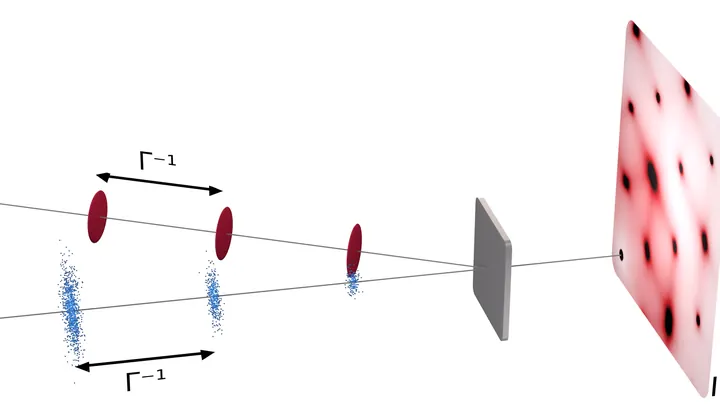
A regular rangefinder sends a single light pulse and waits for it to return — like a person shouting into the void and listening for an echo. But if you use multiple sources that glow in unison, and analyze not the volume but the rhythm of the echo of reflected flashes, the picture becomes sharper.
An ordinary photometry detector can't tell a left photon from a right one. But let it start moving, and everything changes.
Imagine a rower moving between two flutists playing the same note. His ear is perfectly tuned to that note and ignores all others. As he moves, the pitch from the flutist ahead sounds higher, and from the one behind sounds lower.
A solar telescope is like an eye trying to spot an ant through a pot of boiling soup. The daytime sky dazzles, the air shimmers, and the image swims. To freeze it, you need adaptive optics — a system that predicts distortions and corrects them hundreds of times per second.
A pendulum swings with such precision that, had it been counting seconds since the Big Bang, it would have drifted by only half a second by today. That is the stability of the new portable ultraviolet laser — the heart of aluminum atomic clocks.
Light leaves a trace even when there is almost none of it. A single photon, a tiny bundle of energy, strikes a silicon wafer and knocks out a handful of electrons. The trouble is that the handful is too small to notice. You need an amplifier.
Usually, the signal is amplified by applying a voltage to metal contacts on the detector's surface.
A conventional lidar is like an artist who paints a landscape but sees only gray shadows. It measures distances to each point accurately, but can't tell whether it's looking at rock, wood, or plastic. To learn the composition, you need a spectrometer — a separate device that works slowly and can't keep up with a fast scanner.
The new system takes a different approach.
An ordinary light sensor answers the question "how much light" but not "where did it come from." To do that, you need lenses, mirrors, or entire arrays. In a new study, researchers propose a sensor that determines the direction of a light beam on its own, without any optics.
An ordinary antenna picks up radio waves, but there are fields it barely feels. We're talking about slow electric fields: those that change once a second or less. For them, physicists built a sensor from a beam of rubidium atoms.
Plain water in a glass is clear and calm. But if you add tiny carbon dots made from sugar and citric acid in an ordinary microwave, the water starts to glow when a charged particle flies through it.
A tiny superconductor, levitating above a magnet, is like a cork on the surface of an invisible ocean. The slightest breath of dark matter makes it shudder. Scientists examined two kinds of such 'wind'. The first – gravitational waves, which stretch and squeeze space itself, like ripples on the fabric of the cosmos.
A regular camera captures the world as a series of frames: twenty-four, sixty, or even a hundred images per second. That's enough for filming a falling drop, but inside a living cell, events unfold a thousand times faster. Protein molecules carry cargo, membranes bubble, ions slip through channels — all in fractions of a millisecond.
A standard laser rangefinder works like a stopwatch on a 100-meter dash: it times how long light takes to run to the target and back. But such a stopwatch has a limit: it ticks in steps of tens of picoseconds (trillionths of a second). In that step, light travels about a centimeter, so finer details are invisible.
The tiny green alga Chlamydomonas spends its life rowing with two flagella toward light, like a swimmer heading for shore. It senses light with a photoreceptor protein, and behind it lies a red spot — the 'eyespot'—which casts a shadow and helps the cell figure out where the light is coming from.
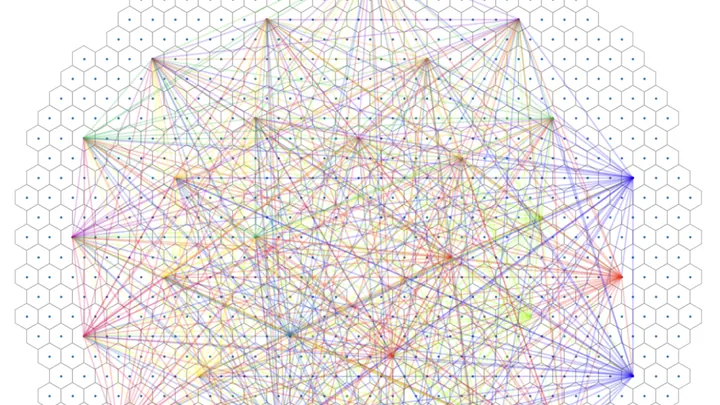
Light from a star travels for millions of years, yet in a telescope it still appears as a point: it's just too far away. To see a star's surface, you need an instrument the size of a city. In Chile, such a giant is already under construction: ELT with a 39-meter mirror made of 798 hexagonal segments.
The night sky is not all that dark. Even far from cities, it glows faintly — which hampers astronomers trying to catch weak flashes from distant cosmic rays.
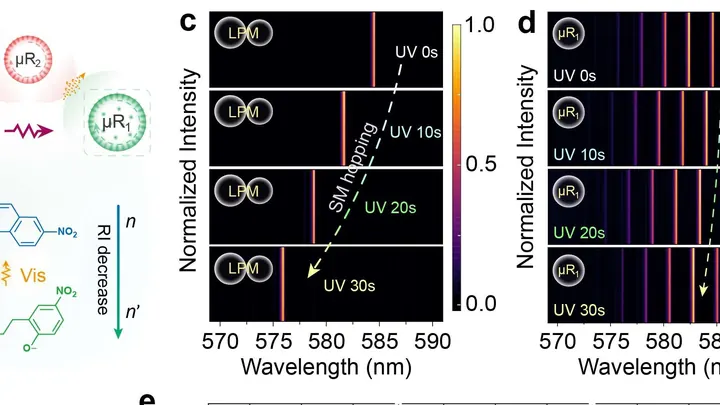
Two liquid droplets hanging side by side begin to sing in unison. One droplet is like a string tuned to a certain pitch, and together they form a laser that shines with a single, pure color. That's how a new type of sensor, a liquid photonic molecule, works.
The secret is that the droplets are slightly different in size.
A camera that captures not light but a stream of electrons reflected off a crystal is a hybrid pixel detector. It can count every electron that hits it, generating almost no noise of its own. In normal mode, when the electron beam flows continuously, the detector works perfectly.
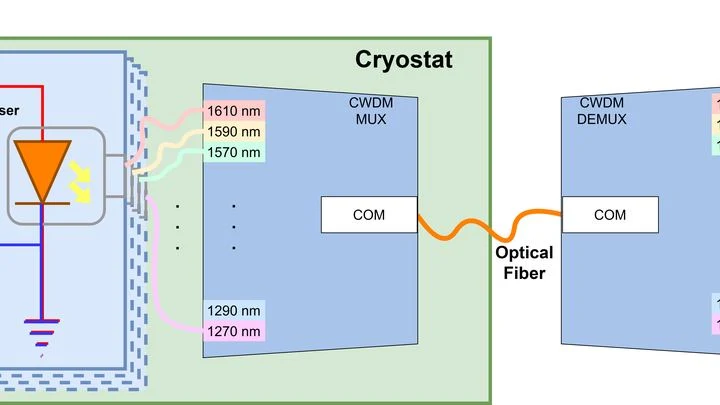
A thermos of liquid xenon cooled to minus 100 degrees Celsius. Inside are sensitive sensors that catch rare signals from dark matter particles. To bring these signals out, copper cables are usually used. But over the long haul, the signal weakens, and adjacent cables start 'cross-talking' — that's called crosstalk.
A conventional thermal camera is like a thermometer that slowly heats up and cools down. It shows where heat is well, but it can't keep up with fast motion. The new sensor works differently: it counts individual quanta of heat, like a droplet counter during rain.
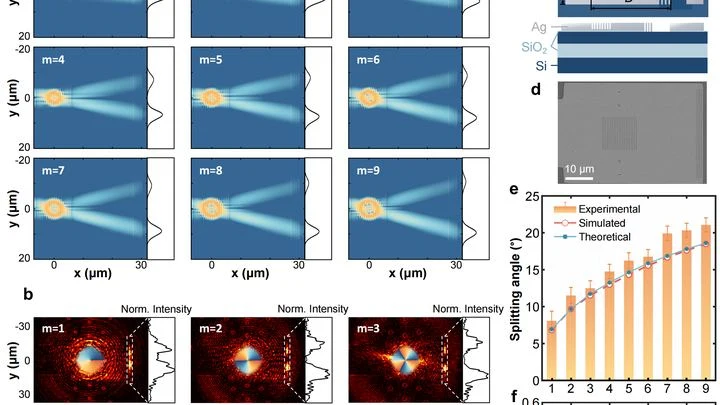
Light doesn't always travel in a straight line. Its wave can be twisted into a spiral, like a stream of water from a rapidly rotating hose. This twist is called orbital angular momentum, and it can hide information: each turn acts as a separate communication channel. The problem was that only bulky setups of lenses and mirrors could recognize these twists.
Light, regardless of its source, consists of photons — elementary particles, quanta of the electromagnetic field. The simplest light detector, such as a photometric illuminance meter, operates in a binary mode: it merely registers whether photons hit it or not, giving a 'yes/no' answer.
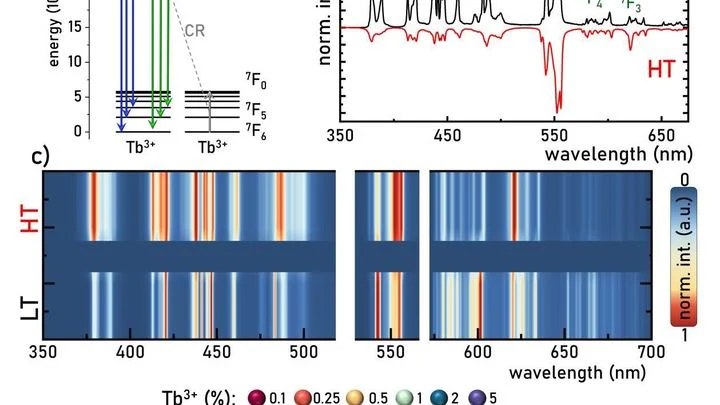
A piece of material glows blue. Heat it up, and the glow turns green, as if someone flipped a switch at a traffic light. That's how the new luminescent thermometer described in the paper works.
Inside the material are terbium ions — a rare-earth metal that knows how to shine. At room temperature, they emit blue light.
Light is like a many-voiced choir: color, direction of oscillation, and instantaneous changes all intertwine. An ordinary camera hears only one voice, while the rest are lost. Scientists have built a camera that listens to the entire choir at once, and from a single image understands what is happening.
The merger of two neutron stars is like a strike on a gong: a ripple in space, a gravitational wave, spreads through the universe. Detectors on Earth catch this ripple and, from its strength, calculate the distance to the source.
Light is a great tool for studying tissues, but it fades fast deep inside the body. Within a few millimeters, photons scatter so much that you can't make out anything. Scientists came up with a workaround: instead of shining light from outside, deliver a tiny light source right inside. The challenge is how to power that source without wires.
A rubidium atom is like a lock that opens only with one key: a particle of light of a strictly defined color. Even under the fiery rain of the sun, where myriads of colorful 'keys' fall, the lock remains silent. But when the right one strikes, the atom gets excited for an instant, and the detector registers a click.
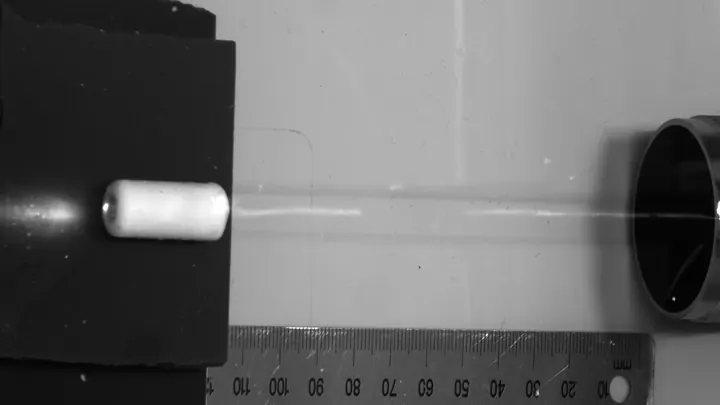
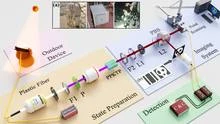
Sunlight collected by a Fresnel lens and passed through 20 meters of plastic fiber had a power of just 3 microwatts, a million times less than a typical laser pointer. That was enough to generate photon pairs correlated in position inside a nonlinear crystal. One photon from each pair passed through the object, the second was scanned by a detector, and coincidences built up the image.
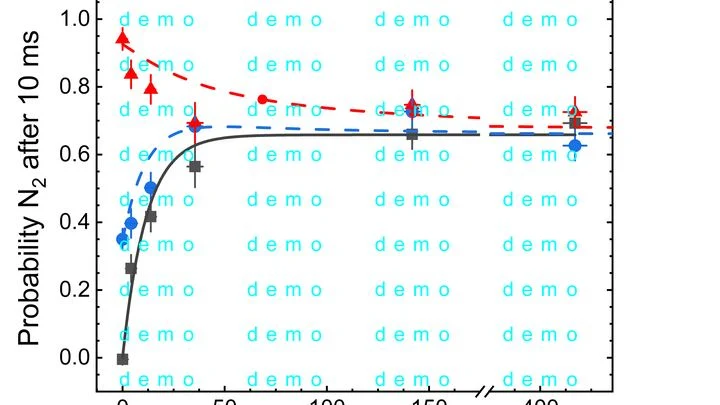
A silicon sphere 166 nanometers in diameter floats in a beam of infrared laser light. The pressure is below 10⁻⁸ mbar, and the motional temperature is about 10 millikelvin. That is colder than the cosmic microwave background.