A Powder That Remembers Motion express
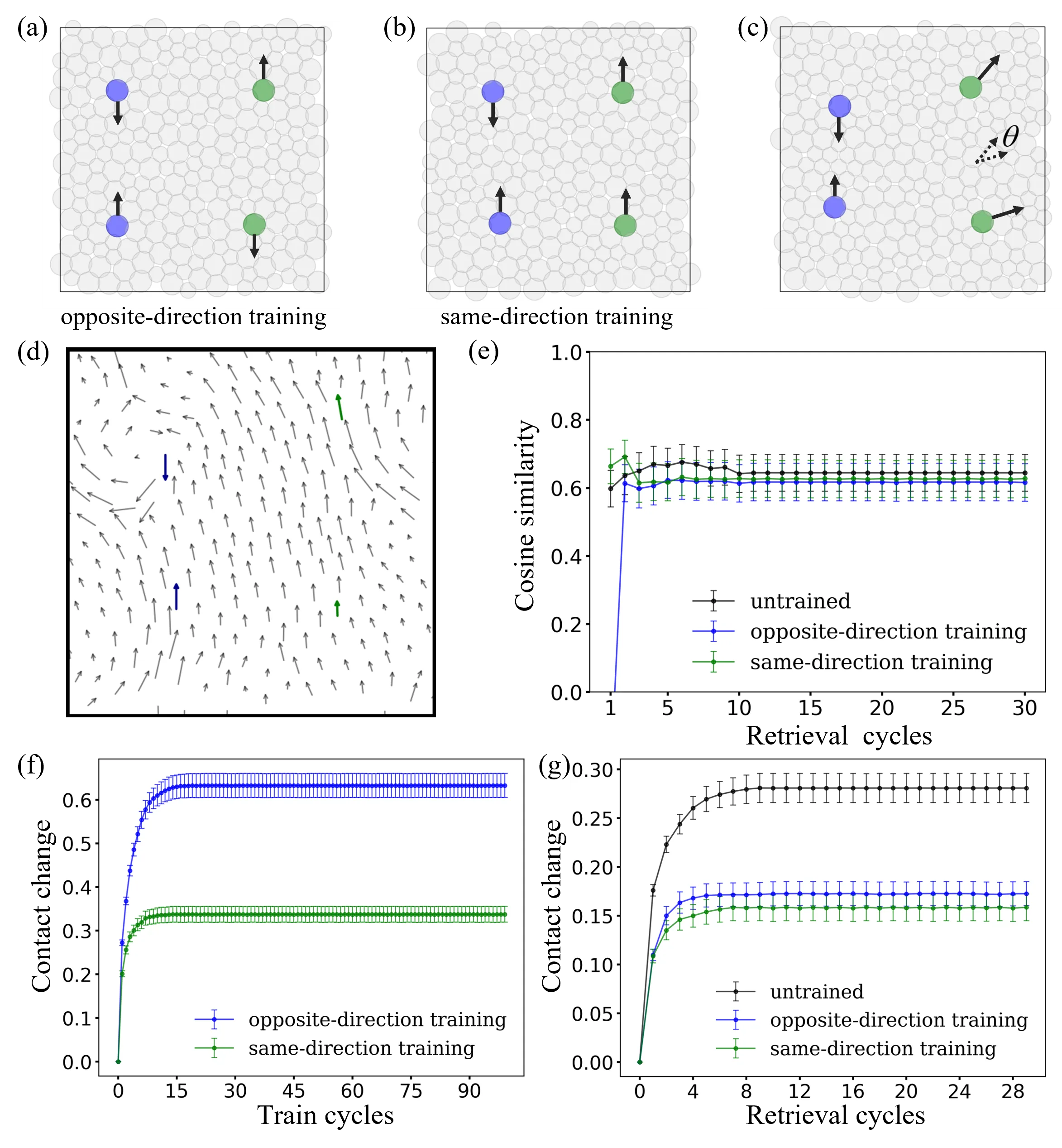
A handful of sand on a table is just a pile. But if you shake the grains just right, the pile starts behaving like a memory: it remembers which motion follows which. In the new experiment, particles were moved cyclically, and after training, they reproduced the desired pattern even without a full command.
The secret lies in the contacts between particles. When grains shift, they change neighbors and interaction forces — so the pile's 'wiring' rearranges itself. This is like how a path in the woods becomes more visible if you walk it often: each step changes the ground, and the route is remembered.
The scientists tested tasks of varying difficulty. The simple task was solved right away — the particles were already moving in the right direction. In the hard task, learning barely helped until pauses were added: the particles had time to 'settle' and remembered better. And in the medium task, simply changing the arrangement of inputs and outputs did the trick.
The experiment shows that associative memory doesn't need complex circuits — just a granular medium and the right rhythm. Perhaps in the future, we'll see materials that learn on the fly, like this sand.
Original abstract
as written by the authors arXiv:2603.14534
We investigate associative-memory behavior in a reconfigurable particle packing programmed by purely local cyclic driving. The system is a two-dimensional bidisperse Lennard--Jones particle assembly with periodic boundaries evolved under athermal quasistatic relaxation. During training, a fixed set of input particles is driven cyclically while output particles are selected on-the-fly by a region-driving rule and driven according to a prescribed flow pattern; during retrieval, only the inputs are driven. Associative-memory performance is quantified by the cosine similarity between realized and target output displacement directions. Unlike physical learning systems with fixed architecture, learning here arises through emergent weight updates: localized rearrangements modify the contact network and reshape the effective mechanical couplings between inputs and outputs. Across task difficulty we identify three regimes. In an easy setting, the intrinsic mechanical response already produces coherent motion in the right-hand region under input-only driving, yielding high performance without training. In a hard setting, the desired mapping conflicts with the dominant collective drift, resulting in low baseline performance and only modest training gains; introducing intermittent relaxation cycles reduces train--retrieval mismatch and improves performance. In an intermediate quadrupolar task, repositioning the input--output geometry stabilizes the desired response and converts initially stochastic trajectories into reproducible learned motions. Together these results identify minimal physical ingredients for association-based functionality in athermally driven particulate media and motivate an association learning phase diagram for reconfigurable matter.
In the experiment, particles moved without heating — only through mechanical action, as if you were shaking a box of marbles.