A one-dimensional chain is a simplified physicalmodel in which particles are arranged in a single line, interacting only with their nearest neighbors. This model is a cornerstone of condensed matter physics and statistical mechanics, providing a tractable framework to study phenomena like wave propagation, phase transitions, and thermal transport. Despite its simplicity, the one-dimensional chain captures essential physics that often carries over to higher dimensions, making it a powerful pedagogical and research tool.
History
The one-dimensional chain model has roots in the 18th-century study of vibrating strings, but it was formalized in the early 20th century by Peter Debye and Max Born, who used it to explain the heat capacity of solids and the propagation of elastic waves in crystals.
How it works
In a one-dimensional chain, each particle is typically connected to its neighbors by springs or other interactionpotentials. The equations of motion for the particles form a set of coupled differential equations, which can be solved using normal modes—collective oscillations where all particles move sinusoidally with a common frequency. The dispersion relation, which links frequency to wavevector, reveals key features like acoustic and optical branches, band gaps, and the speed of sound in the chain. In quantum mechanics, the chain becomes a model for lattice vibrations (phonons) and can exhibit phenomena like the Peierls transition or topologicaledge states.
In a one-dimensional chain of identical masses connected by springs, the speed of sound is independent of the number of particles—it depends only on the spring constant and mass, a result that holds even for an infinite chain.
A thin silver thread nearly as long as a hair's width, and inside it, pristine quantum laws hold sway. Physicists built a conductor where electrons can only move forward or backward, like on a perfectly straight single-lane road with no shoulders. On such a road, any pothole or pebble would normally destroy the fragile quantum state.
Water droplets shoot out of a nozzle one after another, like cyclists on a narrow track. The faster ones catch up with the slower ones and merge into larger drops. This simple mechanism is called ballistic aggregation, and until now it had only been observed on cosmic scales: this is how dust particles stick together to form planets.
Quantum spin chains resemble a line of people passing along a secret handshake: each turns to a neighbor, and how firmly they clasp palms determines how the wave runs through the entire chain. In the ideal Heisenberg chain, quantum magnetism’s bedrock, all handshakes are equal.
At a party, guests don't just chat in pairs; they gather in circles of shared interests: three discussing movies, four debating sports. The usual acquaintance map, like a phone's contact list, can't capture that: it only sees one-on-one links.
A lightning strike splits the sky in a fraction of a second, leaving a branched trail. At the same moment, in a tiny superconducting crystal cooled to near absolute zero, an avalanche of magnetic field rushes through — thin fingers of magnetization piercing the material.
An ordinary crystal is like an apartment building: electrons move through shared hallways and staircases, influencing each other through the walls. Now, imagine removing all the walls, leaving just a single line of apartments. How would the residents behave?
Hydrogen has nothing to do with it, but the collective behavior of electrons takes center stage.
Strike a tuning fork, and it rings with a single pure note. But if the fork is trembling and people are chattering nearby, the sound won't be perfect. Same with molecules: each one absorbs light of a specific color, but due to its own vibrations and the jostling of neighbors, that color gets smeared out.
The authors of the paper figured out how to show this to students without complex formulas.
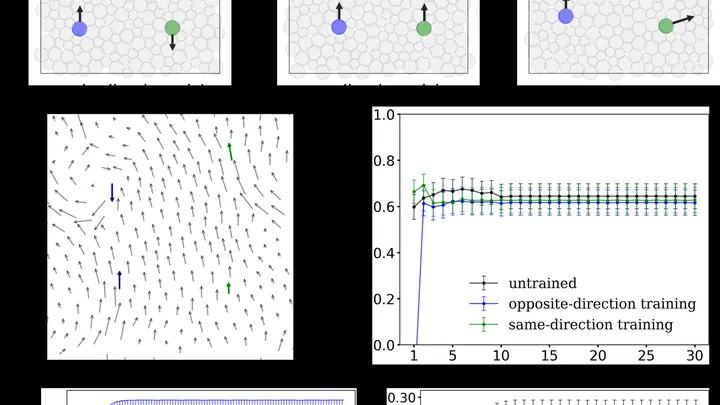
A handful of sand on a table is just a pile. But if you shake the grains just right, the pile starts behaving like a memory: it remembers which motion follows which. In the new experiment, particles were moved cyclically, and after training, they reproduced the desired pattern even without a full command.
The secret lies in the contacts between particles.
When a typical computer searches for a law of nature from data, it tries to guess a complete formula in one go. It's like a cook who, without knowing the recipe, dumps all the ingredients into a pot at once and hopes for soup. Most often, the result is an inedible mess: the formula is long but meaningless, and it fails on new data.
A rubber band is stretched, and suddenly snaps. In the atomic world, a similar picture emerges: the string binding particles can break. In a new study, physicists took a chain of Rydberg atoms and tracked how such a string breaks.
Under weak tension, the string breaks completely, and the system splits into several independent pieces, as if a rubber band shattered into segments.
A light pulse can be sliced into short time bins, like a train into carriages. If two photons are born together and their carriages are tightly linked, the arrival of one in a specific bin guarantees that the other arrives in the paired bin, this connection is called time-bin entanglement.
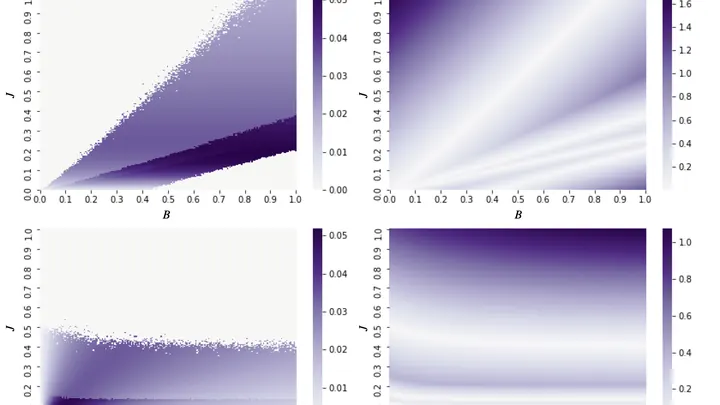
In a chain of cold spins stretched along a single line, order and disorder can intertwine into a pattern that defies the usual rules. Two states of matter, two kinds of "order," are separated by a crossroads where the roads do not converge but diverge.
In a chain of eight spins, a defect lurks — a tiny magnetic moment. The Kondo effect, known since the 1930s, makes electrons around it align into a collective screen. The material's resistance abnormally increases. But detecting such an impurity hidden deep in the structure is like finding a stone at the bottom of a dark pond.