Magnets That Take Their Time to Demagnetize express
A tiny molecule made of just a few atoms can behave like a permanent magnet. It becomes magnetized and is in no hurry to demagnetize, even when the external field is removed. Such molecules are called single-molecule magnets, and they interest scientists as a possible basis for ultra-dense information storage.
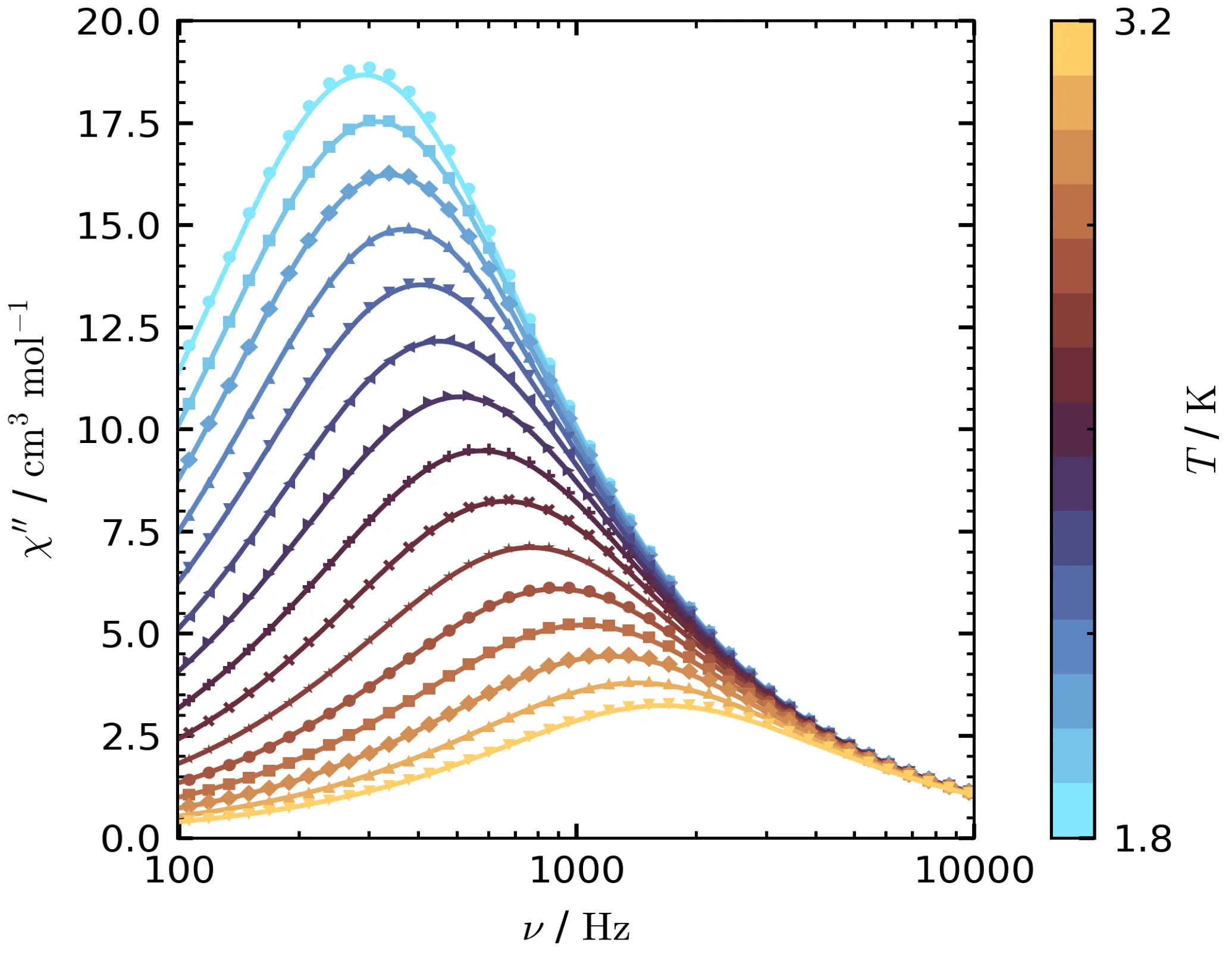
Previously, the behavior of these molecules was described using simplified models. Now physicists have built a full calculation "from scratch": they took the equations of quantum mechanics, added the interaction of the molecule with environmental vibrations, and calculated how the molecule responds to an alternating magnetic field. The result was compared with experiment for three compounds where magnetic ions of ytterbium, terbium, and dysprosium are diluted in a non-magnetic yttrium polymer matrix. The agreement was good both at low and high temperatures.
This approach shows for the first time that the complex behavior of molecular magnets can be predicted without fitting parameters. It is a step toward designing materials with desired magnetic properties on a computer, rather than searching for them blindly in the lab.
Original abstract
as written by the authors arXiv:2603.18725
Single-Molecule Magnets (SMMs) exhibit slow magnetic relaxation as a result of axial magnetic anisotropy inhibiting spin-phonon transitions. In order to establish a direct link between physical observables and the microscopic theory of magnetic relaxation, we here develop and numerically implement a first-principles linear-response theory for open quantum systems that provides access to the complex a.c. magnetic susceptibility in the presence of an oscillating a.c. magnetic field. Once combined with density functional theory and multiconfigurational electronic structure simulations, this formalism is applied in a fully first-principles fashion to three cyanido-bridged Ln/Y-based coordination polymers with general formula {Ln$$^{III}_x$$ Y$$^{III}_{1-x}$$ [Co(CN)$$_6$$]}, where Ln = Yb (1), Tb (2), and Dy (3). The method is able to reproduce the low-temperature direct relaxation process and its field dependence, as well as the high-temperature Orbach relaxation regime for all the investigated compounds. These results demonstrate the feasibility of ab initio simulations of magnetic a.c.susceptibility in lanthanide-based SMMs and support the potential of further development of ab initio open quantum systems methods towards the completion of a magnetization dynamics theory.
Single-molecule magnets can store one bit of information in a single molecule: this is millions of times denser than modern hard drives.