A permanent magnet is a material that generates its own persistent magnetic field without any external power source. Unlike temporary magnets, which only exhibit magnetism while in the presence of an external field, permanent magnets retain their magnetization after the field is removed. This property arises from the alignment of magnetic domains—microscopic regions where atomic magnetic moments point in the same direction—which remain locked in place due to the material's internal structure.
History
The earliest known permanent magnets were lodestones, naturally magnetized pieces of magnetite, used in compasses by ancient civilizations. The modern understanding of ferromagnetism was developed in the early 20th century, with Pierre Weiss proposing the domain theory in 1907.
How it works
In ferromagnetic materials like iron, cobalt, and nickel, atoms have unpaired electrons that act as tiny magneticdipoles. In an unmagnetized state, these dipoles are randomly oriented, canceling each other out. When exposed to an external magnetic field, the domains align, and in permanent magnets, the material's crystal structure and defects (such as lattice defects) pin these domains in place, preventing them from returning to randomness. This creates a stable, self-sustaining magnetic field.
In practice
Permanent magnets are ubiquitous in technology, from electric motors and generators to hard disk drives, loudspeakers, and magnetic resonance imaging (MRI) machines. They are also used in magnetic separators, sensors, and in research on magnetic traps for neutral atoms.
Fun fact
The strongest permanent magnets, made from neodymium-iron-boron alloys, can lift over 1,000 times their own weight.
A sculptor looks at a block of marble and sees the figure within, waiting to be freed from excess material. Instead of adding clay, he removes everything that is not part of the form. The authors of a new study on magnetic resonance took a similar approach: rather than complicating the tissue model by adding ever more details, they stripped away the superfluous to reveal the essence.
Inside an MRI magnet, current flows through a closed superconducting loop, like water circling in a bucket after you give it a spin, it just keeps going on its own. To change that current, you heat the loop with a small heater: it stops being superconducting, becomes an ordinary resistor, and then an external source can 'top up' or 'draw off' current.
A magnetic vortex is like a tiny whirlpool in the sea, except that instead of water, it's magnetization that swirls. Such vortices could become memory cells in future computers, but to write and read information, you need to be able to move each vortex individually. So far, this is done crudely — shifting a whole bunch at once.
Electricians working with high voltage are like divers: they need to see what's happening deep underwater without going down themselves. What's needed is a sensor that stays away from the dangerous current and relays information to the surface. Usually, light is used: a beam passes through a transparent crystal, and the electric field slightly rotates it.
A lighthouse that blinks not every second but once every few minutes or even hours. That is exactly how long-period radio transients behave — cosmic sources discovered only recently.
A black hole is not a vacuum cleaner. By itself, it doesn't pull everything in more strongly than an ordinary star of the same mass. But if there's a magnetic field nearby and charged particles flying around, an interesting game begins.
A magnetic mirror is a tube open at both ends. The magnetic field inside is arranged so that hot plasma doesn't leak out: at the ends, the field lines bunch up like a cork in a bottle. Plasma particles flying toward the exit are repelled by these "corks" and bounce back. But some still escape: that's the classic "loss cone" argument.
A Tesla coil crackles, and a beam of light begins to rotate around it. The medium it passes through is still stable, but the field grows, and the rotation intensifies. This is not a trick but the behavior of special materials that couple electricity and magnetism. For such coupling, there is a fundamental limit — the Tellegen limit.
An inflatable balloon with magnetic field lines drawn on it with a marker is a simple model of how a weak magnetic field behaves in an expanding universe. While the balloon is small, the lines lie obediently on the rubber and don't hinder its stretching. That's roughly how a field fills ready-made space without arguing with its geometry.
A guitar string keeps vibrating even after the musician lets it go, and that vibration changes the sound the listener hears. Magnetic moments in a crystal behave much the same way: they align into a strict antiferromagnetic order (neighbors point in opposite directions), but they never completely freeze.
In the vast clouds of rarefied gas that fill the space between stars, something is always churning. Supernova explosions, colliding streams — all of it shakes the plasma. And in this rippling, as it turns out, hides the mechanism that gives birth to magnetic fields.
Plasma is a gas in which electrons are stripped from atoms.
Space is threaded with magnetic fields. They exist around galaxies, stars, and even in nearly empty voids — the vast empty spaces between galaxy clusters. It's usually thought that fields are amplified from weak 'seed' fields by turbulence, much like a dynamo. But the origin of the seed fields themselves has remained a puzzle.
Imagine a translator working in a noisy hall. The hum of voices, the clatter of dishes, fragments of other people’s conversations: it seems they should constantly make mistakes. But by the end of the day, their notes match perfectly with what they would have written in the quiet of an office. This is roughly how the quantum rule known as the axial anomaly behaves.
Two magnets on a table either attract or repel — depending on how their poles are oriented. Inside each piece hide tiny regions where all the magnetic arrows point in the same direction. These regions are called domains, and their arrangement determines how the material behaves in an electrical circuit.
In altermagnets, a new class of materials, domains are trickier.
A neutron star is a sphere the size of a city but with the mass of an entire Sun. Its magnetic field can tear atoms apart from thousands of kilometers away. Yet until now, it was a mystery how this field is arranged inside: whether it is twisted into tight ropes or more like neat lines radiating from the poles.
An ordinary magnet always carries two poles — north and south. Split it in half, and each piece immediately grows its own pair. But deep in particle theory lives a strange notion: the monopole — a particle carrying just one magnetic charge, a lone pole without a partner.
A thick rubber band is twisted tighter and tighter. At some point, it can't take it anymore — it snaps and whips around, releasing the stored energy. That's roughly how magnetic fields inside neutron stars — the ultra-dense remnants of exploded stars — behave.
A comb rubbed through your hair picks up scraps of paper. Physicists decided to apply this simple trick at the microscopic level — to control magnetic vortices called skyrmions. A skyrmion is like a tiny tornado in a sea of magnetization: at its center, compass arrows point up, while at the edges they twist downward.
A vast, dark cloud of gas stretched across the young universe. Inside it, like invisible fingers, magnetic field lines left over from the very birth of the cosmos threaded through. These fields act on charged particles, pushing them together, like a gentle breeze gathering fallen leaves into piles.
A drummer beats a rhythm, and the drumhead vibrates in time. If you strike often enough, the vibrations overlap, and a nearly stationary zone, a node, forms at the center. A similar effect occurs with microwaves in a material whose properties change over time. When the changes resonate with the wave, its motion freezes.
A regular fridge magnet attracts iron because all its tiny magnetic arrows point in the same direction. But there are materials where the arrows arrange themselves more cunningly: neighboring rows point in opposite directions, so from the outside it looks like there's no magnetism at all. Such materials are called altermagnets.
In a tiny magnetic dot, smaller than a micron, lives a vortex — magnetization swirls like water in a drain. At the center of this swirl is a core that itself orbits in a small circle, like a spinning top that's been given a nudge.
A fridge magnet holds on thanks to many atoms aligned in one direction. But what if you take a single atom and ask it to remember which way it was magnetized? That's exactly what physicists did: they placed a dysprosium atom on a thin film of ordinary table salt and tested how long the atom holds its magnetic state.
The atom turned out to be stubborn.
In most magnetic materials, a domain wall, the boundary between regions with different magnetization, moves in one direction under current, set by the current's direction. But in ferrimagnets near a special point where the angular momenta of two sublattices cancel each other, the behavior changes.
A powerful laser strikes a tiny target, and it instantly turns into a cloud of scorching gas — plasma. Within this cloud, magnetic fields spontaneously arise. Like invisible hands, they prevent heat from freely escaping the hot core.
Inside a magnet, there are regions where all the atomic magnets point in the same direction. Between such regions lies a narrow transition zone where the magnetization direction gradually rotates. This zone is called a domain wall. Previously, it was considered massless: give it a push, and it stops immediately.
An ordinary superconductor expels magnetic fields, but this ring does the opposite: it creates a magnetic field inside itself. The ring is made of Fe(Te,Se) — a compound of iron, tellurium, and selenium that loses its electrical resistance at very low temperatures.
An electron is not just a tiny ball; it also spins around its own axis like a top. Under normal conditions, these tops point in random directions and quickly get knocked out of alignment. But in some materials, where spin is coupled to electron motion, an astonishing order emerges: all tops point the same way, and their direction does not depend on velocity.
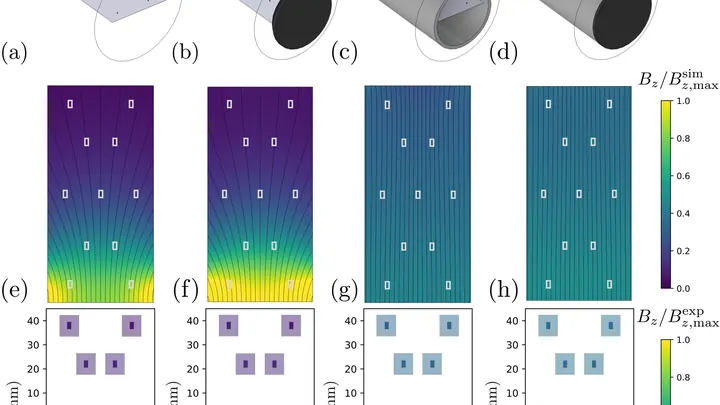
A magnetic field is like a shadow cast by an object: it changes with the shape of the source. But if you put a lens in the path of light, you can alter the shadow. Here, the authors devised a 'lens' for magnetic fields — an assembly of ordinary materials with different magnetic permeabilities (their ability to let the field through).
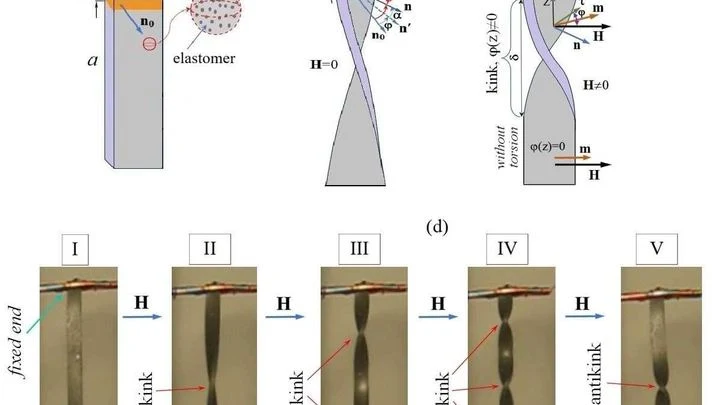
An ordinary rubber strip filled with fine iron filings doesn't just bend in a magnetic field: it ties itself into a stable knot. This effect was predicted and reproduced in experiments by physicists working with magnetoactive elastomers: a silicone base with carbonyl iron particles.
Quantum entanglement works like a leash: it ties particles together, but the length of this tether is strictly limited. In a chain of particles, heat plays the role of an impatient dog tugging at the leash — the hotter it gets, the shorter the distance over which the connection holds.
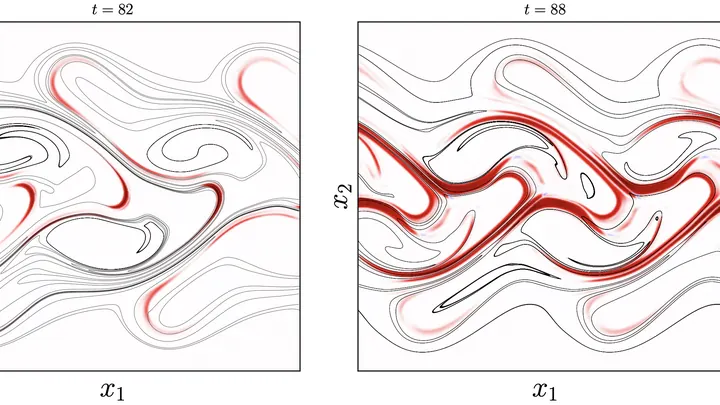
A calm river suddenly starts churning in the middle of a flat stretch: that's the puzzle the authors of a new study set out to solve. They took a thin layer of charged gas with a very weak magnetic field and tracked on a computer what would happen to it. At first, everything flows smoothly, like water from a tap.
Plasma in a fusion reactor is like a swarm of fireflies that you need to keep inside an invisible jar. It used to be thought that the jar's walls had to be perfectly smooth, or the fireflies would find a crack and escape. New work shows that the jar can be glued together from pieces with noticeable seams, and the swarm will still stay inside.
An ordinary magnet can be imagined as a row of soldiers all facing the same direction. An antiferromagnet is arranged differently: neighboring 'soldiers' face opposite directions, but the row as a whole remains ordered. Flipping such a row is difficult: it doesn't respond to weak external fields.
Metals are full of free electrons: they dart between atoms like a swarm of bees around a hive. If you poke such a metal with a thin magnetic filament, the electrons start to feel its field. A new calculation shows they don't just go around the field; they trap it inside, like a cork sealing water in a bottle.
Dark matter is invisible, but according to calculations, it holds galaxies together. Catching its particles is like hearing a whisper in a noisy room. You need a material that responds loudly and noticeably to the slightest nudge.
Molecular magnets could be such a material — substances where each molecule acts as an independent tiny magnet.
Without the invisible framework of dark matter, galaxies would fly apart. Astronomer Vera Rubin proved back in the 1970s that stars rotate as if held by an unseen mass. But new research shows it's not just passive ballast.
Gravity works like an invisible photographer. When a piece of metal falls, inside it, according to Albert Einstein and the electromagnetism of James Clerk Maxwell, an electric field is born — that's how spacetime curvature…
The Universe after the Big Bang was almost perfectly homogeneous. Almost, because tiny density perturbations stretched by inflation became the seeds of galaxies. But what if these same perturbations could give birth not only to stars but also to black holes?