In 1820, after Ørsted's experiment, André-Marie Ampère developed a theory of current interaction within a week. He deduced that the circulation of the magnetic field along any closed path equals the current passing through the loop (multiplied by the constant μ0). Analogy: the stronger the traffic flow on a ring road, the more powerful the air vortex above it, and the wind swirls along the roadside. Later, Maxwell generalized the law, adding the displacement current.
History
In 1820, Hans Christian Ørsted noticed that a current-carrying wire deflects a magnetic needle. André-Marie Ampère, inspired by this, presented a report with a quantitative law just a week later. In 1861, James Clerk Maxwell included the law in his equations and added the displacement current, correcting a contradiction with charge conservation.
How it works
The law is actively used to calculate magnetic fields in symmetric configurations: straight wire, solenoid, toroid. Limits of applicability: only for steady currents; when electric fields change over time, the displacement current must be considered. In the presence of magnetic materials, the relationship becomes more complex.
In practice
Calculation of magnetic fields in electric motors, generators, and transformers, design of MRI magnets.
Fun fact
Using Ampere's law, one can 'weigh' the current — with a current balance, the ampere is determined with high accuracy.
Light knocks electrons out of a crystal, and they fly toward the detector like arrows toward a target. From their trajectories, physicists reconstruct how electrons behaved inside the material: with what energy and in which direction they moved. But switch on a magnetic field, and the trajectories bend. The arrows start to curve, the target turns into a warped mirror, and the picture blurs.
A sculptor looks at a block of marble and sees the figure within, waiting to be freed from excess material. Instead of adding clay, he removes everything that is not part of the form. The authors of a new study on magnetic resonance took a similar approach: rather than complicating the tissue model by adding ever more details, they stripped away the superfluous to reveal the essence.
A laser beam is like a swift vortex that briefly captures a passing electron. As the particle moves through the pulse, its spin (the intrinsic rotation, like a tiny top) experiences a weak kick. After leaving the beam, the top no longer points in the same direction; it has turned a little.
Light from a distant blazar, an active galactic nucleus whose jet points our way, travels for billions of years. Along the way, it triggers cascades of charged particles that the intergalactic magnetic field deflects sideways. This creates a blurred gamma-ray glow around the blazar: a secondary halo.
Right after the Big Bang, space was a hot plasma — a mix of charged particles and light. In such a medium, electric currents couldn't flow on their own: a 'potential difference' was needed to push electrons relative to photons.
Hot water sometimes freezes before cold: this is the Mpemba effect. In the quantum realm, a similar paradox appears: the more the equilibrium is disrupted, the faster it recovers. It's like fleeing from disorder (entropy) in reverse: the system rushes toward order, and a large initial imbalance only helps.
An ordinary magnet always carries two poles — north and south. Split it in half, and each piece immediately grows its own pair. But deep in particle theory lives a strange notion: the monopole — a particle carrying just one magnetic charge, a lone pole without a partner.
In the first moments of the universe's existence, space was filled with hot plasma, where particles emerged and disappeared like bubbles in a boiling pot. The traces of these processes, stretched to gigantic sizes by expansion, are preserved in the cosmic microwave background — ancient light that has reached us across billions of years.
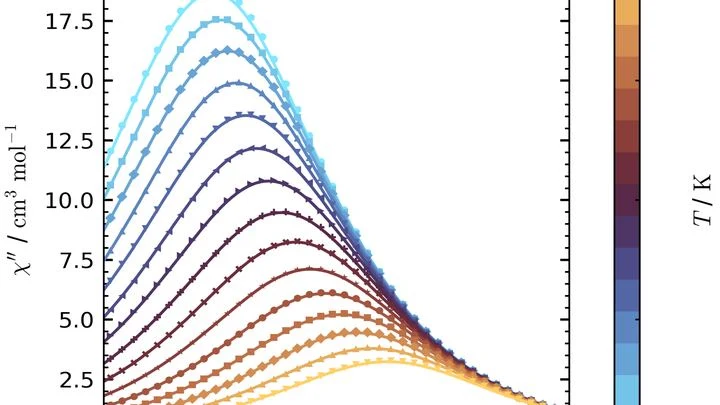
A tiny molecule made of just a few atoms can behave like a permanent magnet. It becomes magnetized and is in no hurry to demagnetize, even when the external field is removed. Such molecules are called single-molecule magnets, and they interest scientists as a possible basis for ultra-dense information storage.
Two metal plates in a perfect vacuum attract each other. Even Richard Feynman compared emptiness to a boiling foam: particle pairs are born and immediately vanish, creating the Casimir effect. If the plates are asymmetric, they also start to twist — that's a vacuum motor.
But rotation doesn't require oddly shaped parts.
The Event Horizon Telescope looks at M87* and sees more than just a ring of light around a dark void. That light is twisted, like a corkscrew. The wavefront carries a helical structure that physicists call orbital angular momentum.