Relaxationtime, in the context of magnetic resonance, refers to the characteristic time constant, T₁, for a spin system to return to its equilibrium magnetization after being disturbed, such as by a radiofrequency pulse. It is also known as the spin-lattice relaxation time, as it involves energy transfer from the spins to the surrounding lattice. T₁ is a crucial parameter in nuclear magnetic resonance (NMR) and magnetic resonance imaging (MRI), as it determines the rate at which signals recover and influences image contrast.
History
The concept of spin-lattice relaxation was developed in the 1940s by Felix Bloch and Edward Purcell, who independently discovered NMR and shared the Nobel Prize in Physics in 1952. The theoretical framework was further refined by Nicolaas Bloembergen, Edward Purcell, and Robert Pound in their seminal 1948 paper.
How it works
When spins are aligned in a magnetic field, they have a net magnetization along the field direction. A resonant radiofrequency pulse tips this magnetization into the transverse plane. After the pulse, the spins gradually realign with the external field, releasing energy to the surrounding environment (the lattice). The recovery of the longitudinal magnetization follows an exponential curve with time constant T₁. The value of T₁ depends on the molecular environment, the strength of the magnetic field, and the mobility of the spins, making it a sensitive probe of local dynamics.
In practice
T₁ relaxationtime is used in MRI to generate contrast between different tissues, such as distinguishing gray matter from white matter in the brain. It is also critical in materials science for characterizing molecular dynamics, as seen in the title 'Рекордное время жизни спиновых состояний в нанокристаллах перовскита'.
Fun fact
The T₁ relaxationtime of water protons in biological tissues can vary from milliseconds to seconds, and this variation is what allows MRI to produce detailed anatomical images without any ionizing radiation.
A sculptor looks at a block of marble and sees the figure within, waiting to be freed from excess material. Instead of adding clay, he removes everything that is not part of the form. The authors of a new study on magnetic resonance took a similar approach: rather than complicating the tissue model by adding ever more details, they stripped away the superfluous to reveal the essence.
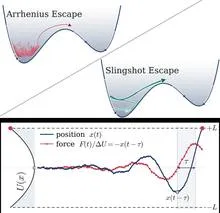
A particle sits in an energy pit like a pea in a dimple. To get out, it needs to go over the barrier, and usually this is rare: the higher the barrier, the longer the wait. The Arrhenius law says the waiting time grows exponentially, meaning doubling the barrier height increases the time by hundreds of times.
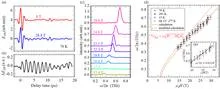
A taut string sounds higher when you pull it tighter. Magnetization in an antiferromagnet behaves similarly: the stronger the external field, the faster it oscillates. But in chromium oxide crystals, something goes awry.
In fields from 20 to 30 tesla, the resonance frequency grows more slowly than it should.
An interpreter in a crowded room tries to make out one person's speech but hears the murmur of hundreds of voices. A molecule storing quantum information in its spin finds itself in a similar situation: its spin is surrounded by the thermal jitter of atoms, and it is this jitter that gradually erases memory.
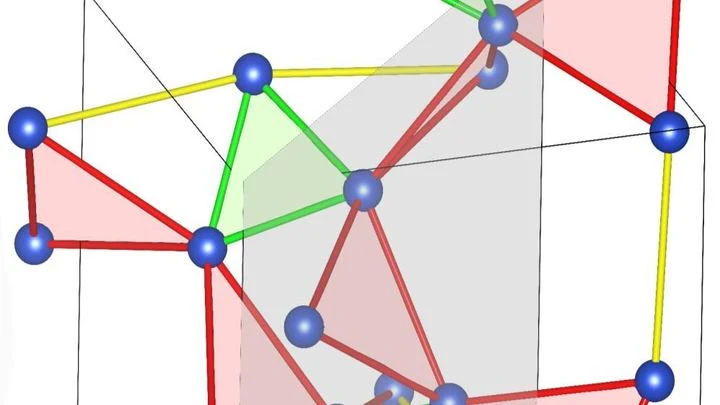
The PbCuTe₂O₆ crystal resembles a three-dimensional web of copper, tellurium, and oxygen. Inside, the magnetic moments, tiny arrows tied to electron spins, are so entangled that they can't settle into an orderly arrangement even near absolute zero.
A car with a single suspension setting for all wheels — smooth on asphalt, but bumpy on dirt roads. That's roughly how modern computer models of fluids and gases work: all disturbances, from large whirlpools to fine ripples, are calmed with one common "brake." Stochastic modeling of flows has long been seeking a more refined tool.
A runner trails the leader but crosses the finish line first. In the quantum world, such a trick was pulled off by a system of nuclear spins — tiny magnetic arrows of carbon-13 atoms in a diamond. This is a manifestation of the Mpemba effect: a state initially farther from equilibrium settles down faster than one closer to rest.
In the brain's white matter, the signal travels along axons — long neuronal processes wrapped in an insulating myelin sheath. Water fills the space inside axons and outside, in the narrow gaps between fibers.
Immediately after the Big Bang, in the seething cauldron of the cooling Universe, much like in unevenly hardening glass, stresses appeared — hairline cracks in reality, cosmic strings. Picture a tightrope walker balancing on an invisible cable stretched across the abyss of warped spacetime.
Electric current in a wire is like a crowd of people hurrying down a corridor. Usually, each person bumps into walls and loses speed almost instantly: that's electrical resistance.
Two swift streams of charged particles collide, and magnetic field lines begin to tear and reconnect. This process powers solar flares and auroras. It was usually assumed that all particles behave alike, like bullets from the same gun. But each particle has a tiny top: its intrinsic rotation, or spin.
To peek inside a muscle, it is illuminated with radio waves in a strong magnetic field: that's how MRI works. Water in cells and water in blood respond differently, but a standard scanner doesn't tell them apart: it produces an averaged image where the signal from capillaries is superimposed on the signal from muscle fibers.
Tiny magnets inside atoms, nuclear spins, can 'freeze' for long minutes in a cold crystal. This hinders the quick tuning of quantum sensors: everything takes too long to reach the desired state. Physicists have found a way to nudge them with light.
About 380,000 years after the Big Bang, the universe cooled enough for electrons and protons to finally combine into neutral hydrogen. Although this event is called recombination, it was actually their first meeting — the heat had kept them from sticking together until then.
A tiny molecule made of just a few atoms can behave like a permanent magnet. It becomes magnetized and is in no hurry to demagnetize, even when the external field is removed. Such molecules are called single-molecule magnets, and they interest scientists as a possible basis for ultra-dense information storage.
A tiny diamond hangs in the air, held by an electric field like a speck of dust in a beam of light. Hidden inside are defects — places where a carbon atom is replaced by nitrogen, with a vacancy nearby. These defects behave like little magnets that can be flipped with laser and microwaves.
An electron is like a tiny spinning top — it's constantly rotating. This property is called spin, and it's crucial for quantum technologies. But under normal conditions, the environment quickly disrupts the rotation, like a top stumbling on gritty sand.
Heat a crystal, and its atoms start to tremble more vigorously, like strings tightened or loosened. In a LaCoO3 crystal (a compound of lanthanum, cobalt, and oxygen), heating from 2 to 650 K triggers two major rearrangements: around 100 K, the magnetic state of cobalt ions changes, and around 550 K, the material transforms from an insulator into a…
A pinch of diamond dust dropped into a glass of liquid acts like hundreds of tiny magnetic compasses. When molecules with unpaired electrons, known as paramagnetic, appear nearby, the needles of these compasses start to quiver. From that quiver, you can tell what the molecule is and how much of it is there.
A quantum computer is like an orchestra where every musician must play with precision down to a billionth of a second. If one instrument goes out of tune, the whole symphony collapses. So scientists spent a year watching 27 qubits — the simplest cells of quantum memory.
A crowd of people in a subway station moves slower than individuals: everyone gets in everyone else's way. A similar picture emerges in a dense cloud of magnetic atoms exchanging energy. Previously, it was thought that the transfer rate depended only on the atoms' own properties.
The neutron star 1E 161348-5055 in the supernova remnant RCW 103 pulses with a period of 6.67 hours. That's very slow for such a compact object, and astronomers long puzzled over what was going on.
A magnetic compass in a test tube sounds like a magic trick, but it's pure physics. In a solution of fumarate (a salt of malic acid), carbon-13 nuclei behave like tiny spinning tops.
In a silicon crystal, the stuff of microchips, there sometimes sits a foreign atom, like magnesium. It behaves like a tiny magnet with several 'pointer positions.' If you illuminate such a crystal with a short flash of light, the atom momentarily gets excited, then returns to its ground state.