The Noise That Gives Away the Charge express
Current flowing through a wire is never perfectly smooth. If you listen closely enough, you hear a rustle — shot noise. It arises because charge is not carried as a continuous stream but in discrete portions, like raindrops on a roof. From the character of this noise, you can tell how much charge each 'drop' carries.
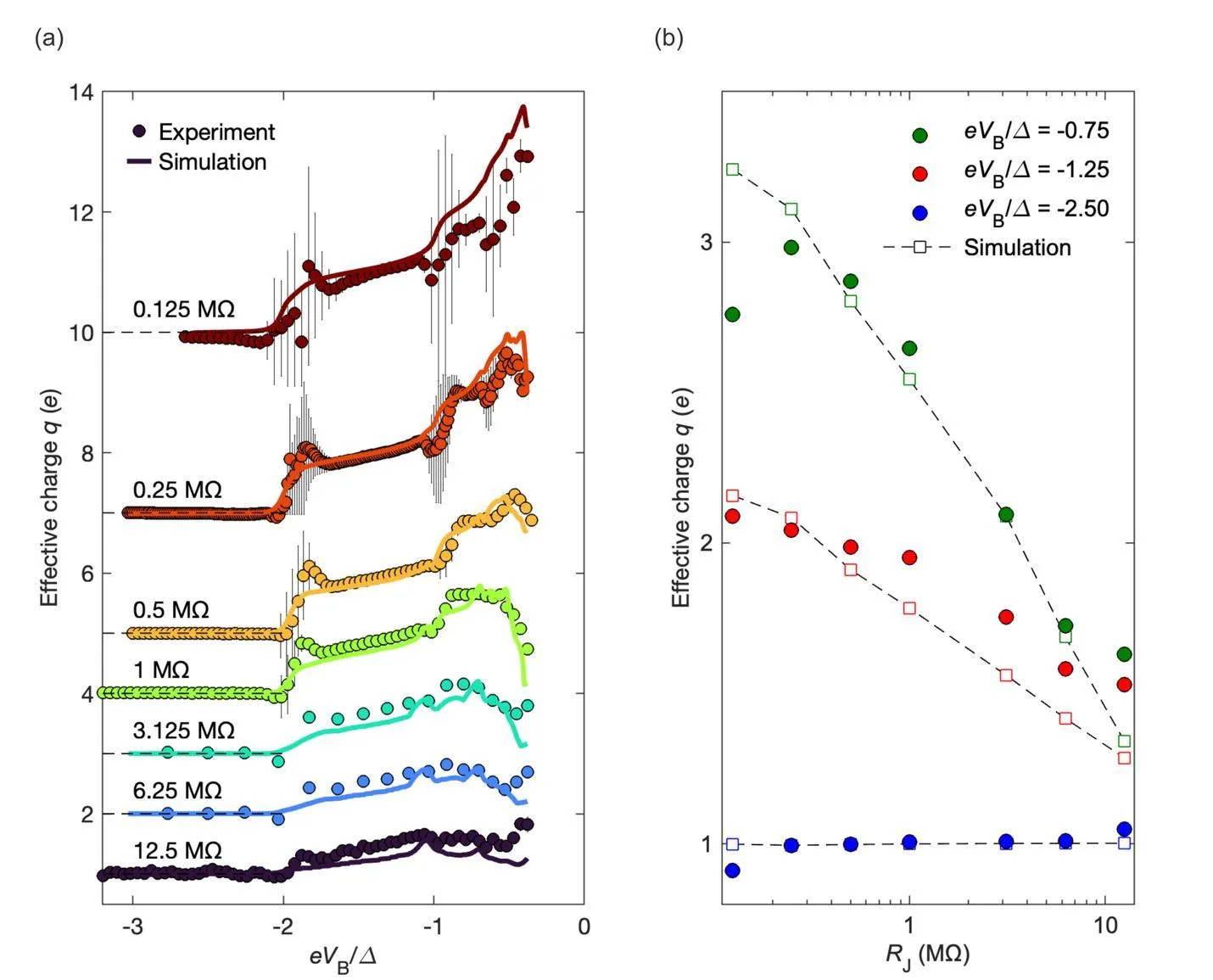
Physicists measured such noise in a superconducting contact — a thin bridge between a superconductor and a metal tip. At a temperature of 2.2 kelvin (about minus 271 degrees Celsius), they varied the contact's transparency — how easily electrons pass through it. When the contact was nearly closed, electrons slipped through one by one, and the noise corresponded to the charge of a single electron. But when the contact was opened wider, Andreev reflections came into play — processes in which an electron entering the superconductor turns into a pair: one electron goes deeper, while a 'hole' (an empty spot with positive charge) returns. Such processes allow charge to be transferred in portions that are multiples of the electron charge — for example, two charges at once in a single event.
To see this change in regime, a new amplifier was needed, capable of capturing extremely small noise at very low currents. The experiment was conducted on a lead surface Pb(111) using a scanning tunneling microscope, which allowed precise adjustment of the distance between the tip and the sample, and hence the contact's transparency. The measurements showed that as transparency increased, the noise changed from 'single-electron' to 'multi-charge', fully matching theoretical calculations for a single-channel system.
This approach turns noise into a precise tool. Now, by varying the contact's transparency at the atomic scale, one can study exactly how charge is transferred through microscopic structures. This is important for future quantum devices, where every electron counts.
Original abstract
as written by the authors arXiv:2603.22145
Charge transport in superconducting junctions at finite voltages is governed by Andreev reflections, including multiple Andreev reflections, which are processes that enable multiple charge transfer, a hallmark that shot noise can directly quantify. Since the effective charge extracted from shot noise measurements varies with the transparency of the junction, systematic control of transparency is essential but experimentally challenging. Here, we present shot noise scanning tunneling microscopy measurements enabled by a newly developed amplifier, allowing access to different transparency regimes. We perform shot noise measurements on Pb(111) with tunable transparency at 2.2 K and observe that the shot noise evolves from a single electron tunneling regime to multiple charge transfer regime as transparency increases. Our results are quantitatively consistent with theoretical simulations of Andreev reflections and multiple Andreev reflections for a single-channel system. These results establish junction transparency as the key parameter governing the evolution of charge transport and demonstrate that noise-STM is a powerful platform for investigating microscopic charge transport mechanisms with controlled junction transparency at the atomic scale.
Shot noise was first described in 1918 while studying shot in vacuum tubes — hence the name: 'shot' from the English word for a projectile or buckshot.