Signal averaging is a technique used to extract a weak, repetitive signal from a noisy background by summing multiple measurements of the same event. The underlying principle is that random noise tends to cancel out when averaged, while the signal, which is consistent across measurements, adds coherently. This method is fundamental in many areas of science and engineering, from detecting gravitational waves to improving the resolution of medical imaging.
History
Signal averaging has been used since the early days of electronics, but it became a standard technique in the mid-20th century with the development of computers that could sum thousands of traces. It was crucial in early radio astronomy and in the discovery of pulsars in 1967.
How it works
The signal-to-noise ratio (SNR) of a single measurement is often poor. By taking N repeated measurements of the same signal and summing them, the signal amplitude grows linearly with N, while the noise, being random, grows only as the square root of N. Thus, the SNR improves as the square root of N. This works only if the signal is time-locked to a trigger and the noise is random and uncorrelated with the signal. In practice, the measurements are aligned in time, summed, and then divided by N to get the average.
In practice
Signal averaging is used in electrocardiography (ECG) to detect tiny cardiac signals, in magnetic resonance imaging (MRI) to improve image quality, and in gravitational wave detectors like LIGO to extract the faint signals from black hole mergers.
Fun fact
The first pulsar was discovered because Jocelyn Bell Burnell noticed a signal that appeared every 1.337 seconds, which was only visible after averaging many minutes of data, and it was initially nicknamed 'LGM-1' (Little Green Men) because it was so regular that it was thought to be artificial.
Imagine a simultaneous interpreter in a room where two people are speaking: they must keep up with both meaning and intonation, but if the speech is too fast, only a paraphrase remains. That's roughly how scientists feel as the stream of gravitational waves from black hole and neutron star mergers grows, while precise signal calculations lag behind.
Imagine a lottery where instead of money, you win black holes. Each ticket is a random spot on the sky, and the prize is a gravitational wave from the merger of two giants. The chance of hitting the jackpot is minuscule, but if you do, the wave is heard across the entire universe.
The cosmic dawn is hidden behind a dense veil of time. To see beyond it, you need to catch the radio signal from clouds of neutral hydrogen — the so-called global 21 cm signal. But it is so faint that the receiver's own noise drowns it out.
You're listening to the faint whisper of stars, and nearby someone keeps moving a chair. In gravitational wave telescopes, that role is played by scattered light: it reflects off trembling surfaces and creates false signals.
Conventional antennas for precise direction finding must work coherently: they capture not just volume, but also the wave's phase at a given moment. The slightest tuning mismatch, and the direction is lost. The new method relies solely on signal strength. It's like finding your way in fog, seeing only the brightness of lights, not their color.
Wireless devices flood the airwaves with signals that blend into chaos — as if everyone in a room started talking at once. Scientists have proposed a solution: smart panels, reminiscent of acoustic tiles. Each cell can either reflect a radio wave on command, like a wall echo, or absorb it, as soundproofing dampens noise.
The gamma sky, captured by the Fermi telescope, is a grand symphony of thousands of sources. Here, the rhythmic pulsations of pulsars, the powerful chords of active galactic nuclei, but most of all — unidentified objects, whose part remains a mystery.
Ever since Einstein predicted gravitational lensing, and gravitational waves were first heard by LIGO detectors, physicists have dreamed of catching the lensed echo — a repeating signal from one merger, multiplied by the gravity of a massive body.
The Universe is not silent: it is filled with a continuous gravitational-wave hum. In a decade, the LISA space observatory will tune its "ears" to the millihertz range, and the richest source will be our Galaxy — tens of thousands of white dwarf pairs whirling in a frantic dance.
Trying to count people in a dark room by the sound of their breathing hits a wall of background noise — individual breaths are inaudible. Scientists working with quantum spins in solids face a similar challenge. Each spin (the electron's magnetic moment) has its own "voice," but it is drowned out by the technical noise of the instruments.
A quantum computer measures a molecule's energy much like an old tape measure that only has markings every meter. If the actual length of a table is 2.37 meters, the tape shows “two and a bit,” and you can't do better. Physicists call this resolution: the step of the grid, finer than which you cannot go.
The authors of the new work turn this flaw into an advantage.
A rock concert blares at full volume, and you're trying to catch your friend's whisper. That's roughly how radio detectors feel when they pick up signals from cosmic dust particles. A particle slams into the atmosphere and spawns an air shower, a cascade of millions of secondary particles, and this shower emits a short radio pulse.
A tuning fork sounds incredibly pure, but touch it and the pitch changes almost instantly. Engineers faced a similar challenge: creating a laser that simultaneously possesses two seemingly incompatible properties — exceptional spectral purity (a very narrow emission line, like a tuning fork producing a single note without wobble) and the ability to rapidly tune that frequency.
Magnetic sensors smaller than a match head can already detect weak fields — from a beating heart or a distant planet. But making them even more sensitive involves a trade-off: improve one part, and you lose performance in another.
A person hears a ringing that isn't there. The doctor asks them to describe it — loudness, pitch, persistence. But it's subjective: one might say "like a mosquito," another "like steam from a kettle." We need a way to see tinnitus directly, in the brain itself.
In the headphones used to listen to a distant orchestra, there is an occasional crackle. The crackle can be so loud that it drowns out the music or even blends in with it.
The Taiji detector, planned for launch into space, will pick up the trembling of space caused by collisions of enormous black holes. But its data is frequently marred by random bursts, like static crackling in a radio receiver.
If you photograph the same mountain with a film camera and a modern smartphone, you get different images: colors are brighter in one, details are blurrier in the other. The same goes for telescopes: each instrument sees the sky in its own way, adding its own distortions to the true light of galaxies, like a filter through which we look.
A laser that usually produces a steady beam starts to tremble near its threshold, like a string about to sound. This trembling is not a defect but quantum noise: atoms inside the laser emit light randomly, without any external cause.
A detector that hunts for rare particles is like an ear trying to catch a whisper in a noisy room. The quieter the signal, the harder it is to tell apart from random noise. In the NUCLEUS experiment, such detectors, cryogenic calorimeters, are cooled to near absolute zero so they can pick up even a faint pulse of heat from a single particle.
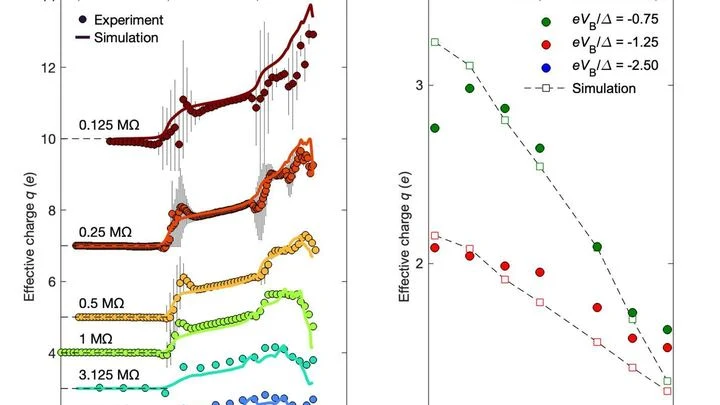
Current flowing through a wire is never perfectly smooth. If you listen closely enough, you hear a rustle — shot noise. It arises because charge is not carried as a continuous stream but in discrete portions, like raindrops on a roof. From the character of this noise, you can tell how much charge each 'drop' carries.
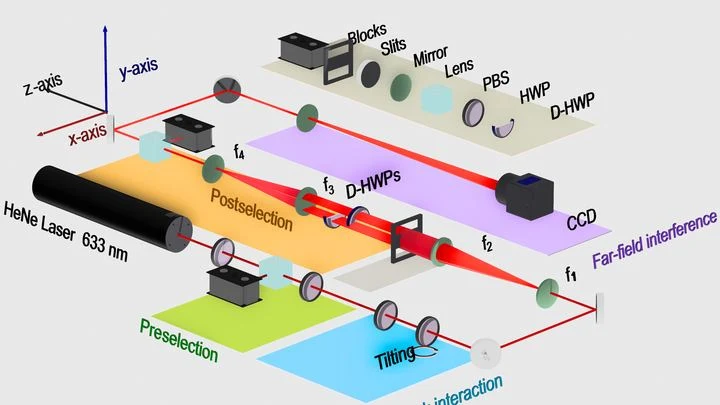
Light passing through narrow slits can reveal delays invisible to the eye. In a new experiment, physicists sent a laser beam through two slits simultaneously and measured how much one part of the wave lagged behind the other. The delay was a few attoseconds: that's one billionth of one billionth of a second.
When two black holes merge, the newborn hole rings like a bell, emitting gravitational waves. In the past, only the fundamental tone of this ringing was captured. But analysis of the GW250114 merger showed that the signal hides extra faint vibrations — nonlinear overtones.
Measuring the universe’s expansion is like timing a race when the track stretches. Neutron star mergers act as standard sirens: their gravitational waves ring out with a known “volume,” so fainter signals mean greater distance.
Detecting a faint signal against a noise background is like trying to hear a distant bell in a storm. Ordinary amplification only makes the din more deafening. Quantum error correction solves the problem in an unexpected way.
Sound waves on a chip usually spread in all directions, like whispers echoing around a dome. In a gyroscope, this creates noise that obscures rotation. But a new design forces sound into a one-way flow. By tapping the sound path at several points with precise timing, backward-traveling waves cancel out, while forward waves reinforce.
Imagine an interpreter who gets distracted by every rustle in the hall. The more rustles, the more errors in the translation, even though the meaning of the speech hasn't changed. The same happens with data: if measurements are unevenly spaced, standard analytical tools start "hearing" changes that never occurred in the underlying process.
An old aviation instrument sometimes sticks: the needle catches on the scale and doesn't move, even though the plane is already changing altitude. Engineers found a simple solution: add a slight vibration. The shaking doesn't hinder; on the contrary, it helps the needle break free and show the truth.