Shot noise is the random fluctuation in an electrical current that arises because charge is carried by discrete particles—electrons—rather than flowing as a continuous fluid. When electrons cross a barrier or junction, they arrive at random times, like raindrops hitting a roof. Even if the average current is perfectly steady, the instantaneous rate of arrival fluctuates, producing a small, broadband electrical noise that is fundamentally irreducible.
History
The phenomenon was first described by Walter Schottky in 1918, who called it the 'Schrot effect' (from the German word for small shot or pellets), while studying vacuum tubes.
How it works
The effect is most pronounced when electrons must overcome an energy barrier one by one, as in a vacuum tube diode or a semiconductor p-n junction. Each electron crossing the barrier contributes a discrete pulse of charge. The arrival times follow a Poisson process, so the variance of the current is proportional to the average current. This is distinct from thermal (Johnson) noise, which depends on temperature and resistance, and from flicker noise, which has a different frequency spectrum.
In practice
Shot noise sets a fundamental limit on the sensitivity of optical detectors and electronic amplifiers, but it is also exploited in quantum cryptography to generate truly random numbers.
Fun fact
In a typical electrical current of one ampere, about 6.24 × 10^18 electrons pass per second, yet the random timing of their arrival still produces a measurable noise signal.
Imagine a lottery where instead of money, you win black holes. Each ticket is a random spot on the sky, and the prize is a gravitational wave from the merger of two giants. The chance of hitting the jackpot is minuscule, but if you do, the wave is heard across the entire universe.
A pebble the size of a grape enters the atmosphere almost tangentially and skims across the sky without falling. That's exactly what happened to a meteoroid weighing about 45 grams. It came in at such a shallow angle that it traveled 164 kilometers at an altitude of 92 kilometers — where the air is a million times thinner than at the surface.
A dust grain hangs in the air, held by an invisible beam of light. Around it is ordinary air, but sometimes a tiny spark jumps across the grain. For the first time, scientists have observed such discharges up close and found that they are triggered not by the grain itself, but by invisible visitors from space and from the ground.
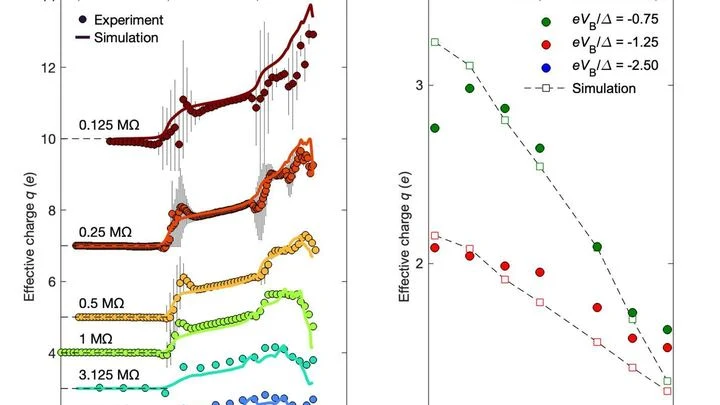
Current flowing through a wire is never perfectly smooth. If you listen closely enough, you hear a rustle — shot noise. It arises because charge is not carried as a continuous stream but in discrete portions, like raindrops on a roof. From the character of this noise, you can tell how much charge each 'drop' carries.
A dark matter detector is like a super-sensitive microphone listening for silence. It picks up tiny heat jolts, phonons, that occur when a particle grazes a crystal. But instead of silence, the instruments have been hearing noise for years: a slew of weak signals below a few hundred electronvolts.
In quantum communication, a secret key is transmitted using single photons. Eavesdropping on such a channel is supposedly impossible: any interception attempt disturbs the particle and leaves a trace. But the idea has a weak spot — the real hardware, which sometimes behaves differently than theory dictates.
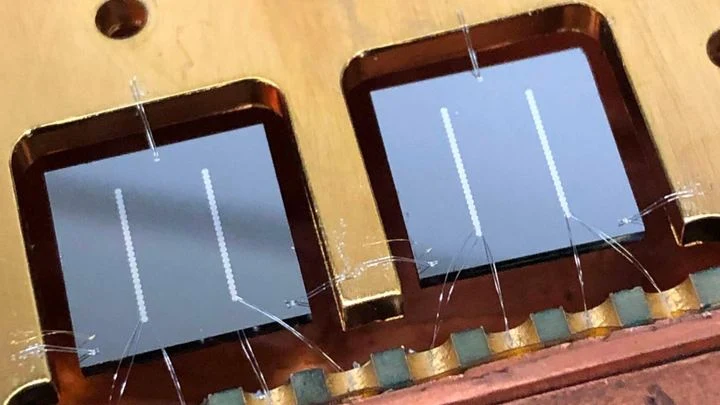
Run a current through a contact between a superconductor and a ferromagnet, and you will hear the whisper of the quantum world. In the lab at 0.3 K, that whisper turned into a roar: the shot noise—electrical noise due to the discreteness of charge—was a hundred times louder than theory allows for ordinary contacts.