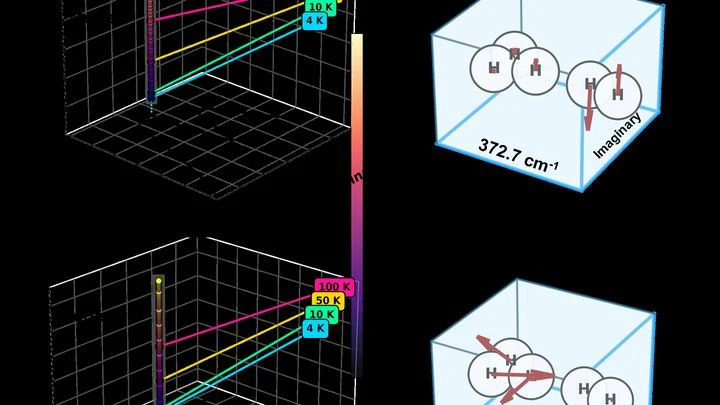
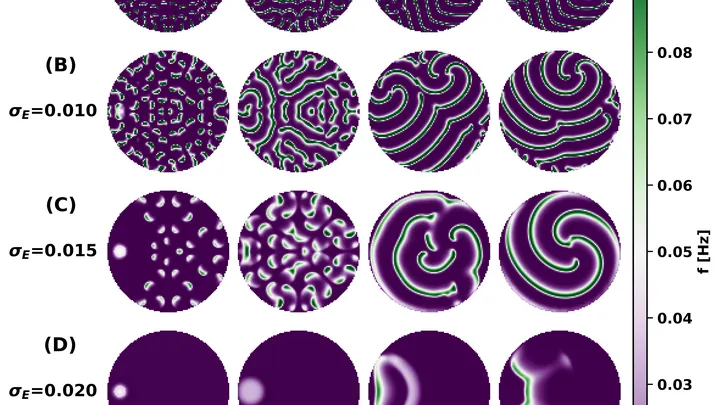
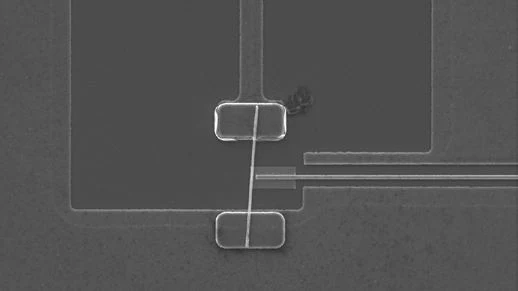
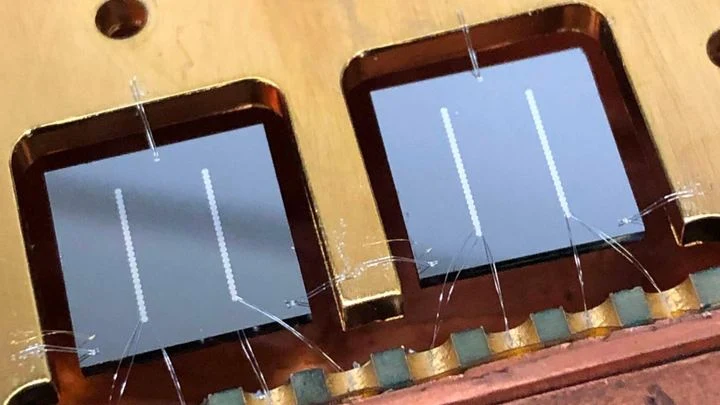
Ion channel noise is the stochastic fluctuation in ion currents, observed in quantum computing systems and nanopore transistors due to environmental or material factors.
Ion channel noise is the stochastic fluctuations of transmembrane current arising from the discrete nature of conductance and the random switching of individual ion channels between open and closed states. The noise amplitude is inversely proportional to the square root of the number of channels, so in small cells or thin neuronal processes it can reach a significant magnitude, comparable to the signal. The spectral density of the noise follows a Lorentzian with a characteristic frequency determined by the channel kinetics.
History
The first indications of the discrete nature of membrane currents appeared in the classic work of Hodgkin and Huxley (1952), but direct measurements of single-channel noise became possible thanks to the patch clamp technique developed by Erwin Neher and Bert Sakmann (1976, Nobel Prize 1991). By analyzing current fluctuations in a microscopic membrane patch, they showed that channels switch randomly, obeying first-order kinetics. The theory of ion channel noise was formalized in the work of Dennis Baylor, Trevor Lamb, and King-Wai Yau (1979) using photoreceptors as an example, where noise imposes fundamental limits on vision.
How it works
Each ion channel can be represented as a two-level system with an energy barrier between states. Transitions occur due to thermal fluctuations obeying the Boltzmann distribution: the probability of overcoming a barrier of height ΔG is proportional to exp(-ΔG/kT). Consequently, at physiological temperatures (~310 K), channels flicker chaotically. The current through the membrane I(t) = Σ_k γ_k (V - E_k) s_k(t), where s_k(t) is an indicator function equal to 1 if the k-th channel is open and 0 if closed. Current fluctuations are determined by the correlation function <I(t)I(t+τ)> and in the frequency domain by the power spectral density. For an ensemble of identical independent channels with a single open state, the current noise has binomial statistics, and the current variance σ_I² = N i² p(1-p), where N is the number of channels, i is the current through one channel, p is the open state probability. This is classical shot noise. In real channels, kinetics is more complex: the presence of multiple closed and inactivated states leads to multi-exponential correlations and colored noise. In small neurons, where channel numbers are on the order of hundreds, noise is comparable to the signal amplitude, causing spontaneous action potentials and contributing significantly to stochastic resonance — a phenomenon in which a weak signal is amplified by an optimal level of noise. Laws and principles: Boltzmann distribution (probability of thermal transitions), Nernst equation (driving force), Ohm's law (current-voltage relationship for an open channel).
In practice
Understanding noise helps develop accurate neural network models and explains why the neural code sometimes errs. In nanoelectronics, similar phenomena limit the miniaturization of sensors.
Fun fact
In retinal photoreceptors, the visual noise from random channel activations sets a fundamental sensitivity limit: we are able to capture just a few photons only because the channel noise is small.
Two mica plates, smooth as mirrors, slowly approach each other in a calcium solution. At a distance of fifty nanometers, an invisible barrier suddenly appears between them: as if someone had stretched a web of molecules between the walls. This web prevents the plates from touching, even though by all calculations they should glide freely toward each other.
Imagine a large orchestra without a conductor. Each musician hears everyone else and adjusts to the collective hum. If every instrument amplifies its neighbors, the sound builds to a screech; if some occasionally dampen it, the orchestra may fall into silence or break into cacophony.
In 1996, physicists asked: how much noise can a quantum channel withstand before it stops transmitting information? A phone call where every third word is replaced by random noise is still understandable. Up to what level of interference can the listener still grasp the meaning?
A laser beam passes through a glass cell filled with cesium vapor. The atoms in the vapor dart around chaotically, like a crowd at a train station: each one enters the beam, spends a moment there, and flies back out. Their internal state, something like the orientation of a tiny magnet, changes under the influence of light. If all atoms were identical and stationary, the signal would be steady.
A laser beam passes through a glass cell filled with cesium vapor. The atoms in the vapor dart around chaotically, like a crowd at a train station: each one enters the beam, spends a moment there, and flies back out. Their internal state, something like the orientation of a tiny magnet, changes under the influence of light. If all atoms were identical and stationary, the signal would be steady.
A tiny defect in a diamond crystal is like a sensitive microphone picking up the faintest magnetic fields. That's how sensors based on nitrogen-vacancy centers work (where a nitrogen atom and a neighboring vacancy form a quantum system). To hear the whispers of individual molecules, the sensor is placed right at the surface.
Ion current through a membrane is like a queue at a turnstile. Sometimes the turnstile is free — ions pass through quickly. Sometimes it gets stuck — the flow drops. A weak magnetic field, it turns out, doesn't push ions from behind; it simply changes the number of open turnstiles.
Plasma is not just hot gas; it's an entire orchestra of charged particles, each group playing its own part. Heavy ions (atoms that have lost electrons) set the slow rhythm, while light electrons dart around ten thousand times faster.
In 1915, Albert Einstein and Wander Johannes de Haas demonstrated that when an iron rod is magnetized, it twists slightly — the angular momentum of electrons is transferred to the crystal lattice.
A new system analyzes a short interview to recognize human doubt by combining text, voice, and facial expressions. But the main key to uncertainty turned out to be the dark matter of speech — pauses and filler words that standard speech systems erase like a black hole.
A laser is like a tuning fork that rings at a single note. But even in complete silence, its sound trembles slightly. Previously, it was thought that this tremor, random kicks from spontaneous emission of light by atoms inside the laser, was the main limit to precision.
The Orion Nebula is a showcase of astrophysics, a laboratory for studying star formation right in our backyard. For over a century, its light has been split into spectra, and each forbidden line whispers its own version of how many electrons per cubic centimeter.
A quantum computer is like an orchestra where each ion is a musician and laser pulses are the conductor's baton. But if someone in the audience rustles, the delicate melody of quantum states goes off key.
You're looking for a quiet room for an important conversation. You step into a space, and hear silence. But upon closer inspection, you find that in one corner the ventilation is simply broken, and in another there's a hole in the floor that absorbs sound.
A quantum simulator based on ion traps is like an orchestra where each ion is a musician and the phonon bus (the collective vibrations) is the conductor relaying signals. As long as everyone plays the same tune, everything goes smoothly.
Three guitar strings on the same instrument, but each tuning peg turns with a different resistance: one gives way immediately, another is stiff, and the third is completely stuck.
Gravitational waves are the trembling of spacetime itself. Usually we only catch their overall hum, but each wave also has a direction of oscillation – polarization. Old maps were built only from signal loudness, which led to errors. It's like trying to see the bottom of a pond through sun glare.
A person hears a ringing that isn't there. The doctor asks them to describe it — loudness, pitch, persistence. But it's subjective: one might say "like a mosquito," another "like steam from a kettle." We need a way to see tinnitus directly, in the brain itself.
A chemical reaction resembles passing through a turnstile: a crowd creates chaos and gets stuck, while an orderly line moves. In the quantum world, however, when the jostling subsides, the barrier can become ghostly — a particle passes through it as if the turnstile has vanished.
A neuron that has just calmed down is like a pianist lifting their hands from the keys. But inside, silent work continues: tiny pumps push chloride ions outward, returning the instrument to a state of readiness. If the pumps fall behind, chloride builds up, and then an inhibitory signal meant to quiet the cell suddenly starts exciting it.
Two identical cars roll off the same assembly line. Body, wheels, steering — everything matches. Only one has a regular gasoline engine, while the other has a hybrid engine that can be tuned to the road. And the hybrid stalls after a couple of kilometers, while the gasoline one runs for tens.
Electric current in a superconductor is like a crowd running down a frictionless corridor. But in type-II superconductors there are obstacles, tiny vortices of magnetic field, that the current shoves out of place. Once a vortex moves, resistance appears and the current drops.
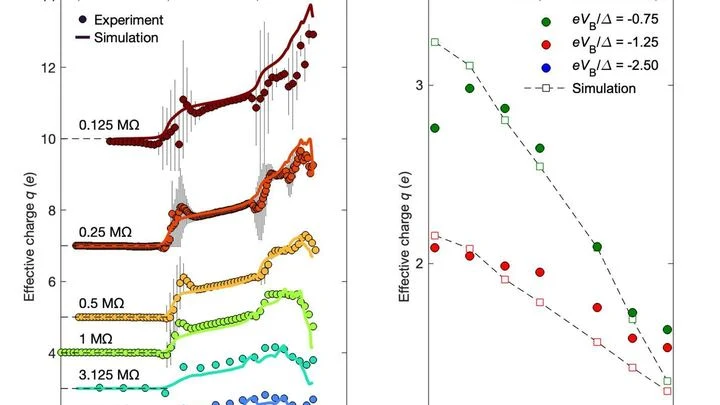
Current flowing through a wire is never perfectly smooth. If you listen closely enough, you hear a rustle — shot noise. It arises because charge is not carried as a continuous stream but in discrete portions, like raindrops on a roof. From the character of this noise, you can tell how much charge each 'drop' carries.
The cell membrane isn't just a wall; it's a turnstile gate. Embedded within it are protein channels that let ions in and out, creating an electric charge, like a battery that powers nerves and muscles.
A dark matter detector is like a super-sensitive microphone listening for silence. It picks up tiny heat jolts, phonons, that occur when a particle grazes a crystal. But instead of silence, the instruments have been hearing noise for years: a slew of weak signals below a few hundred electronvolts.
A tiny glass sphere floats in a laser beam like a speck of dust in sunlight. Inside it is radioactive lead, which decays from time to time. Each decay ejects charged particles, and the sphere loses or gains a tiny electric charge.
A membrane for water electrolysis is like a sponge soaked with water. Inside it, hydroxide ions, particles that carry electric charge, must move freely. But exactly how they move has long been a mystery: tracking each ion in an experiment is too difficult.
A cell is a city with gates. Each gate is a protein channel in the membrane: through it, ions, sugars, and signaling molecules pass in and out. Some gates are almost always open, while others open and close randomly, like subway doors that let a passenger through one moment and slam shut in their face the next.
Inside a piece of diamond hides a tiny defect — a nitrogen atom next to a vacancy. This defect catches magnetic fields like an antenna catches radio waves and responds with flashes of light. Such sensors already measure temperature inside living cells and find defects in microchips.
A quantum computer is like an orchestra, where each qubit is a musician playing their part. But every now and then, a cosmic ray bursts into the hall, and the violinist flinches, losing the rhythm. These particles from deep space pierce the chip, knock out extra electrons, and spoil the delicate quantum music.
A barium ion trapped in a cage behaves like a tuning fork: its internal vibrations set the pace for the most accurate clocks. But even this tuning fork shivers from heat — infrared radiation from the walls slightly shifts its frequency. To keep clocks from lying, this shift must be known down to the last detail.
A semiconductor film one atom thick is like a tightly stretched membrane. Light makes it flash: luminous points (excitons) are born, which quickly fade. Where the membrane is torn or crumpled, the glow flickers and stutters, like a string with a knot sounding off-key.
An ion channel in a cell membrane is a gate just a few atoms wide. Every second, millions of charged particles, sodium and potassium ions, pass through it. Classical physics said that to get through, an ion must jump over an energy barrier, like a traveler crossing a high mountain pass.
A quantum computer in the lab resembles an orchestra: lasers play the role of bows, and ions are the strings. To play the desired melody, powerful radio signals are sent to the lasers: they set the rhythm and pitch. But part of this "music" escapes the stage.
Ahead of the bow shock that Earth creates in the solar wind, giant bubbles of rarefied gas sometimes appear. Inside them, particle density drops by factors, and electric fields start to tremble like a plucked string.
A quantum computer is like an orchestra where every musician must come in exactly on the beat. The faintest rustle in the hall throws off the violinist, and the melody falls apart. In silicon chips, that rustle is electrical noise: random fluctuations of charge inside the material. They make quantum bits err.
A dark matter detector is like a room where you're trying to hear a whisper while static electricity crackles nearby. This crackle is produced by radon atoms — a radioactive gas that seeps out from materials and air.
A quantum computer is like an orchestra where each musician, a qubit, must play its note without missing a beat. But every now and then, a passerby, a particle of radiation from space, bursts into the hall and throws the musicians off rhythm. Such glitches are called error bursts, and they disrupt computations.