Quantum noise transport refers to the phenomenon where random fluctuations — noise — in a quantum system can actually drive the directed motion of particles or energy, rather than simply disrupting it. In classical physics, noise is usually an obstacle: it jostles particles randomly, washing out any orderly flow. But in quantum systems, especially at small scales, noise can interact with quantum coherence in ways that produce net transport. This is particularly relevant in biological ion channels, where ions pass through narrow membrane pores with remarkable selectivity and speed, and in nanoscale electronic devices where quantum effects dominate.
History
The concept of noise-assisted transport gained prominence in the early 2000s, particularly through studies of photosynthetic complexes, where researchers found that environmental noise actually helps energy transfer. The application to ion channels is more recent, building on decades of biophysics research into how these proteins achieve their remarkable efficiency.
How it works
The mechanism often involves a process called 'stochastic resonance' or 'noise-assisted transport.' In a quantum system, particles exist in superposition states, and noise can cause transitions between energy levels. When the noise is tuned to match the energy spacing of the system, it can actually enhance the probability of a particle moving from one site to another, much like a swing that gets pushed at just the right moment. In ion channels, thermal fluctuations in the surrounding membrane can couple to the ion's quantum states, helping it overcome energy barriers that would otherwise block its passage. The key is that the noise is not purely random — it has a spectral character that resonates with the system's own quantum dynamics.
In practice
Understanding quantum noise transport is crucial for designing nanoscale electronic devices, quantum sensors, and for explaining the remarkable efficiency of biological ion channels, which could inspire new types of selective membranes for water purification or drug delivery.
Fun fact
In some quantum systems, adding just the right amount of noise can actually speed up transport, a phenomenon that has been experimentally observed in photosynthetic proteins.
A laser beam passes through a glass cell filled with cesium vapor. The atoms in the vapor dart around chaotically, like a crowd at a train station: each one enters the beam, spends a moment there, and flies back out. Their internal state, something like the orientation of a tiny magnet, changes under the influence of light. If all atoms were identical and stationary, the signal would be steady.
Waves on the water's surface usually break against any obstacle — a rock, a piling, an island. But what if you arrange obstacles so cleverly that the wave barely notices them? In a new study, scientists assembled a pattern of many points on the water, arranged according to special mathematical rules, and sent waves through them.
In a ring accelerator, a beam of electrons circles millions of times. If the electrons are twisted like strands in a rope, their vortex motion should persist. But along the way, random jolts from imperfect magnets can disturb them.
Scientists have described how vortex motion changes under such perturbations.
At the heart of a dying star, as its core collapses into a neutron sphere, an invisible storm is born. Trillions of neutrinos, particles that barely interact with matter, race through the scorching plasma. There are so many of them that they begin to influence each other, changing their 'flavors' (electron, muon, tau) like chameleons.
A chemical reaction resembles passing through a turnstile: a crowd creates chaos and gets stuck, while an orderly line moves. In the quantum world, however, when the jostling subsides, the barrier can become ghostly — a particle passes through it as if the turnstile has vanished.
Physicists found out: to open a wormhole, you have to shake it hard. Not literally — but on a quantum chip, they simulated a system of 8 particles, so chaotic and entangled that it turned into a vibrating hologram of a black hole.
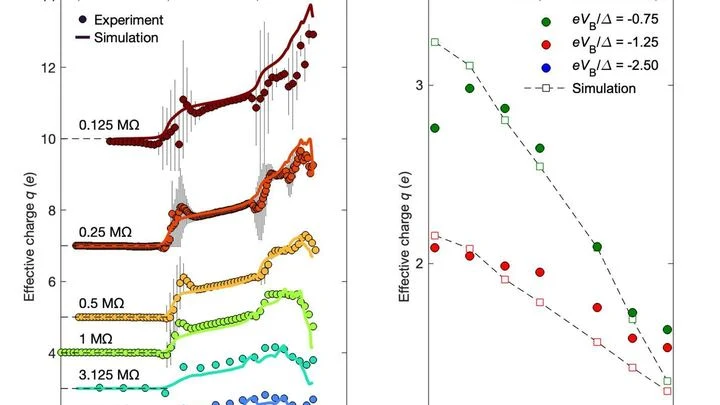
Current flowing through a wire is never perfectly smooth. If you listen closely enough, you hear a rustle — shot noise. It arises because charge is not carried as a continuous stream but in discrete portions, like raindrops on a roof. From the character of this noise, you can tell how much charge each 'drop' carries.
An ion channel in a cell membrane is a gate just a few atoms wide. Every second, millions of charged particles, sodium and potassium ions, pass through it. Classical physics said that to get through, an ion must jump over an energy barrier, like a traveler crossing a high mountain pass.
A quantum computer is like an orchestra where every musician must come in exactly on the beat. The faintest rustle in the hall throws off the violinist, and the melody falls apart. In silicon chips, that rustle is electrical noise: random fluctuations of charge inside the material. They make quantum bits err.
A thin wire made of a special material, a topological insulator, behaves like a city street: the interior is empty, and all traffic runs along the edges. Electrons in such a wire move only along the surface, like pedestrians on a sidewalk, never stepping onto the roadway.
Toss a handful of peas into a pot of semolina porridge — the peas quickly sink, pushing the grains aside. But if you make the porridge very thick and sticky, the peas get stuck. That's roughly how light lithium atoms behaved in a cloud of heavy potassium atoms at temperatures just a few millionths of a degree above absolute zero.
In a narrow slit between two plates, ions don't behave like free particles but like a crowd in a packed bus: pressed tightly together, they form dense clusters. This very property, the ability of ions to bunch up in extremely confined spaces, underpins a new mechanism for controlling ion transport.
Researchers studied ion behavior in two-dimensional nanochannels just a few atoms wide.