Invisible Rings Snuff Out Starlight express
A star shines billions of times brighter than its planet. To see the planet, you need to quench the starlight, like shading your eyes with your hand to spot an airplane against the sun. Telescopes use a mask with a clever pattern that twists the star's light into a ring and cancels it out, while the planet's light passes through almost untouched.
Earlier masks only worked with one polarization of light, like glasses that let through only waves tilted a certain way. Half the light was lost. Now, by etching tiny pits into the mask, the effect works for any polarization. In the lab, the mask was tested on a rig simulating a space telescope, and it dimmed starlight by a factor of one hundred billion.
This achievement is a step toward a telescope that could hunt for planets around other stars and, possibly, signs of life on them. The mask already works in air, just as it would in space, and is ready for flight.
Original abstract
as written by the authors arXiv:2603.22551
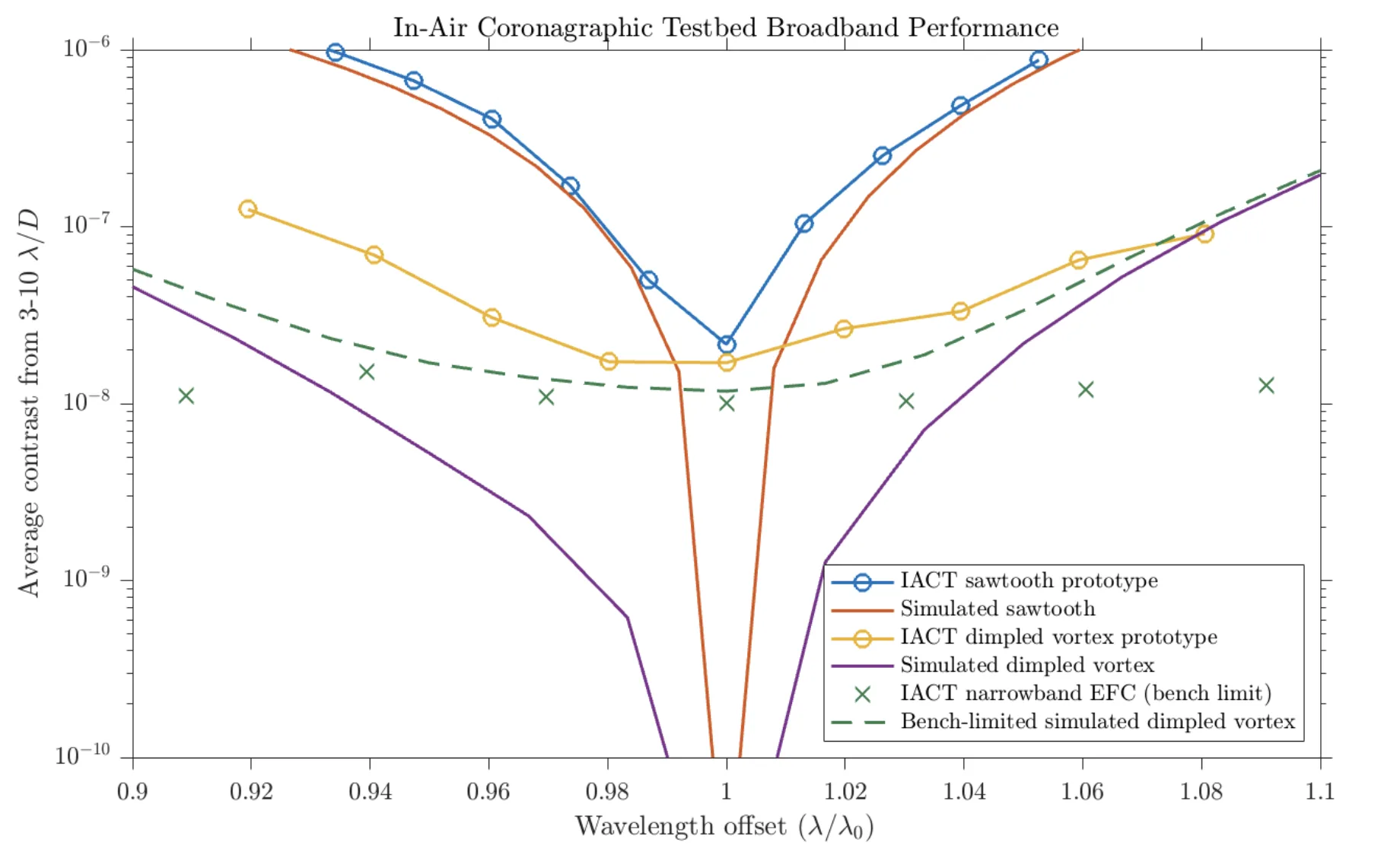
Achieving the Habitable Worlds Observatory (HWO) goal of 10^-10 contrast at a separation of 3 $$\lambda$$/D across a 20% bandwidth requires coronagraph focal plane masks with both broadband high contrast performance and high planet throughput. Scalar vortex coronagraphs (SVCs) offer a promising alternative to polarization-sensitive vector vortex designs but face chromatic limitations. This work presents the latest laboratory demonstrations of second-generation scalar vortex prototypes that incorporate radial phase dimples to improve broadband starlight suppression. We compare these new "dimpled" sawtooth masks to previous-generation scalar designs through high-contrast imaging experiments on the In-Air Coronagraph Testbed. Using electric field conjugation, we achieve near testbed-limited contrasts across both narrow (2%) and broadband (10%) spectral ranges. We report the best in-air contrasts achieved to date for scalar vortex masks across narrow and broadband spectral ranges and we also show that the dimpled vortex predicted bench-limited contrast performances for 2%, 10% and 18% bandwidths agree with the measured lab contrasts within a factor of two. These results highlight the potential of topographically achromatized scalar vortex masks as candidates for future space-based high-contrast imaging missions and mark a significant step toward polarization-independent coronagraphs capable of meeting HWO performance requirements.
Starlight is dimmed by a factor of one hundred billion — imagine spotting a firefly next to a stadium floodlight.
In the movie Interstellar, observing planets around a black hole would have required such masks — otherwise the light from the accretion disk would have blinded the cameras.