A support vector machine (SVM) is a supervised learning model that finds the hyperplane that best separates data points of different classes. The 'best' hyperplane is the one with the largest margin—the maximum distance to the nearest points of any class, called support vectors. This margin maximization gives the model good generalization to unseen data. SVMs can handle both linear and non-linear separation by using kernel functions that implicitly map data into higher-dimensional spaces.
History
Developed in the 1990s by Vladimir Vapnik and colleagues at AT&T Bell Laboratories, building on earlier work in statistical learning theory.
How it works
Given labeled data, the SVM solves an optimization problem to find the hyperplane that maximizes the margin while minimizing classification errors (soft margin). The support vectors are the data points closest to the hyperplane; they define the margin and the decision boundary. For non-linear data, a kernel function (e.g., radial basis function) computes dot products in a high-dimensional feature space without explicitly transforming the data, allowing complex boundaries.
In practice
Widely used in image classification, text categorization (e.g., spam detection), and bioinformatics for protein classification.
Fun fact
SVMs perform well even with high-dimensional data, such as thousands of features, because the margin maximization acts as a form of regularization.
A radiologist looks at an abdominal scan and sees not just organs but their spatial relationships: which kidney is larger, where the tumor lies relative to a vessel. It's like reading a map, where it's not enough to know where a city usually stands; you also need to measure the distance between two points on the ground.
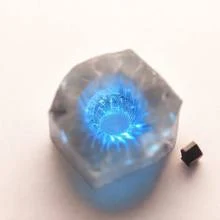
Diamond is not just a gemstone. Hidden inside its crystal lattice are defects that sense magnetic fields better than many instruments. One such defect, the NV center, acts as a tiny compass, but its needle wavers from heat and noise. For the compass to point accurately, calibration is needed.
Inside a piece of aluminum, atoms are arranged in neat rows, like bricks in a wall. But sometimes a row ends before reaching the edge, and a "step" appears in the crystal, which physicists call a dislocation. These defects determine how strong, ductile, and how a metal behaves under load.
Each morning, dozens of telescopes swing toward the Sun. Their cameras catch a narrow band of red light — the Hα line, discovered by Johann Balmer. The images reveal dark, whimsically curved threads. They look like stitches in a giant tapestry sewn through the blazing corona.
Reconstructing a full picture from fragments is like discerning an orchestra's melody in a noisy hall. Such challenges arise in photometry, where a star's brightness is recovered from faint twinkling. Traditional methods need precise noise information, which is almost always unknown.
The cameras of a self-driving car capture light like telescopes aimed at a distant galaxy. Each frame is a fragmented observation; together they must form a map of the road ahead.
The computer, like an astronomer, doesn't just stitch images together: it generates several possible bird's-eye views and compares them to real data.
Data on gene activity usually looks like a long string of numbers, like a rainbow stripe (spectrum) with no visible connections. In the scVision model, these numbers are turned into a meaningful picture — not a list of ingredients, but a photo of a finished dish.
A city signal bounces between walls like a ball, and your phone catches dozens of its 'reflections'—echoes. Each microsecond of delay adds 300 meters to the path.
The signal's speed is constant, like that of light (speed of light).
Power systems with solar panels and wind turbines are like a chess game: cloud cover and load changes are the opponent's moves, impossible to foresee. To maintain balance, operators used to run through dozens of scenarios (uncertainty) — that took too much time and computing power.
A robot swarm is like a cloud of fireflies: each moves on instinct to wherever is freer, and chaos turns into order. For a long time, it was a mystery how coherence emerges without communication or commands. The answer came with the creation of the Response Map — a tool that, like an X-ray, illuminates the hidden logic of the machine brain.
Modern cosmology has hit a dissonant chord. Local measurements of the Hubble constant from supernovae and Cepheids give around 73 km/s/Mpc, while global constraints from the cosmic microwave background within the standard ΛCDM model point to 67 km/s/Mpc.
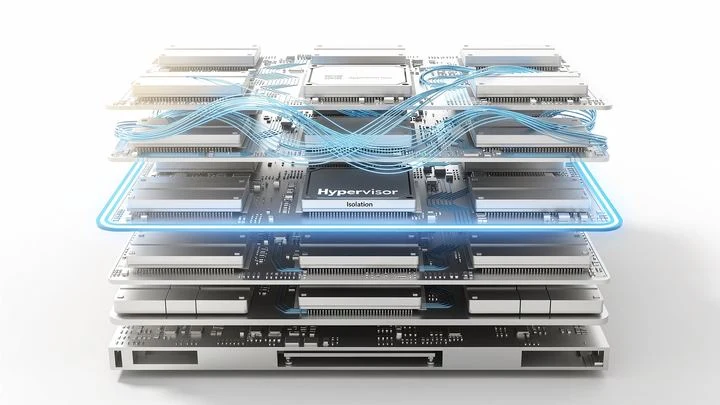
Stuttgart, 2025. A software engineer plugs a laptop into a test car, not for diagnostics, but to replace the car's 'personality'—like flashing a smartphone's firmware. But instead of a quick update, he faces a cascade of incompatibilities. Each electronic control unit (ECU) speaks its own dialect, tied to a specific supplier's chip.
Imagine an interpreter sitting in a meeting room, translating every word. But then they notice their translation could improve if they learned from their mistakes. They start noting which phrases caused confusion and adjust them. Within an hour, their translation is more accurate and the meeting runs smoother.
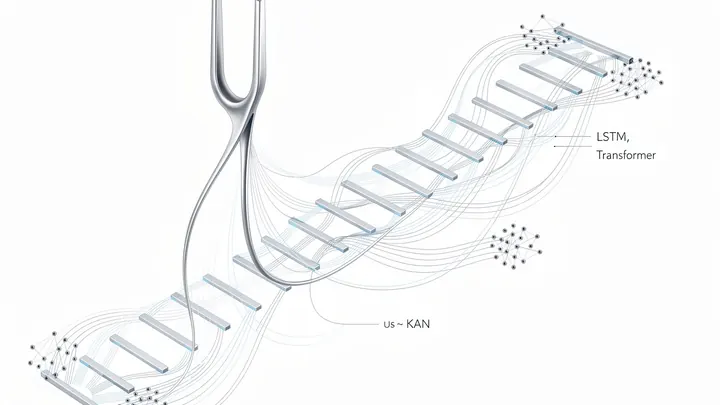
An orchestra plays without a conductor, and you hear the tempo speeding up and slowing down. All you have is a recording of the sound, not the score. Can you tell from that recording which string to pluck to make the whole orchestra play more steadily?
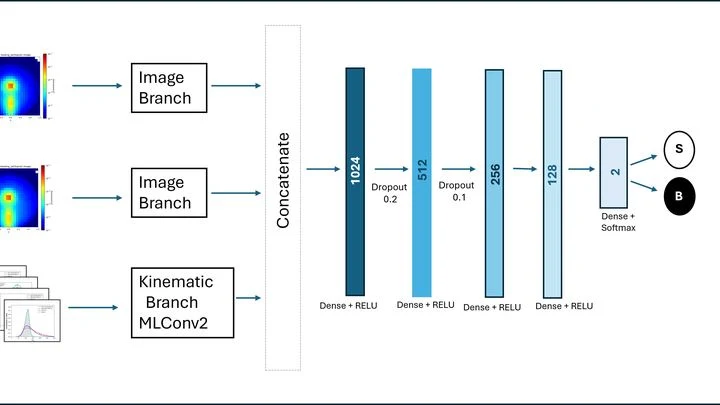
Deep inside the detector at the Large Hadron Collider, protons collide, and for a fleeting moment something heavy is born. It instantly shatters into two Higgs bosons — particles that, like nesting dolls, each hide two pairs of b-quarks.
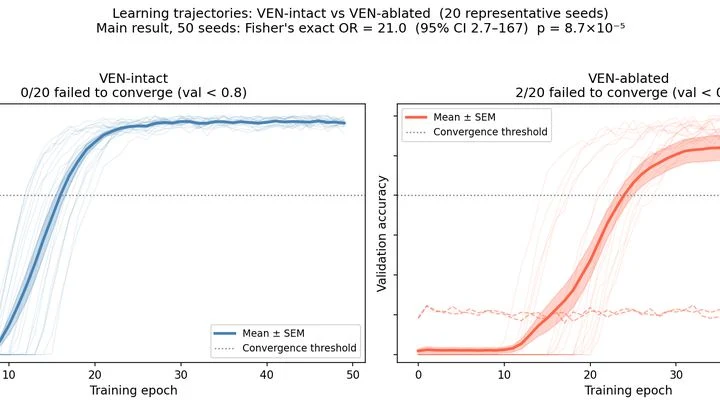
An orchestra at its first rehearsal without a conductor. Violins come in at the wrong time, brass is late, and instead of a symphony, you get cacophony. That's roughly how a computer model of the brain behaves when you remove special cells — von Economo neurons.
Two dice always land on the same number, no matter how far apart you toss them. In quantum physics, this behavior is called entanglement, and it's the key resource for future computers and secure communication. The trouble is, not all entanglement is easy to spot.
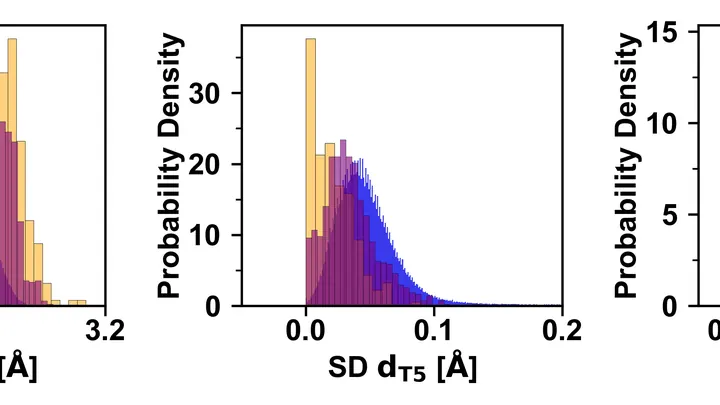
Proteins, like people, have family trees. Two proteins performing the same job in different organisms descend from a common ancestor. By comparing their sequences, you can reconstruct that history. But when proteins diverged long ago, standard methods lose the trail: so many differences pile up that the signal fades, like old photographs yellowing.
A drop of cream falls into a cup of coffee, and within a minute, the entire drink turns beige. This mixing process can be quantified: how much "stirring" is needed to transform one distribution of particles into another? In mathematics, this approach is called optimal transport, and the measure of effort is the Wasserstein distance.
The authors applied this idea to quantum systems.
The lungs are not two bags but millions of tiny sacs where air enters and blood flows close by. To see how they work, doctors sometimes use MRI without contrast: the scanner picks up weak signals from the tissues themselves. But these signals are like a radio in a thunderstorm — breathing is irregular, pulse jumps, and the image falls apart.
In a cold cloud of atoms chilled to near absolute zero, energies can behave like threads that weave into braids. These braids are not just a pretty image: their pattern is tied to topology, the branch of mathematics that studies properties preserved under continuous deformations.
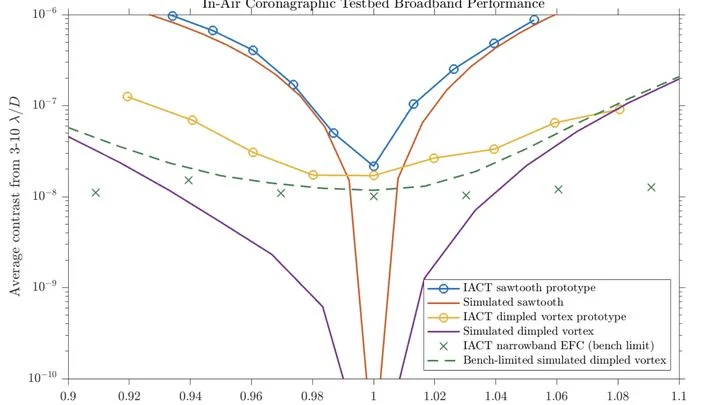
A star shines billions of times brighter than its planet. To see the planet, you need to quench the starlight, like shading your eyes with your hand to spot an airplane against the sun. Telescopes use a mask with a clever pattern that twists the star's light into a ring and cancels it out, while the planet's light passes through almost untouched.
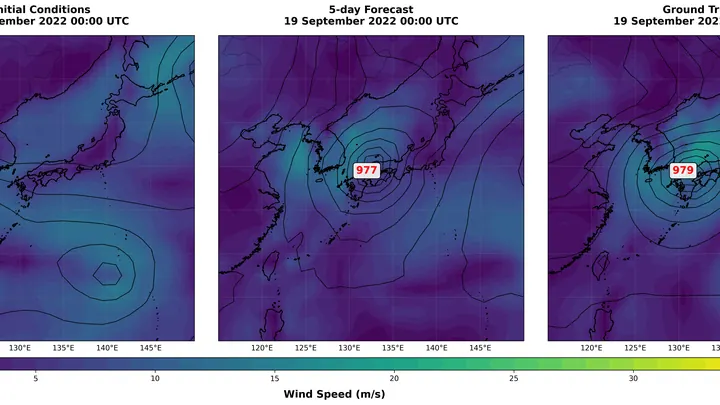
Weather forecasting is like trying to predict where a rock will roll down a slope, knowing the shape of every bump and the force of the wind. Make a mistake at the start, and a week later that error grows into a full-blown storm. In the past, accurate forecasts required massive computers and days of computation.
A particle detector at the Large Hadron Collider runs for years without stopping. Its sensors produce mountains of data every second, and among it all, you need to spot a fault quickly, like overheating or a broken channel. In the past, simple rules did this, but they often made mistakes.
A teacher in class explains the difference between 'dog' and 'tog': put your hand on your throat and feel the vibration. A speech recognition machine does much the same thing, except inside it's not a throat but long lists of numbers. It turns out these numbers can be sorted onto shelves, like alphabet blocks in a child's room.
Light passing through a lens bends slightly. For an optical computer, this is like a warped mirror for an artist: the image is there, but the details blur. An Ising machine using light beams tackles problems like packing luggage or planning a courier's route.
Porous zeolite minerals work like tiny sponges with holes of a strictly defined size. Through such holes, molecules of one kind pass while others get stuck: this is the basis for water purification, gas separation, and catalysis in petrochemistry.