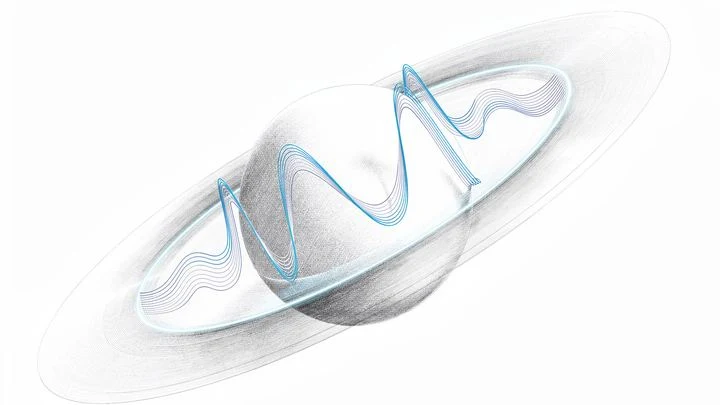
A light ring is a specific optical pattern where light is distributed in a ring shape rather than a solid disk. This is typically created by placing a specially designed mask or phase plate in the path of a light beam. The mask alters the phase of the light so that the central part cancels out due to destructive interference, leaving a bright ring around a dark center. This technique is used in astronomy to block out the light from a bright star, allowing faint objects like exoplanets or dust disks around the star to be observed.
History
The concept of using a phase mask to create a dark center in a telescope's image was proposed by Bernard Lyot in the 1930s for coronagraphy, and later refined with vortex masks in the 2000s.
How it works
The mask is designed to introduce a phase shift that varies across the beam, for example, a vortex phase that changes by 2π around the center. When the light passes through, the central region experiences destructive interference, creating a dark spot. The ring of light that remains can be focused onto a detector, and if a star is placed in the dark center, its glare is suppressed, revealing nearby faint sources. The size of the ring can be tuned by adjusting the mask design and the optical setup.
In practice
Light rings are used in coronagraphs on telescopes to image exoplanets and in optical tweezers to trap particles in the dark center.
Fun fact
The same principle is used in some laser pointers to create a 'donut' beam, which can trap atoms in the dark center for quantum experiments.
Two million years away, around the young star CI Tau, a gas-dust disk whirls — a protoplanetary cradle. ALMA observations have already shown rings and gaps in it, but the finest details remained invisible: their width is smaller than the instrument's resolution.
Moments before totality, swift shadow bands glide across the ground, like ripples from pebbles tossed into water. For centuries, this phenomenon baffled scientists. It turns out the key is that light is a wave.
The Sun isn't a pinpoint lamp but a vast disk. When the Moon nearly covers it, a thin glowing crescent remains.
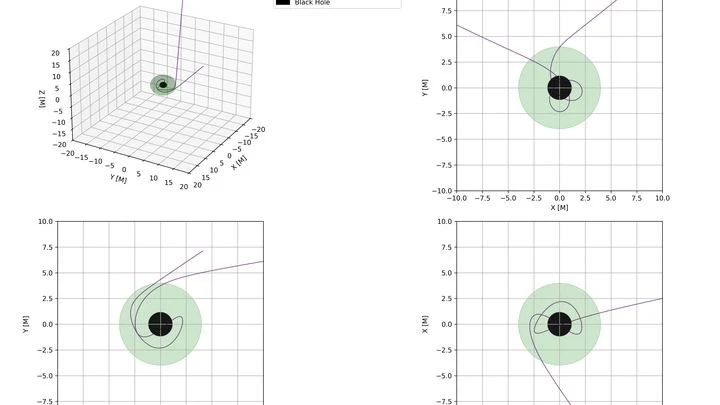
Light passing by a black hole falls into a gravitational trap: its trajectory curves and the particle bounces along a nearly closed orbit, like a pinball.
The night sky sometimes throws up riddles that take your breath away. One of them is a ring of galaxies stretching across a third of the horizon. Astronomers have named it the “Giant Ring on the Sky”: a cluster of galaxies stretched into a thin filament and closed into a circle about 400 megaparsecs in diameter.
In galaxy clusters, invisible dark matter serves as the framework holding star systems together. Its shape is betrayed by a faint glow — stars ripped from galaxies by tidal forces. This stellar 'broth' fills the cluster like a liquid taking the shape of its container: it envelops the clumps of dark matter, creating a precise cast of their outlines.
Light from the star HD 163296 passes through the surrounding gas-and-dust disk like a flashlight beam through murky water. The disk's particles scatter the light, giving it a special property — polarization: the waves begin to oscillate in a single plane, like a rope shaken strictly up and down.
Using the most powerful space telescope, James Webb, astronomers peeked into the cosmic dressing room and saw how the rings of asteroid Chariklo are changing.