A coronagraph is an instrument designed to block out the bright light from a star, allowing astronomers to see faint objects nearby, such as exoplanets, dust disks, or stellar coronae. The name comes from the solar corona, which was the first target of such instruments. By artificially creating an eclipse, a coronagraph reveals the otherwise hidden environment around a star, making it a cornerstone of direct imaging in astronomy.
History
The coronagraph was invented by French astronomer Bernard Lyot in 1931 to observe the solar corona without waiting for a total solar eclipse. It was later adapted for stellar observations in the 1980s and 1990s.
How it works
A coronagraph uses an opaque disk (or a more complex mask) placed in the focal plane of a telescope to block the star's light. However, light diffracts around the edges of the disk, so additional components — such as a Lyot stop and apodizing masks — are used to suppress this diffracted light. Modern coronagraphs use advanced phase masks or deformable mirrors to cancel out the starlight while preserving the light from nearby faint objects. The result is a dark region where planets or dust can be detected.
Photographing an exoplanet orbiting another star is like trying to spot a firefly in front of a spotlight. Earth's atmosphere is constantly churning, which makes stars appear as dancing speckles through a telescope.
Assembling the puzzle of the Universe, astronomers are used to every new detail fitting perfectly into the already completed picture. But sometimes there are pieces that seem cut from another jigsaw. Twenty thousand active galactic nuclei, and eleven percent of them the neural network confidently rejects as alien.
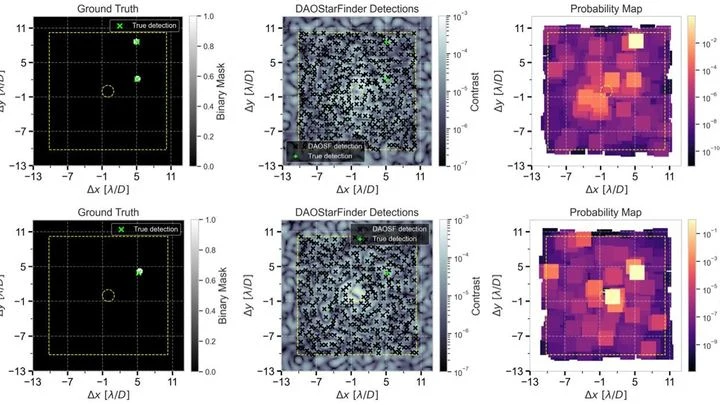
A pebble on a streambed lies still as sunlight sparkles dance on the water's surface. In astronomy, the contrast is similar: a real exoplanet is the stone, while myriad speckles (patches of scattered starlight) are the ripples trembling in instruments.
The solar wind, a stream of charged particles from the Sun, slams into the tenuous gas that fills the space between the stars. The collision produces a faint X-ray glow. For astronomers, this is like fog in front of headlights: it obscures distant objects.
A galaxy is like a glowing pancake studded with stars. If you look at it face-on, you see everything at once — both the bright spiral arms and the dark dust lanes. But tilt the pancake, and the picture changes: layers overlap, light blends together. This very effect, it turns out, creates the illusion of a tight link between radio and gamma-ray emission in distant star systems.
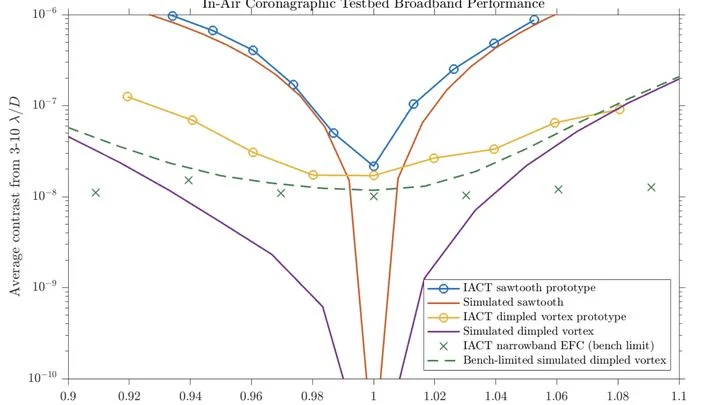
A star shines billions of times brighter than its planet. To see the planet, you need to quench the starlight, like shading your eyes with your hand to spot an airplane against the sun. Telescopes use a mask with a clever pattern that twists the star's light into a ring and cancels it out, while the planet's light passes through almost untouched.
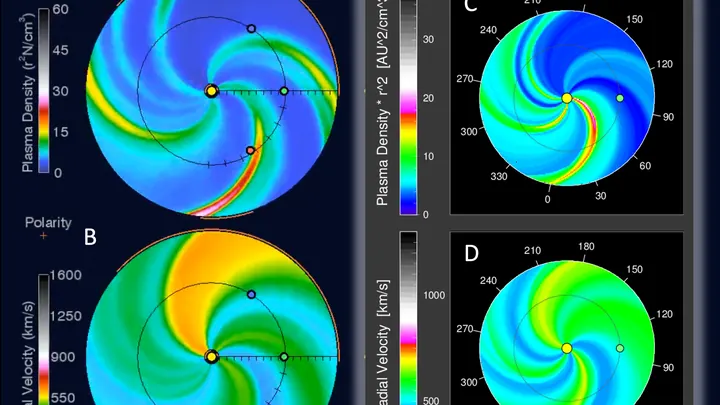
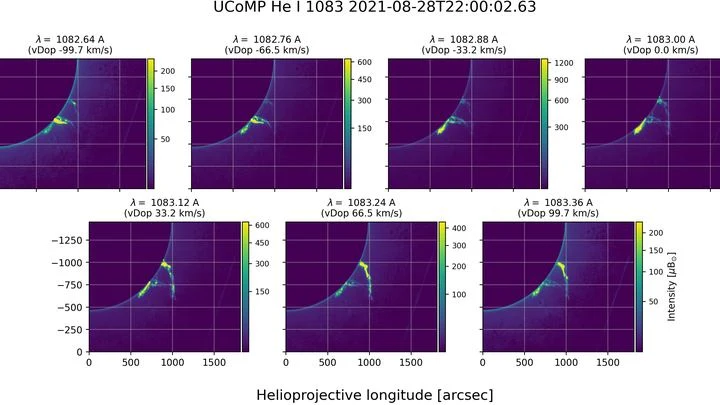
The Sun occasionally hurls enormous clouds of plasma into space — coronal mass ejections. Often tangled within these clouds are prominences: cooler, denser clumps of material. These contain plenty of neutral atoms that shine brightly in specific spectral lines.
The solar corona, the Sun's outer atmosphere, stretches millions of kilometers, yet it's visible only during a total eclipse or with specialized instruments. Typically, we gauge the corona's density by how it scatters white light, but that method relies on simplifications that can skew the results.
The Comet Interceptor mission launches without a target. The spacecraft freezes at a point of space equilibrium, like a fighter jet on combat standby: engine warmed up, but takeoff only on alert.
Scientists have described a new type of invisible star that behaves like a breathing lens. Such a star is made of ultralight boson particles (not yet discovered). Its gravity causes spacetime curvature — this is the lens, which rhythmically expands and contracts, as if breathing.
Back in the 18th century, William Herschel was searching for life on Mars. Today, astronomers are targeting not planets but artifacts — for example, alien probes lurking in the Solar System. The problem is that spotting a tiny object next to the blinding Sun is nearly impossible.
On the night of March 9–10, 2024, a cloud of plasma ejected by the Sun raced away from the star. It had already passed a distance of five solar radii when a ground-based array of 352 antennas in California's Owens Valley caught a brief radio signal from it.