Dusty Quasars: Radio Bursts from Shock Waves express
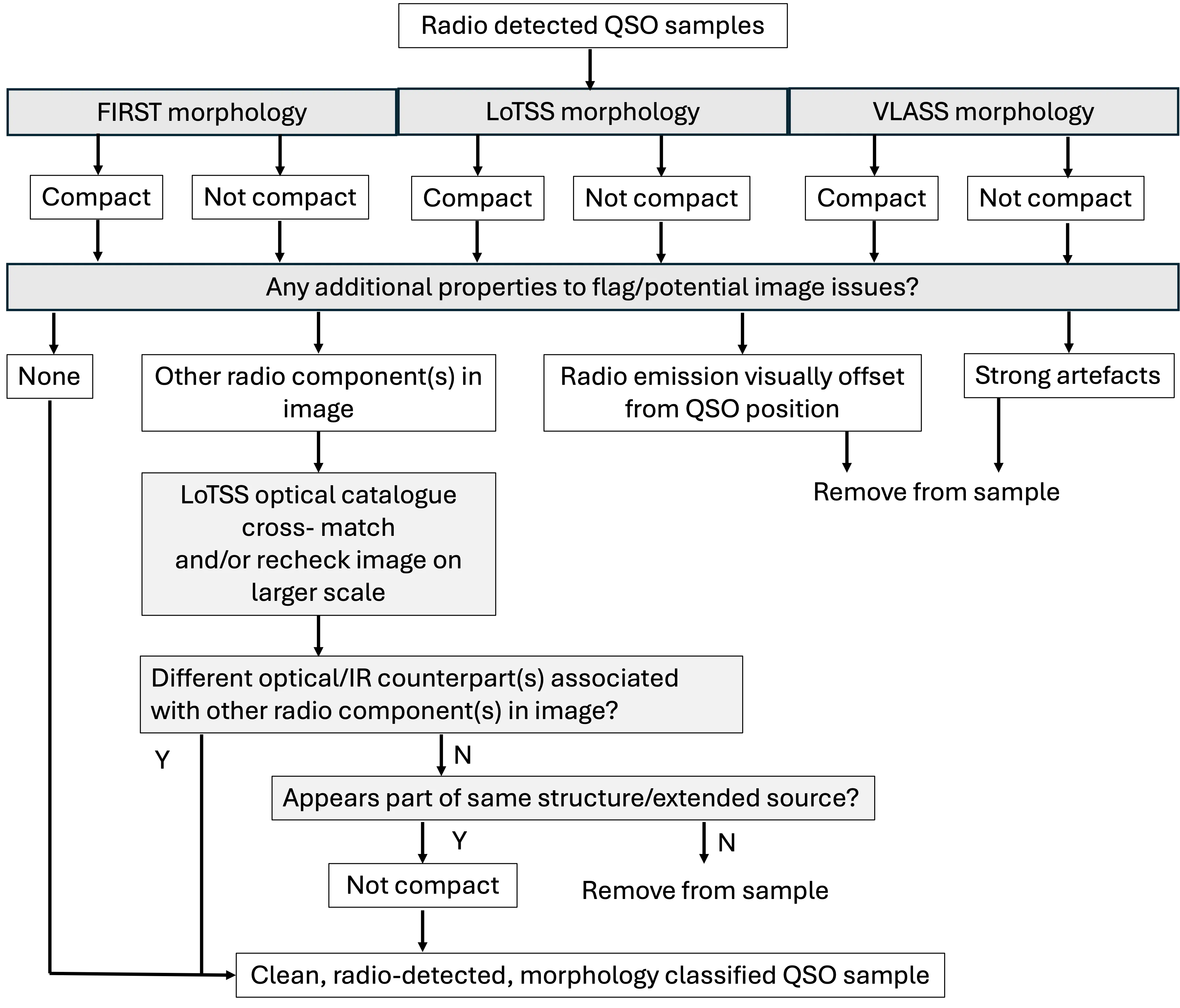
Red quasars are the brilliant cores of distant galaxies, wrapped in dust that makes their light appear reddish. Astronomers have noticed that such quasars more often than ordinary blue ones exhibit compact radio emission — radio waves coming from a region the size of a galaxy or smaller.
Using data from three radio telescopes, the team manually examined 573 red quasars and 1278 blue ones for comparison. It turned out that red quasars with compact radio emission have an unusually steep radio spectrum: at low frequencies the signal is noticeably stronger than at high frequencies. This spectral slope is like a characteristic signature of a shock wave.
Shock waves arise when fast streams of gas and particles from the black hole (winds or jets) crash into the dusty surroundings of the galactic nucleus. During the collision, particles are accelerated and begin to emit radio waves, with low-frequency emission dominating. The more dust, the stronger this effect.
The dustiest quasars with steep spectra (86%) have radio emission that fits well with a wind-driven shock wave model with an efficiency of up to 7%. This means such quasars are undergoing a "dusty outflow" phase: compact jets or winds from the black hole accelerate dust and gas, triggering shock waves and enhanced radio emission. Over time, the dust disperses, and the quasar turns blue.
The dustiest quasars are like "teenagers" among galaxies: they are actively blowing out dust, and in a few million years they will become clean and blue.
In Carl Sagan's novel "Contact," the alien signal comes from the Vega system, where a dusty disk around the star resembles the dusty veil of a quasar hiding powerful processes.