Dust in space consists of small solid particles, typically micrometers in size, composed of silicates, carbon, and ice. It is a key component of protoplanetary disks, where it clumps together to form planets. Dust also plays a crucial role in the interstellar medium, absorbing and scattering light, and providing surfaces for chemical reactions that form molecules.
History
The importance of interstellar dust was recognized in the early 20th century through observations of star extinction and reddening. The modern understanding of dust as a building block of planets developed with the advent of infrared astronomy in the 1980s.
How it works
Dust grains form in the atmospheres of cool stars and in supernovaejecta. In protoplanetary disks, dust grains collide and stick together, growing into larger bodies called planetesimals, which can eventually form planets. Dust also affects the thermal balance of disks by absorbing starlight and re-emitting it as infrared radiation, which can be observed by telescopes.
In practice
Dust is studied to understand planet formation, the evolution of galaxies, and the chemistry of the interstellar medium. It also poses a hazard to spacecraft and is a key factor in the design of telescopes that observe in the infrared.
Fun fact
Interstellar dust grains are so small that a single grain can be up to a million times smaller than a grain of sand, yet they are responsible for blocking about 30% of visible light from distant stars.
Deep inside a sub-Neptune, where pressures reach a hundred thousand bars and temperatures hit four thousand degrees, rock behaves like boiling soup. Heavy vapors of silicon and magnesium rise, cool, and fall back as a rain of solid particles.
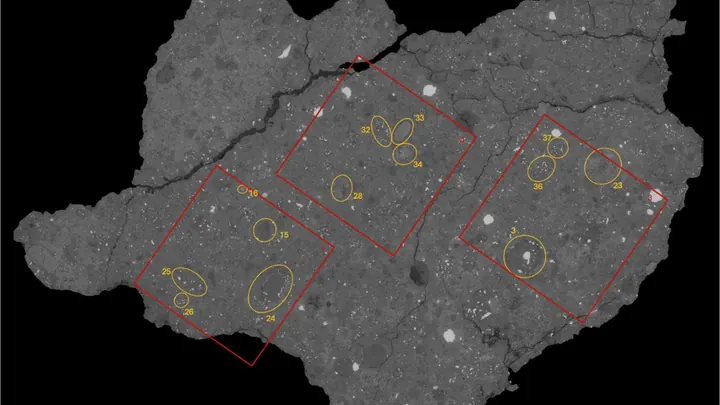
In the cold depths of space float rocks older than Earth itself. Inside some of them hide tiny glassy spheres — chondrules. They formed when a disk of gas and dust still swirled around the young Sun.
Carbonaceous meteorites Asuka 12236, Paris, and Maribo have preserved these spheres almost untouched.
In the dark kitchen of the Taurus molecular cloud, 450 light-years away, dozens of planetary systems are being prepared. Each young star is a chef, and its protoplanetary disk is a counter piled with flour-like dust and steam-like gas.
Around young stars, flat clouds of gas and dust swirl: these are future planetary systems. Inside some of them, a void gapes: the dust and gas have been swept away, as if someone thinned out the middle of a vinyl record.
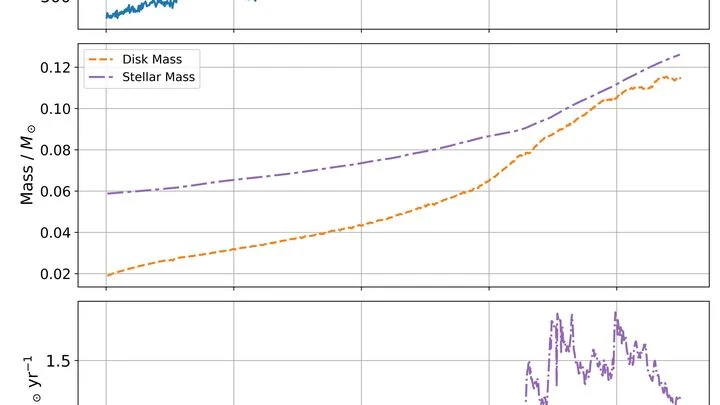
Around a just-ignited star swirls a vortex of dust and gas. This vortex, the protoplanetary disk, grows by accreting material from the surrounding cloud.
In the furnace of star formation, the heat reaches 900 degrees Celsius, like a glowing blast furnace. It is in this hellish heat that cosmic crystals are born. Astronomers have for the first time caught the moment when crystalline dust appears right during an accretion flare (when the star gobbles up surrounding gas) at the very young star EC 53, still cocooned in dense gas.
A disk of gas and dust spins around the young star HV Tau C, nearly edge-on to us. The James Webb Space Telescope examined its spectrum and detected the glow of hot molecular hydrogen (H₂). This revealed a wide, bipolar wind blasting from the inner regions far beyond the disk.
Seventy-two protoplanetary disks, swirling cocoons of cosmic dust and gas, came under the gaze of the MIRI instrument on JWST. Most of them shoot outflows into space: dense conical structures and narrow, high-speed jets. They blast like fountains. This process is not accidental.
The star AB Aur is young, about 4 million years old. Around it swirls a dense disk of gas and dust. Recently, a long gas stream, a flow of material from the surrounding cloud, crashed into it.
When a giant planet grows, it pulls in gas. Some of that gas swirls around it into a small disk — called a circumplanetary disk. It is in such disks that moons are thought to form. For the planet PDS 70 c, located 370 light-years away, such a disk was directly observed using the ALMA antenna array in the millimeter range.
Two million years away, around the young star CI Tau, a gas-dust disk whirls — a protoplanetary cradle. ALMA observations have already shown rings and gaps in it, but the finest details remained invisible: their width is smaller than the instrument's resolution.
A sub-Neptune is a planet that falls between Earth and Neptune in size. These worlds are abundant in our galaxy, but their internal structure has been hotly debated. New research shows that in their youth, these planets behave like a sponge soaked with water.
In 2019, an unusual visitor, comet 3I/ATLAS, zoomed into the Solar System. It came from another star, and for the first time, astronomers were able to see what its dusty tail is made of.
The James Webb Space Telescope peered into a disk of gas and dust around a young star where planets are born, and for the first time spotted ice made of heavy water. This water is not ordinary: in its molecules, regular hydrogen is replaced by deuterium, its heavier sibling.
A fire hose blasts into a snowdrift. The water doesn't just shove the snow aside — at the point of impact, spray, steam, and a roar are born. That's roughly how jets behave: narrow streams of matter shooting out from around a black hole at enormous speeds.
Putting together the Solar System is like crafting a high-end tasting menu: the recipe isn't always set in stone — sometimes the final ingredient is added while the dish is already cooking.
The young super-Jupiter TWA5B, a scorching ball 25 times Jupiter's mass, floats just fifty light-years away. Its faint infrared glow long hid its chemical makeup. Now, high-resolution spectroscopy with CRIRES+ has registered the ghostly trace of SiO — silicon monoxide.
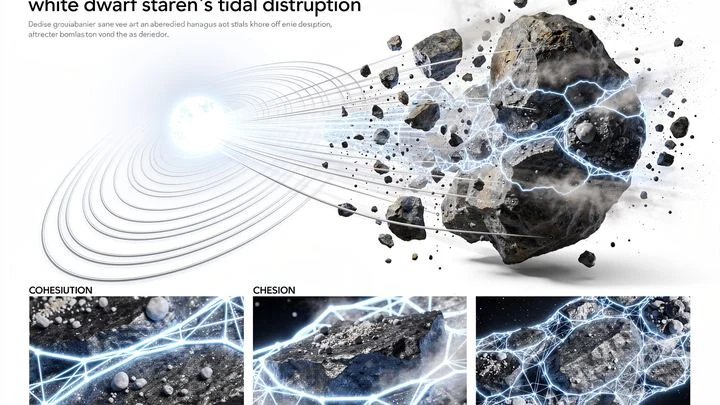
When a telescope catches the light of a distant white dwarf, the spectrograph sometimes fishes out heavy elements — calcium, iron, magnesium. These metals could not have stayed in the thin atmosphere of the stellar remnant; they are the traces of recently fallen planetary debris.
The cosmic accounting has hit a snag. The bookkeeper is balancing the books: in one column, all the planets astronomers have counted in the galaxy; in the other, the stockpile of building material in the dusty cocoons of newborn stars. The numbers don't line up. Even if you gathered every last grain of dust and molded it into planets, there wouldn't be enough material.
In a city park, trees grow faster than in a deep forest — not because the soil is better, but because branches collide and seeds are exchanged more often. Galaxies in the Spiderweb protocluster behave much the same way. This vast clump of matter will become a mature cluster billions of years from now.
A huge rotating pancake of gas and dust surrounds a young star. In such a "maternity ward" for planets, rings and gaps are often seen, as if an invisible plow had carved furrows. These are usually attributed to already-formed planets that clear paths with their gravity.
Recently, astronomers spotted three interstellar comets coming from deep space. One of them, 3I/ATLAS, turned out to be unexpectedly large: its nucleus is several kilometers across.
Chondrules look like frozen raindrops made of stone. They're about the size of a grain of sand, but they record the history of the first few million years of the Solar System. Once, these droplets floated in the scorching gas around the young Sun, then clumped into asteroids and fell to Earth as meteorites.
A distant city seen through a fogged-up window: bright lights blur, details are lost. That's roughly how astronomers see gas with magnesium ions (magnesium) in our galaxy — the strongest spectral lines "peg the needle," preventing us from knowing how much material is really there.
An old chest of family heirlooms opens, and inside lie jewels that were thought to be as old as great-grandmother. But suddenly it turns out: the gold was remelted, the stones were recut, and this happened much later than thought. A similar story happened to the oldest particles in meteorites — calcium-aluminum inclusions, or CAIs.
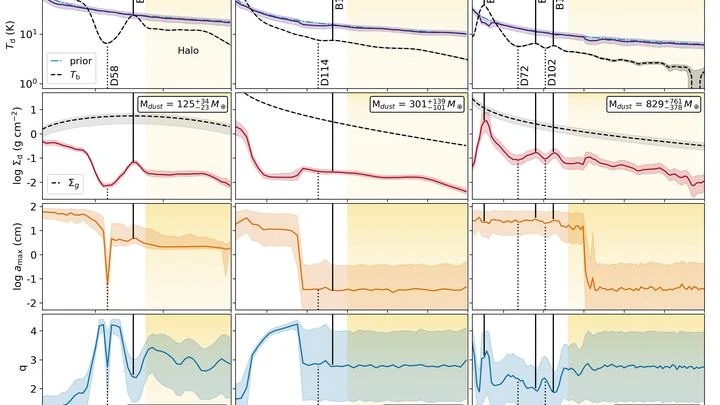
A young star is surrounded by a flat, rotating disk of gas and dust, like pizza dough that's been spun out. Planets are born inside such a disk. But around three stars (Elias 2-24, IM Lup, and DM Tau) astronomers noticed something odd: far beyond the edge of the bright disk stretches a barely visible but enormous dust halo.
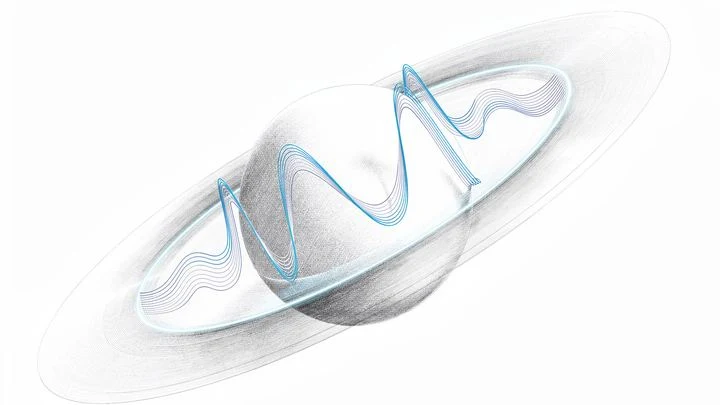
In a disk of gas and dust around a young star, dust particles behave like sand grains in a stream of water: the gas flows faster, the dust lags behind, and friction arises between them. This friction can rock the magnetic waves that run through the disk. The galaxy is full of such disks: it is precisely in them that planets are born.
Around young stars, flat clouds of gas and dust swirl, like pizza dough from which planets will eventually be shaped. This cloud contains various chemical elements, and sulfur is one of the most elusive: it's hard to catch with telescopes because it hides in solid grains or escapes as gas.
A newborn star is like a kitchen mixer: it whips up the surrounding cloud, and splatters fly in all directions. Only instead of batter, it's gas and dust. Previously, astronomers had only seen gas jets, and dust was considered too fragile: the shock wave should shatter dust grains into atoms.
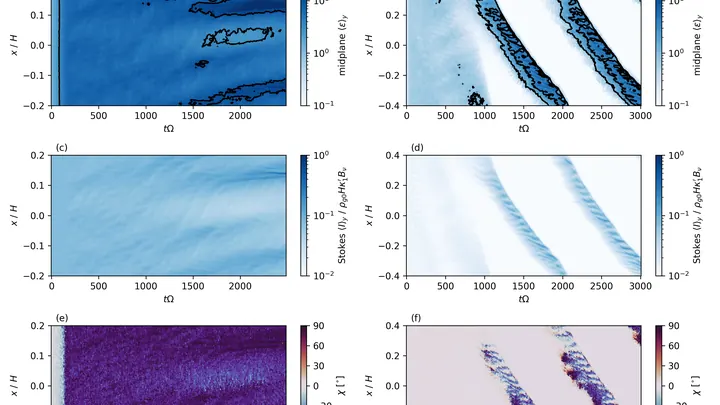
Around young stars, disks of gas and dust swirl — the building blocks for future planets. Inside these disks, dust grains don't just fly randomly: they align along invisible lines of gas flow. Recently, astronomers noticed that dust grains in such disks behave like badminton shuttlecocks — always turning their long side into the wind.
Two very small, cool stars, similar to the famous TRAPPIST-1, reside in the young Upper Scorpius star cluster. They are only 5–10 million years old — by cosmic standards, mere infants. Each is surrounded by a disk of gas and dust from which planets may eventually assemble.
In the cold gas cloud where a star is born, chemistry sleeps. Molecules barely collide, reactions stall. But when a charged particle zips through the cloud, it knocks electrons off atoms — ionizing them. That's how active ions appear in a dormant cloud, ready to build new molecules.
The young star HL Tau is surrounded by a disk of gas and dust — the cradle of future planets. Inside this disk, the gas is not static: it orbits the star, but it also trembles and churns, like water in a raging river. Astronomers have now directly measured the strength of this churning for the first time.
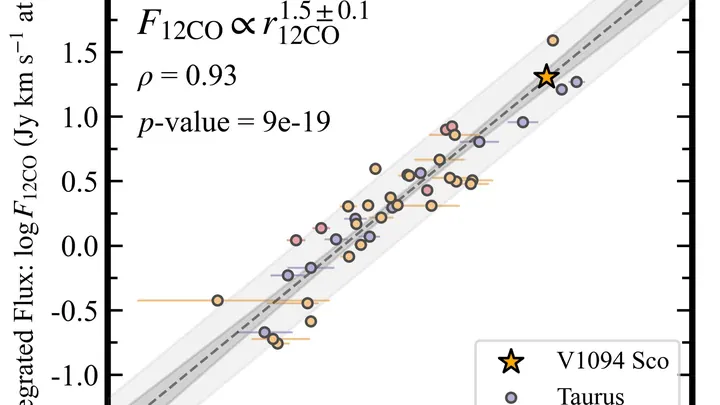
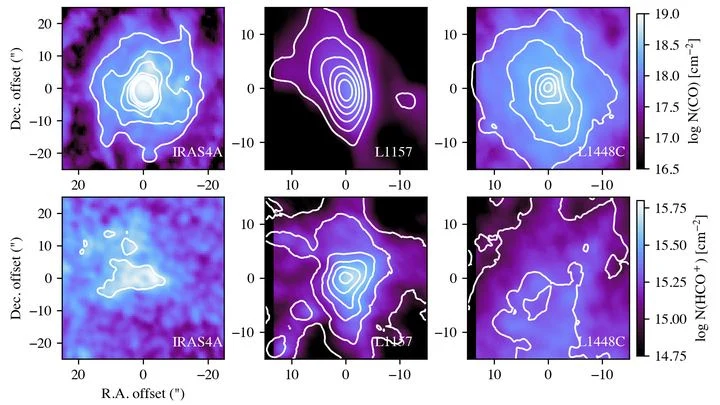
In the cold outer reaches of the Solar System, water is considered the main building material for ices. But some comets and distant icy bodies have an unusually high ratio of carbon monoxide (CO) to water, as if a scoop of ice cream suddenly had too much syrup. The authors of a new study set out to find where this imbalance comes from.
The proton is not a solid ball but a seething cloud of quarks and gluons. Each particle carries its own bit of rotation, but if you add up all the bits, you don't get the full proton spin. Part of the rotation seems to hide in the cloud's slowest inhabitants: those carrying only a tiny share of the total motion.
An icy rock is flying through the Solar System on an open trajectory — coming in from interstellar space, swinging around the Sun, and heading back into the dark.
Planets are born from dust. In a disk around a young star, tiny dust grains collide, stick together, and gradually grow like a snowball rolling down a hill. But there's a catch: the gas in the disk moves faster than the dust and drags on it, preventing it from clumping into large chunks.
For dust to stick together, there needs to be enough of it.
In a protoplanetary disk, a cloud of gas and dust around a young star, dust grains don't just fly in circles. They are carried by the gas flow, like sand by the wind, and in turn alter that flow. Layers emerge, sliding past each other, and at their boundaries an instability arises — waves and vortices.
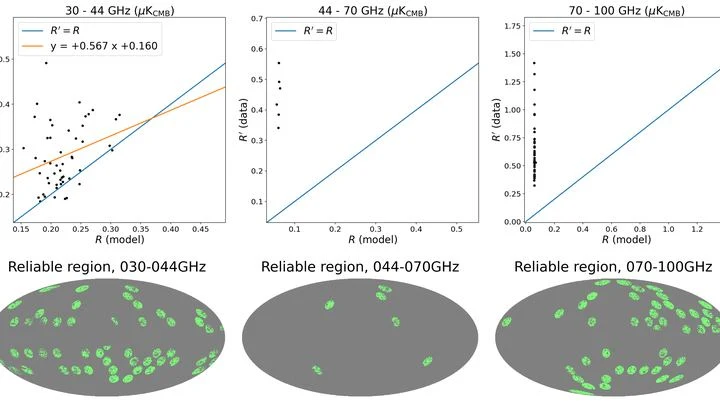
Astronomers are trying to capture the radio echo of the Big Bang — a faint glow that fills the entire universe. But the receiver is choking with noise: our Galaxy is packed with glowing interstellar dust, whose emission can easily be mistaken for a signal from the distant past.
Dust grains in the disk around a young star stick together, grow, and will eventually become planets. But to know how much planet-building material each disk holds, you need to measure its mass and size. You can't weigh a distant cloud directly: you have to infer it from the dust's radiation.