Infrared excess is the observation that an astronomical object emits more infrared radiation than would be expected from a simple blackbody or stellar photosphere alone. In many contexts, this excess is a signpost of dust: warm dust grains absorb light from a central source and re-emit it at longer, infrared wavelengths. However, the concept is more general — any additional component of cool material, such as a thick accretion disk, a circumstellar envelope, or even a debris disk, can produce a measurable bump in the infrared part of the spectrum. The seed definition highlights a specific case: the excess is attributed to an accretion disk rather than to a donor star in a binary system, which is a common scenario in interacting binaries where mass transfer heats the disk.
History
The concept emerged in the mid-20th century with the development of infrared astronomy. Early observations of cool stars and young stellar objects revealed more infrared emission than expected, leading to the identification of circumstellar dust. The term became standard as infrared surveys expanded, but the specific attribution to accretion disks versus donor stars has been refined through detailed modeling in recent decades.
How it works
When a source of radiation — a star, an active galactic nucleus, or an accretion disk — is surrounded by cooler material, that material absorbs some of the incoming high-energy photons and re-radiates the energy at longer wavelengths. The result is a spectral energy distribution that rises again in the infrared after the main stellar or disk emission peaks. Astronomers quantify this by comparing the observed flux at infrared wavelengths to the extrapolated photospheric model. A positive deviation, or excess, indicates the presence of an additional component. The temperature and spatial extent of that component can be inferred from the shape and amplitude of the excess, allowing researchers to distinguish between, say, a dusty torus around a quasar and a flared disk around a young star.
In practice
Infrared excess is used to identify and characterize accretion disks in binary systems, protoplanetary disks around young stars, and dusty tori around active galactic nuclei. It also serves as a diagnostic in searches for technosignatures, such as Dyson spheres, where an artificial structure would produce a distinctive infrared excess.
Fun fact
In some cases, an infrared excess can appear or disappear within weeks, as seen in the title 'Пыль вспыхнула за две недели', indicating that the dust is being rapidly created or destroyed in a dynamic environment.
Every five hours in the binary system IPHAS J190812.63+045728.1, one star completely hides the other. For 18 minutes, the white dwarf and its scorching disk vanish from sight, leaving only a modest red neighbor in the dark. This is a natural shutter that switches off the spotlight to reveal what usually hides in its glare.
A little monster hides in a dwarf galaxy, and its neighbor feeds it. The satellite galaxy is slowly merging with a massive companion, and gas from the outer regions falls toward the center, where a black hole sits. By cosmic standards, it is not large: only 800 to 5000 solar masses, but its appetite is ferocious.
In the coldest, darkest corners of space, dust grains get covered in ice, like a window on a frosty day. This ice isn't just frozen water: it also contains carbon monoxide and carbon dioxide. From such ice, comets and planets may eventually assemble. But until now, it was unclear how the dust grain itself affects the ice that forms on it.
The Andromeda galaxy is our nearest large neighbor, and like the Milky Way, it has an invisible gaseous shroud. This shroud of extremely hot, rarefied gas extends for hundreds of thousands of light-years. Seeing it directly is nearly impossible — the gas is too faint.
Cosmologists are facing a curious situation: two reliable tools draw slightly different maps of the same universe. One tool is the map of ancient light (the cosmic microwave background), and the other is the map of galaxy distribution. They broadly agree, but in details they diverge.
The cosmic detective story began with a quiet flash in the optical band. AT2019wzc slowly brightened and faded like a smoldering ember. But hidden inside was something more energetic — repeating soft X-ray bursts that astronomers call quasi-periodic eruptions.
These eruptions last minutes to hours and repeat every few hours or days.
In the dark outskirts of our Galaxy, far from bright star clusters, millions of black holes lurk. They are invisible: they don't shine and don't noticeably accrete matter. Conventional search methods, designed for dense stellar fields, are useless here. A different approach is needed.
Astronomers have proposed using the very fabric of space as a detector.
A star wrapped in an invisible blanket warms up more than it should. That's exactly how ten red dwarfs look, which astronomers from the Hephaistos project have been monitoring. These stars lie within 300 parsecs (about 1000 light-years) of us and emit far more infrared energy than their modest sizes can explain.
Some 123 parsecs from Earth, in the constellation Corona Australis, drifts the neutron star RX J1856.5-3754. Its diameter is about 12 kilometers, smaller than Moscow's Ring Road, but its surface temperature reaches 460 000 kelvin. The star emits a slow, almost inaudible exhalation.
Ten billion years ago, the universe was speckled with strange crimson sparks. The JWST spotted them in images at distant redshifts — compact sources blazing like entire galaxies yet no larger than a tiny central region. Astronomers nicknamed them “little red dots.” Their nature long defied explanation.
When a star ventures too close to a supermassive black hole, a cosmic requiem plays out — a tidal disruption event. Thanks to photometry and spectroscopy, astronomers discern every instrument in this orchestra.
In 2024, the Hephaestus project sifted through millions of stars and flagged a few dozen suspicious ones: they shone brighter in the mid-infrared than a normal red dwarf should. Two of these candidates, labeled D and E, looked especially tantalizing, as if an invisible heater were working next to the star.
Around some young stars where star formation has recently ended, there swirl not just dust rings but actual planetary battlefields — extreme debris disks.
When a giant planet grows, it pulls in gas. Some of that gas swirls around it into a small disk — called a circumplanetary disk. It is in such disks that moons are thought to form. For the planet PDS 70 c, located 370 light-years away, such a disk was directly observed using the ALMA antenna array in the millimeter range.
When two neutron stars, the ultra-dense cores of dead stars, collide, a kilonova is born: an explosion a thousand times brighter than a typical nova. This is the universe's true smelting works. In the scorching cloud racing outward at near-light speeds, a furious flux of neutrons transmutes atomic nuclei into gold, platinum, osmium.
When a piano falls into an abyss, we think about the abyss. We don't think about the piano's cover. In much the same way, astrophysicists have for decades studied extreme close encounters between small bodies and massive black holes. They focused on the black hole itself and what orbits it. But what the 'bullet'—the small object heading toward doom — is wearing, almost no one asked.
A bonfire that no one sees, but everyone feels the warmth: that's how astronomers found a flare in a distant galaxy. Not by its light, but by the infrared radiation of heated dust. The galaxy SDSS J010320.39+140152.5 caught attention when its center suddenly blazed in the infrared, as if someone had thrown logs onto an invisible fire.
The JWST telescope has spotted a multitude of bright galaxies in the young universe. Their ultraviolet light was barely absorbed by cosmic dust — defying previous expectations.
A dim lightbulb suddenly starts illuminating patterns on the wall that were invisible to the eye. That's roughly how astronomers look at distant dwarf galaxies — tiny stellar islands poor in heavy elements. In some of them, a faint violet glow of ionized helium has been spotted (a specific spectral line He II 4686 Å).
Recently, astronomers spotted three interstellar comets coming from deep space. One of them, 3I/ATLAS, turned out to be unexpectedly large: its nucleus is several kilometers across.
A pair of figure skaters spins while holding hands. If their path is a perfect circle, each push from a partner is predictable. But stretch that path into an oval, and the effort becomes uneven: a jerk as they come together, a lull as they pull apart. Something similar happens with two black holes in the final minutes before they merge.
Red quasars are the brilliant cores of distant galaxies, wrapped in dust that makes their light appear reddish. Astronomers have noticed that such quasars more often than ordinary blue ones exhibit compact radio emission — radio waves coming from a region the size of a galaxy or smaller.
On a deserted road at night, a streetlight flickers rarely but at full power. That's how WZ Sge-type stars behave: they smolder barely noticeably for years, then suddenly flare hundreds of times brighter. Astronomers decided to check what happens in their gas disks during quiescence, and found almost emptiness.
An aging star sheds its outer layers, leaving behind a dense, hot core the size of Earth — a white dwarf. If remnants of planets, asteroids, or comets orbit nearby, they heat up and begin to glow in the infrared. That extra light is like a warm spot on a cold floor.
The dust around the young star CVSO 1942 flared up like a light bulb switched to full power. In 2024, the James Webb Space Telescope (JWST) peered into a transitional disk, a ring of gas and dust where planets are still being built, and saw that in mid-infrared light (wavelengths shorter than 10…
The James Webb telescope peered into the early universe and saw a multitude of mysterious red dots. Their glow didn't resemble familiar galaxies or stars. The answer was unexpected: these are growing black holes, born without a stellar stage.
Light from distant galaxies carries a hidden recipe — a color barcode revealing the elements inside. For decades, astronomers used familiar tricks to decode it, but the James Webb Space Telescope shows these tricks fail for the earliest galaxies.
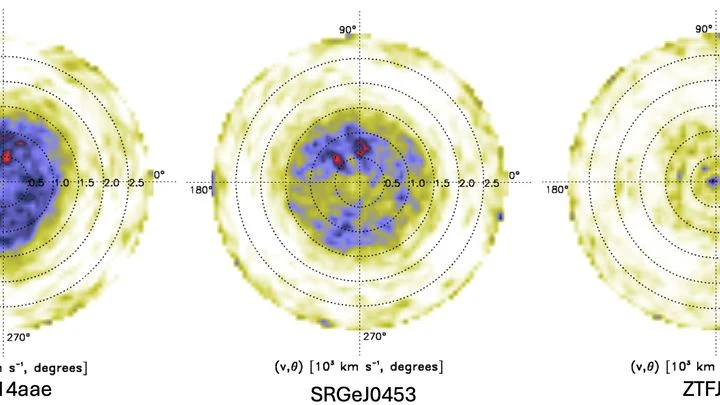
In three binary systems, a white dwarf, the dead core of a star, steals gas from its companion. The companion is so dim that it cannot be seen with an ordinary telescope. The James Webb Space Telescope looked at these pairs in infrared light, like a night-vision camera.
Two houses with identical facades but different interior layouts: from the outside the V-shaped spectrum looks the same, but inside there are different light sources and different amounts of dust. That is exactly how the two populations of distant galaxies that astronomers have long confused appear.
At the center of the supernova remnant SN 1987A, 168,000 light-years from Earth, hides an object that astronomers have been seeking for 37 years. This is the closest supernova to have exploded in front of modern telescopes, and the only one where the compact remnant has yet to be seen directly.