JWST red sources are a class of astronomical objects that appear strikingly red in infrared observations by the James Webb Space Telescope. They are often extremely distant galaxies whose light has been stretched (redshifted) by the expansion of the universe, or galaxies heavily obscured by dust that absorbs blue light and lets red light through. Some of these sources are also magnified by gravitational lensing, where a massive foreground object bends and amplifies the light from a background galaxy, making them visible despite their faintness.
History
The first JWST deep-field images in 2022 revealed an unexpected population of compact, red sources, nicknamed 'little red dots.' Their nature is still debated, with some being candidate massive galaxies in the early universe and others possibly obscured active galactic nuclei.
How it works
The redness arises from two main mechanisms: cosmological redshift, where the expansion of space stretches light to longer wavelengths, and dust extinction, where small particles preferentially scatter and absorb shorter wavelengths. Gravitational lensing can further distort and brighten these sources, sometimes producing multiple images or arcs. JWST's infrared sensitivity allows it to detect these faint, red objects that were invisible to earlier telescopes like Hubble in visible light.
In practice
Studying these sources helps astronomers understand galaxy formation and evolution in the early universe, and tests models of dark matter distribution throughgravitational lensing.
Fun fact
Some JWST red sources are so distant that their light has been traveling for over 13 billion years, meaning we see them as they were when the universe was less than 5% of its current age.
Beyond Neptune's orbit lies an ocean of icy islands that has remained nearly unchanged for four billion years. These islands, known as trans-Neptunian objects, hold the recipe for planet formation. Until recently, astronomers could only see the large ones, while the small, city-sized ones stayed invisible.
A stroboscope in a dark room picks out fleeting shadows from the crowd, shadows the eye cannot catch. A primordial black hole the size of a virus, passing in front of a distant star, briefly magnifies its light for a few seconds, like a magnifying glass held over a bulb.
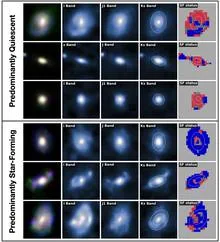
A ground-based image of a distant galaxy looks like a view through frosted glass: the atmosphere smears details, hiding the internal structure. Astronomers have long wanted to know where exactly star formation shuts off in galaxies, but ground-based telescopes could not resolve the subtle color gradients.
The night forest is full of fireflies, but before, we only saw those that happened to be in the beam of a flashlight. That was the case with ultraluminous X-ray sources: points in other galaxies that shine in X-rays more brightly than a stellar-mass black hole can steadily emit. Telescopes looked at galaxies chosen for other purposes, missing most of the fireflies.
Radio telescopes listen to the sky like sensitive ears: they catch the whispers of distant explosions, the hum of galaxies, the crackle of pulsars. But sometimes they pick up a sound that isn't in the catalogs. In 2003, such a sound emerged in the constellation Aquila — a spot in the sky that had been quiet until it suddenly began to speak.
In a distant galaxy, light from hot gas should reveal its composition. The James Webb Telescope split that light into a spectrum, and astronomers saw: oxygen lines too weak.
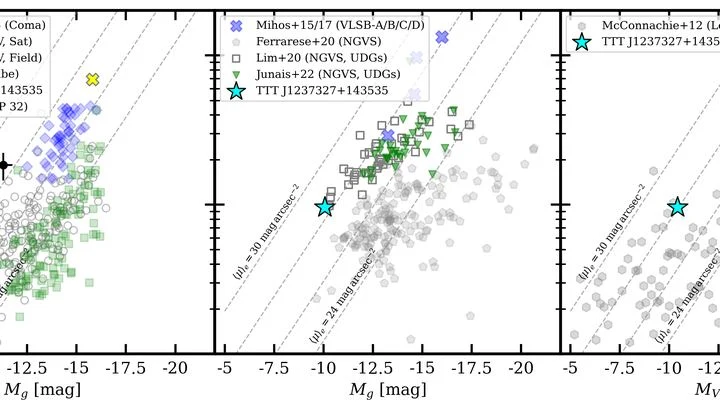
The night sky only looks black: telescopes reveal millions of galaxies, but some are so dim they blend into the background. Astronomers caught just such a "nearly invisible" one by chance while observing the Virgo Cluster with the two-meter telescope at Teide Observatory.
The galaxy is named TTT J1237327+143535.
The night sky is full of deceptive lights. Astronomers were searching for galaxies that ignited in the first few hundred million years after the Big Bang: their light has traveled to us for nearly 13 billion years. Six faint smudges were selected from images taken by the Hubble and Spitzer space telescopes.
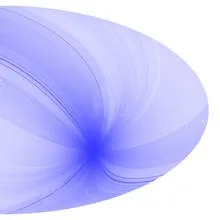
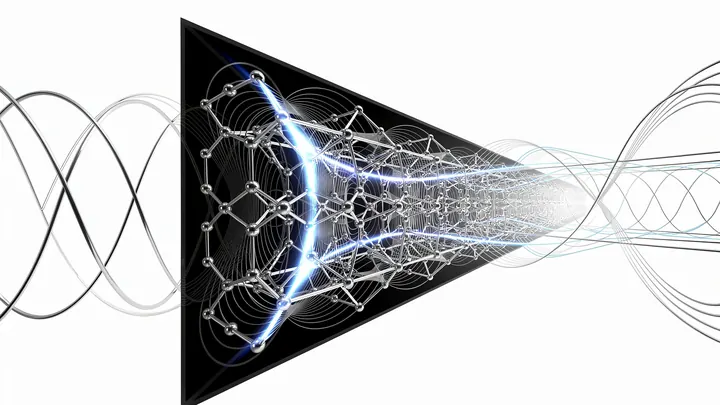
Every morning, a janitor sweeps leaves into a pile. The Sun, as it travels through the galaxy, does something similar: its gravity gathers diffuse interstellar gas into an invisible cone — a giant funnel.
Galaxy NGC 5584 is a vast stellar city, where some neighborhoods are just being built while others are already marked by aging giants. To see both, astronomers used two very different flashlights. The ultraviolet telescope Swift lit up hot blue patches — stellar nurseries where massive stars have recently ignited.
A distant light in the fog looks tiny and reddish: you'd think it's miles away. But then the light shifts sideways, and it becomes clear: it's a cyclist twenty steps away, just with a nearly dead rear light. That's how, in 2025, astronomers stumbled upon 'Capotauro'—a compact red source in images from the James Webb Space Telescope.
When an orchestra of thousands of musicians plays in harmony, the credit goes not only to each player's talent but also to the invisible work of the conductor.
A star wrapped in an invisible blanket warms up more than it should. That's exactly how ten red dwarfs look, which astronomers from the Hephaistos project have been monitoring. These stars lie within 300 parsecs (about 1000 light-years) of us and emit far more infrared energy than their modest sizes can explain.
In the deep field of JWST, among thousands of galaxies, astronomers zoomed in on the source JADES-GS 209777 – and saw a cosmic chick. Its "shell" is a thick cocoon of gas and cosmic dust that long hid the growing black hole at its center. But at a redshift of 3,711 (1,8 billion years after the Big Bang), the shell began to crack.
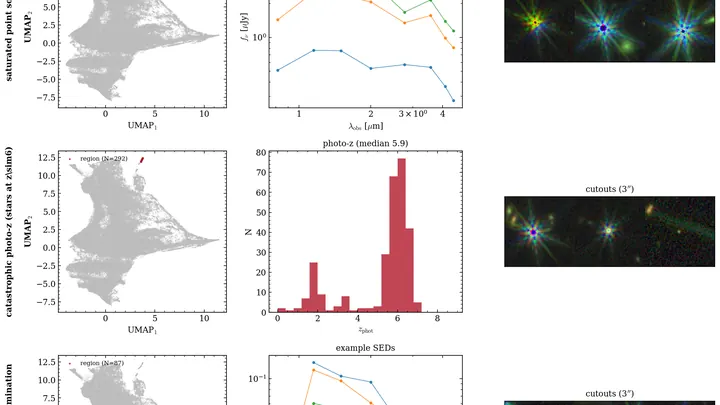
Two hundred forty-two thousand three hundred twenty-seven galaxies — like grains of sand on a beach. But astronomers turned this chaos into a map: the UMAP algorithm (a machine learning method) took from each galaxy eleven parameters — seven colors from optical to mid-infrared (that's photometry), magnitude…
The JWST spectrograph caught a barely perceptible dip in the spectrum of a distant galaxy — two lines, like shadows cast by cold gas. These are the sodium lines, the very yellow light of streetlamps. Here, at the edge of the visible Universe, they betray the slow exhalation of a galaxy returning matter to space.
In the early universe, just a few hundred million years after the Big Bang, astronomers see strange objects — little red dots. They are compact, red, and in their spectra, broad Balmer lines scream the presence of supermassive black holes. But how did the hole manage to accumulate millions of solar masses in such a short time?
The hunter of ancient light, the James Webb Telescope, aimed its mirrors at a tiny patch of sky and caught a strange beacon. The object, with the working name beacon_1420-$$5253_{4770}$$, flashed and faded. At first, it was logged as a candidate for the most distant galaxy, as if we were seeing it just 300 million years after the big bang.
Two cities endure a series of fires. In one, the wind carries ash far beyond the outskirts, leaving the sky clear. In the other, ash settles as a dense veil, painting sunsets crimson. Roughly the same thing, just on a galactic scale, happens with supernova explosions, the final flares of massive stars.
Ten billion years ago, the universe was speckled with strange crimson sparks. The JWST spotted them in images at distant redshifts — compact sources blazing like entire galaxies yet no larger than a tiny central region. Astronomers nicknamed them “little red dots.” Their nature long defied explanation.
A spinning top that makes a hundred turns per second suddenly starts losing speed dramatically — much faster than any known top. That's exactly what pulsar J0435+3233 is doing. It's a dead star, crushed to the size of a city, but whirling at a furious rate.
For thirteen billion years, light battled through cosmic emptiness. It bent around massive galaxy clusters that, as Einstein predicted, acted as giant lenses — amplifying and distorting the distant glow. In 2023, the NIRSpec instrument on the James Webb Space Telescope captured this light and spread it into spectra.
The optical sky background is a cosmic palimpsest, where light from billions of unresolved galaxies is layered, each layer corresponding to a different epoch. Until now we could only distinguish the brightest "letters"—individual stars and nearby galaxies.
The Universe is humming, but our ears catch only the bass. LIGO hears the rumble of black hole mergers — the infrasound of space. Higher up, in the gigahertz range, the flutes and violins of primordial gravity ring out.
In 2016, astronomers saw something incredible: a distant star, named Icarus, flared up for several weeks, crossing the abyss of space. Gravitational lensing, an effect predicted by Einstein, had kicked in: a massive object bends spacetime and focuses light like a giant magnifying glass.
In 2024, the Hephaestus project sifted through millions of stars and flagged a few dozen suspicious ones: they shone brighter in the mid-infrared than a normal red dwarf should. Two of these candidates, labeled D and E, looked especially tantalizing, as if an invisible heater were working next to the star.
A low rumble coming from underground could be the noise of a distant construction site, or it could be the echo of an ancient earthquake. Astronomers faced a similar puzzle in 2023 when they detected ultra-low-frequency gravitational waves — the trembling of spacetime itself, rippling across the universe.
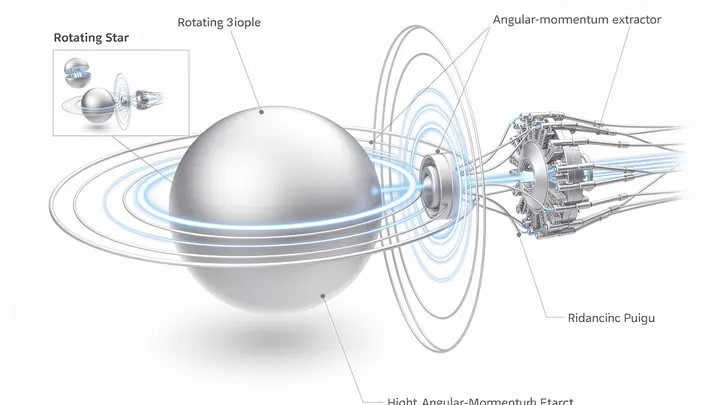
For decades, SETI has hunted for Dyson spheres — hypothetical shells that capture a star's light stars and re-radiate it in the infrared. But the cosmos remains silent. Perhaps an alien intelligence operates more elegantly: instead of collecting light, it tames the rotation of a sun, like a giant flywheel.
The cosmic spectacle unfolds on the stage of Galaxy галактики Centaurus A. In the lead role: a supermassive сверхмассивная чёрная дыра with a powerful jet that pierces space for hundreds of thousands of light-years.
The Zone of Avoidance is the most stubborn gap in our knowledge of the local Universe, like pages blotted out with ink in an ancient chronicle. Up to 20% of the extragalactic sky is reliably hidden behind dense cosmic dust and swarms of stars in the Milky Way's disk.
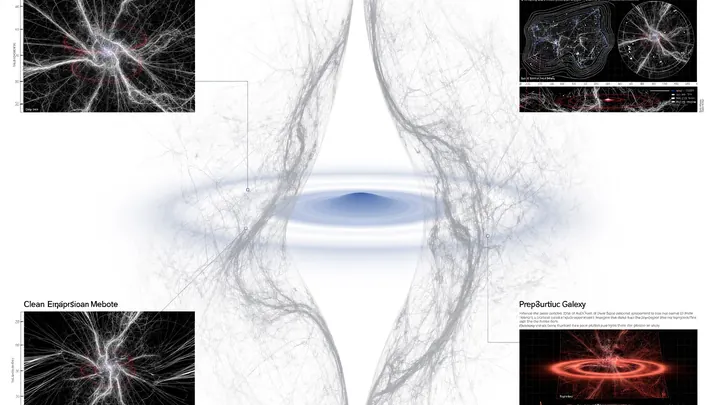
The Universe is less than a billion years old, yet at its centers already sit black holes with masses of a billion suns. According to the conventional picture, they grew by voraciously devouring matter, but calculations show that 'feeding' must have been almost continuous, while visible quasar flares last only a few million years. So where does all the accreting fuel go?
Within a field of view the size of a grain of sand held up to the eye, hundreds of galaxies lie hidden, smeared into arcs by the massive cluster Abell S1063.
When JWST peered into the young universe at redshifts of 6–10, it revealed a scattering of mysterious 'little red dots' (LRDs). These objects combined features of galaxies and active nuclei, but their spectra refused to fit into familiar patterns.
Long-period radio transients (LPTs) are a mysterious class discovered only recently. Their pulses last minutes or hours, and their nature was completely unknown. ASKAP J1745-5051, caught by the Australian telescope ASKAP, became the first to get a full explanation.
In the constellation Aquila, about 40,000 light-years away, one of the most powerful natural accelerators in the Galaxy is at work. It's the microquasar GRS 1915+105—a pair consisting of an ordinary star and a black hole.
The giant galaxy cluster Abell S1063, lying 4 billion light-years away, works not just as a lens but as a gravitational well of time. Its mass bends space so sharply that photons from an era when the Universe was just 500 million years old slide along curved paths, like rays in slow motion, and converge on us magnified forty-three times.
Imagine a spotlight: if you look at it from the side, it glows dim red, but if you stare straight into it, it blinds you with white-blue light. That, according to new data, is exactly what the mysterious 'little red dots' in the early universe look like. They are giant black holes, objects with gravity so strong that even light cannot escape, turned edge-on to us.
When a distant galaxy sends us light, it dims with distance, and from that dimming, we can tell how far away it is. Gravitational waves work in much the same way: the farther their source, the weaker the ripple in space that detectors on Earth pick up.
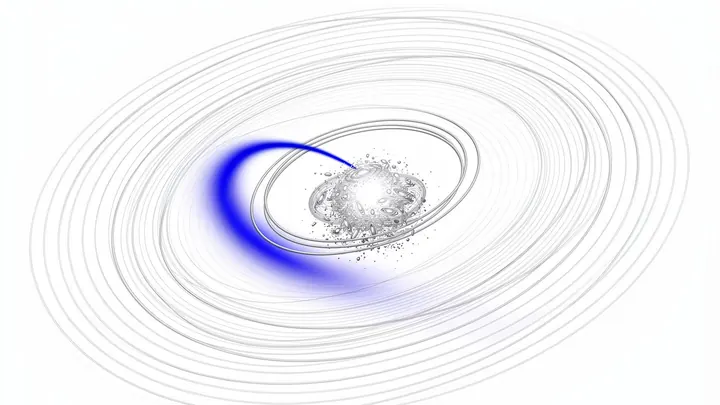
At the heart of nearly every large galaxy lives a supermassive black hole — a silent giant around which stars, gas, and other, smaller black holes orbit. From time to time, one of these objects breaks free from its orbit and begins to fall toward the central monster in a tightening spiral.
Gravitational waves are ripples in the very fabric of spacetime, akin to vibrations of a giant cosmic string. Conventional detectors like LIGO and Virgo pick up low-frequency "notes"—disturbances from mergers of massive black holes of stellar masses.