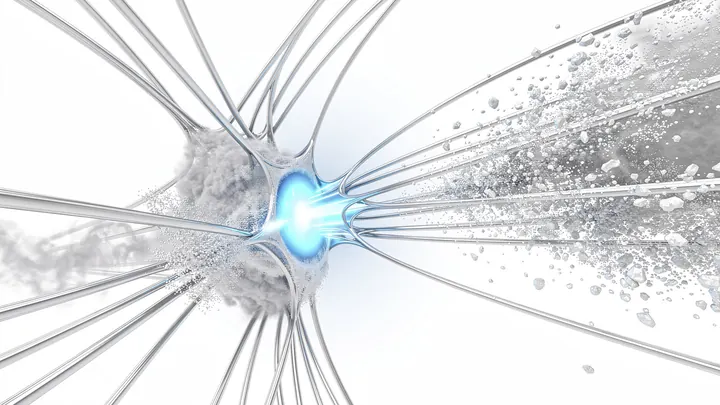
Galactic dust winds are large-scale outflows of dust grains driven out of galaxies by the energy and momentum released from active galactic nuclei (supermassive black holes accreting matter) or from intense bursts of star formation. These winds are a key part of 'feedback' processes that regulate how galaxies grow, by removing gas and dust that would otherwise form new stars. They also enrich the intergalactic medium with heavy elements and dust, affecting the evolution of the cosmos on large scales.
History
The concept of galactic winds driven by star formation was developed in the 1960s–70s, with early theoretical work by astronomers like Lyman Spitzer and later detailed models. The role of dust in these winds became clearer with infrared observations in the 1990s and 2000s.
How it works
The wind is launched when radiation pressure from a bright quasar or from a cluster of hot young stars pushes on dust grains in the surrounding gas. The dust absorbs ultraviolet and optical light and re-emits it as infrared, transferring momentum to the gas and driving it outward. In some cases, supernova explosions or stellar winds provide the mechanical push. Once moving, the dusty gas can be accelerated to hundreds of kilometers per second, escaping the galaxy's gravitational pull if the velocity exceeds the escape speed.
In practice
Understanding galactic dust winds is crucial for interpreting observations of distant galaxies and for modeling galaxy evolution in cosmological simulations.
The night sky in neutrino light resembles a canvas worked on by two hands. One holds a broad, soft brush: these are supernova remnants, the shells left behind after stellar explosions. The other grips a fine, hard pen — microquasars, binary systems where a black hole twists matter into narrow jets.
A balloon that lets out air in bursts zips around the room — the jet blasts first one way, then another. A dying star behaves the same way as it sheds its bloated shell. Only instead of air, it's superheated gas, and instead of a balloon, it's a future white dwarf (the dense stellar remnant about the size of Earth).
A disk of gas and dust spins around the young star HV Tau C, nearly edge-on to us. The James Webb Space Telescope examined its spectrum and detected the glow of hot molecular hydrogen (H₂). This revealed a wide, bipolar wind blasting from the inner regions far beyond the disk.
In the first fractions of a second after the Big Bang, the universe was a stage of rapid change. A stretched rubber sheet that cools quickly becomes covered with microscopic cracks. A similar process on a cosmic scale could have given rise to cosmic strings — ultra-thin but super-dense threads of energy stretching across the entire universe.
These strings are not just defects in space.
In the early universe, as it cooled after the Big Bang, defects could have formed, like cracks in ice. One such defect is a global monopole, a tiny clump of field where energy is trapped in a knot.
The cosmos resembles silk fabric with threads of the dark web showing through. We only glimpse tiny swatches of the real tapestry — through telescopes, in actual galaxy catalogs. To separate the fundamental signal from astrophysical noise in the cosmic pattern, statistical analysis demands thousands of plausible sketches — synthetic sky maps.
In a giant cosmic cradle, the Tarantula Nebula, astronomers took a close look at 122 massive stars, each at least 30 times heavier than the Sun. They measured the nitrogen abundance in their atmospheres, and the picture turned out to be unexpected.
Like an exquisite clockwork mechanism, a multi-planet system responds sensitively to the slightest nudge. And when the star at the heart of this mechanism dies, shedding its envelope and turning into a white dwarf, even a modest kick at a speed of 0.75 km/s can trigger a cascade of events, flinging entire worlds into interstellar emptiness.
At the center of a tiny galaxy lies a dense clump of stars and dark matter. This clump, called a soliton, is not frozen in place: it quivers and oscillates like jelly on a plate.
When JWST peered into the young universe at redshifts of 6–10, it revealed a scattering of mysterious 'little red dots' (LRDs). These objects combined features of galaxies and active nuclei, but their spectra refused to fit into familiar patterns.
In 1933, Fritz Zwicky first spoke of an invisible mass holding galaxy clusters together. Decades later, Vera Rubin mapped galactic rotation, revealing the ghostly presence of dark matter. Today we know it pervades the cosmos, but its particle nature remains elusive.
Massive gas outflows from active galactic nuclei are a key regulator of galactic evolution. They sweep out the interstellar medium, quench star formation, and dictate the growth of supermassive black holes.
Stars are born in cold clouds of cosmic dust and hydrogen. Inside these cocoons, protostars — the cores of future suns — were long thought to be just hot clumps. But it turns out many of them are powerful accelerators: they shoot out narrow jets of gas that, slamming into surrounding matter, produce invisible gamma-ray light.
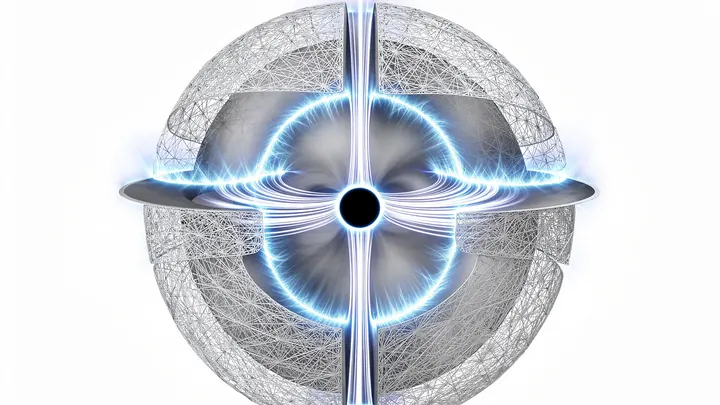
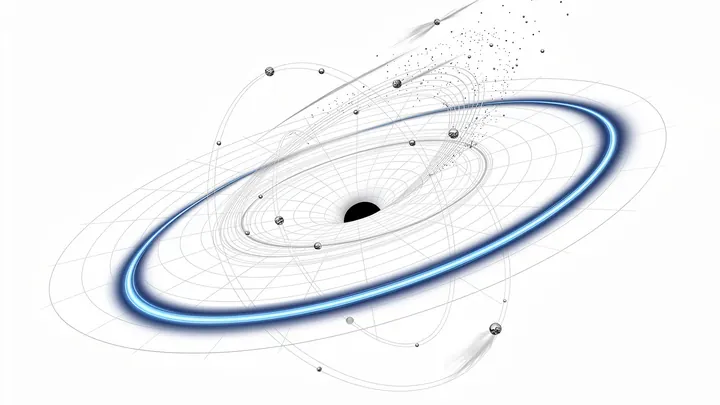
If a black hole spins quickly, it can hold a cloud of ultralight particles around it, so light that their mass almost vanishes. They arrange themselves in layers, like electrons in an atom, only here gravity does the job instead of electric forces. This structure stores energy, like a coiled spring.
A black hole is not an eternal vacuum cleaner. Left alone in the void, it slowly disappears, radiating energy like a puddle drying on asphalt. This process, predicted by Stephen Hawking, is called evaporation.
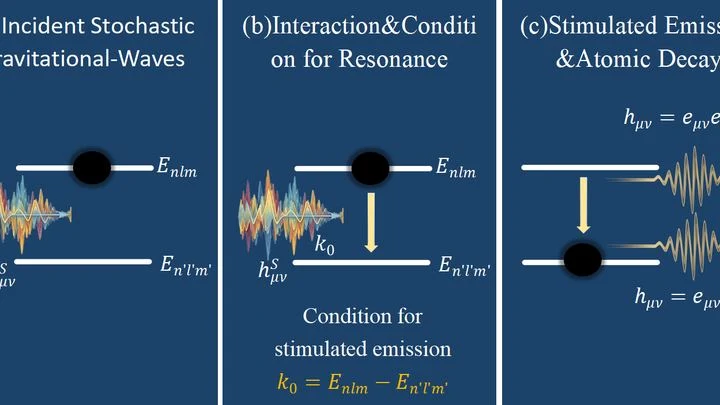
Gravitational waves — the cosmic tremors from distant cataclysms — are so faint that detecting them is like trying to hear a whisper in a hurricane. But a black hole can amplify that whisper many times over.
A dust storm that has raged for millions of years is not in a desert but between the stars. There, clouds of tenuous gas drift, threaded by magnetic fields. These fields align dust grains like compass needles along field lines. When such dust emits, its light becomes polarized: it oscillates in a single plane, like a rope shaken only up and down.
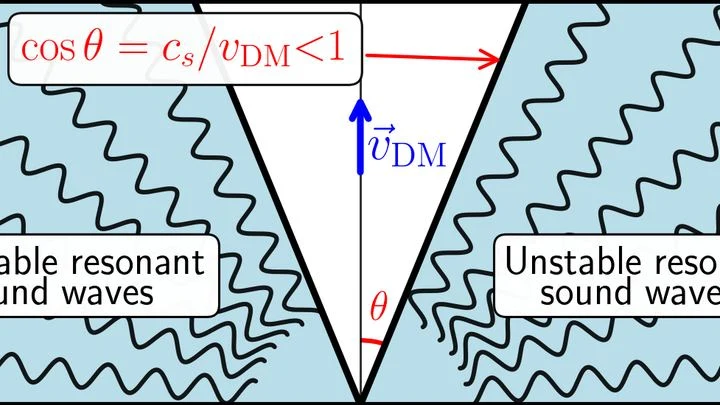
After the Big Bang, dark matter and ordinary matter (mostly hydrogen) went their separate ways in terms of speed. Their gravitational pull acts like a bow gliding across a string: when frequencies match, resonance occurs, and sound waves start to rapidly grow in ordinary matter.
At the center of many galaxies sits a supermassive black hole. When gas falls onto it, the gas heats up and shines brighter than an entire galaxy: this is an active galactic nucleus. Sometimes a true hurricane erupts from there: a stream of ionized gas racing at tens of percent of the speed of light.
When a massive star explodes as a supernova, its outer layers are blasted into space at thousands of kilometers per second. A shock wave forms — a giant invisible bulldozer that sweeps up interstellar gas and dust. In this maelstrom, particles can be accelerated to energies comparable to that of a flying tennis ball compressed into a single proton.
In the first moments after the Big Bang, the cosmos resembled a giant cooling pond. Just as water, when freezing, becomes covered with a network of cracks, so the cooling universe could have cracked — not into ice, but into the thinnest filaments of pure energy. These filaments are called cosmic strings.
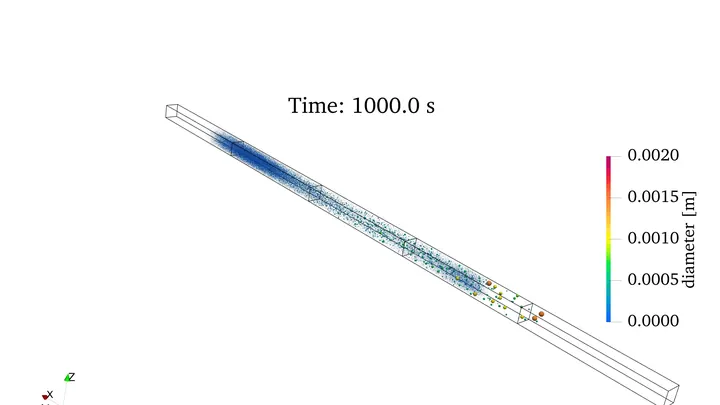
In a cloud, thousands of tiny water droplets hang in the air. For rain to fall, they need to grow: stick together into larger drops and become heavy enough to fall to the ground. But how exactly do droplets find each other in a huge cloud?
Scientists created a computer model that tracks each droplet individually, as if each one had its own little sensor.
Two stars orbit a common center, accreting gas from a surrounding cloud. Rotating disks of gas form around each star and around the pair as a whole. From these disks, jets shoot out like hoses. Inside the disks, gas is constantly churned — that's the magnetorotational instability at work.
Tiny black holes, born right after the birth of the universe, are supposed to evaporate — shedding mass as invisible particles. This was predicted by Stephen Hawking, and this 'Hawking evaporation' contributed to the expansion of the young cosmos.
Red quasars are the brilliant cores of distant galaxies, wrapped in dust that makes their light appear reddish. Astronomers have noticed that such quasars more often than ordinary blue ones exhibit compact radio emission — radio waves coming from a region the size of a galaxy or smaller.
The standard cosmological model describes the birth of the universe as an explosion from a singularity — a point of infinite density and spacetime curvature.
At the center of every large galaxy, including our own Milky Way, resides a supermassive black hole. It doesn't just sit there — sometimes it pulls in gas and dust, and part of that material is blasted back out in powerful outflows. These outflows, or "winds," carry material far from the center and affect the entire galaxy.
The Universe looks like a giant spiderweb: galaxies aren't scattered randomly but are gathered into knots and along filaments. Inside the filaments, there's plenty of gas, and that's where new stars most often flare up. But how has this changed over time? Scientists compared data from a computer model with real observations of thousands of galaxies.
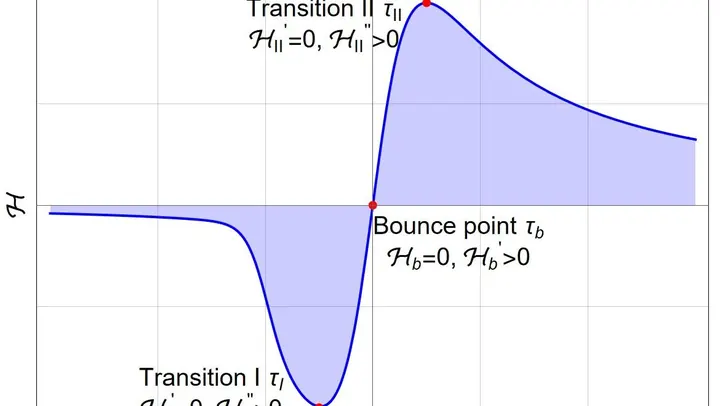
The universe can behave like a spring: compressing to microscopic sizes and then expanding again. In this cycle of contraction and bounce, black holes and dark matter are born.
At the heart of nearly every large galaxy lurks a supermassive black hole. As it devours gas, it blasts powerful outflows back into space, like a dragon that can't swallow all its prey and breathes fire. These 'winds' accelerate to thousands of kilometers per second and can sweep away the gas reservoirs from which stars are born.
In the binary system 4U 1624-49, a neutron star pulls gas from its companion star. This gas spirals into a glowing disk, like water in a funnel. And from the edge of this funnel, a hot stream tears away — hydrogen and other elements fly off at speeds up to 320 kilometers per second.
A spinning black hole acts like a cosmic generator: its rotation pumps energy into an invisible scalar cloud — a prime candidate for dark matter. A scalar field is like temperature: at every point in space it's just a single number, with no arrows or vectors. The cloud grows until it overflows.
At night, invisible bullets streak across the sky — cosmic rays. These are atomic nuclei accelerated to near-light speeds. The Galaxy's magnetic fields tangle their paths, making it hard to pinpoint where they were born.
In a blacksmith's forge, a blast of air fans the glowing coals, and shock waves blow bubbles of hot gas. In galaxy centers, a supermassive black hole drives the same process. Its narrow plasma jets, like bellows, punch through the surrounding space and create bubbles visible in X-rays.
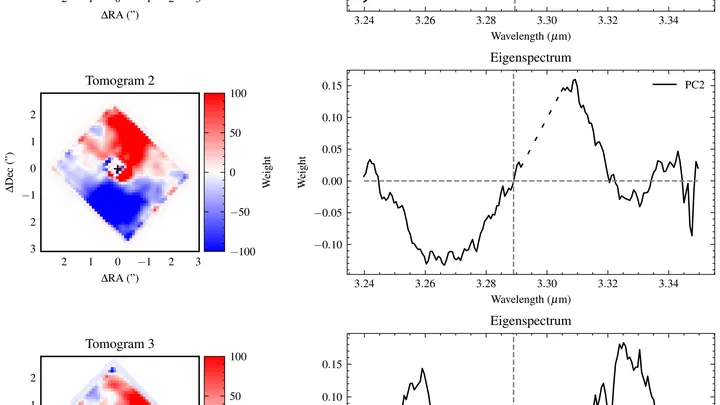
At the center of nearly every large galaxy sits a supermassive black hole. It pulls in gas and dust, and a bright disk swirls around it. But the James Webb Telescope looked further out — into a region where the black hole's light is weaker, yet the dust still glows.
Astronomers examined eight galaxies.
After the Big Bang, the universe was hot and dense. In clumps of dark matter, invisible stuff felt only through gravity, its particles, colliding, annihilated, giving birth to powerful radiation. This hidden heat, like an invisible furnace, warmed gas clouds from within.
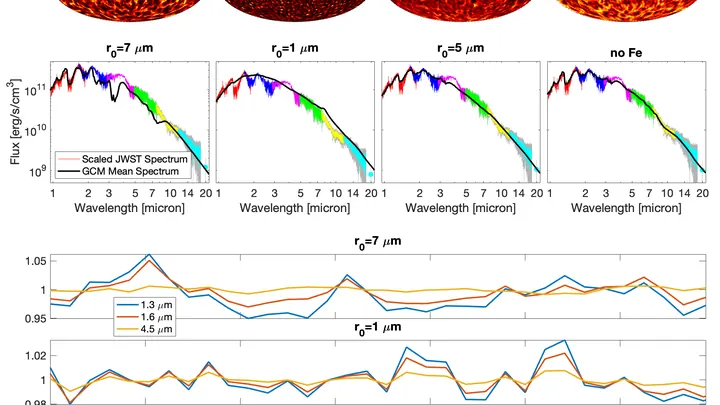
Far beyond the Solar System, a world called VHS 1256B wanders — a giant planet without a star. For a long time, astronomers couldn’t figure out why its brightness jumped by nearly 40% in just a few days. The answer came with the James Webb telescope: it turns out, colossal storms of silicate dust engulf the entire planet.