A radio galaxy is a galaxy that emits exceptionally strong radio waves, often outshining its optical light at those wavelengths. This emission typically comes from an active galactic nucleus (AGN) powered by a supermassive black hole accreting matter, which launches relativistic jets that extend far beyond the galaxy. These jets interact with the intergalactic medium, creating lobes and hotspots that are bright radio sources. Radio galaxies are important probes of galaxy evolution, black hole activity, and the large-scale structure of the universe.
History
Radio galaxies were discovered in the 1950s with the advent of radio astronomy, when sources like Cygnus A were identified with distant galaxies. The connection to black holes was established in the 1960s–70s with the development of unified models of AGN.
How it works
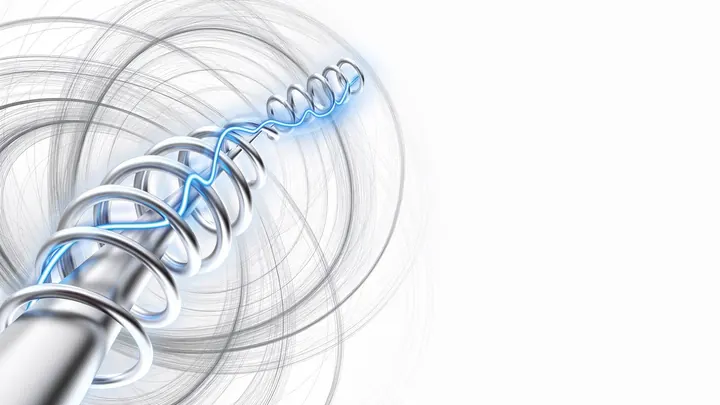
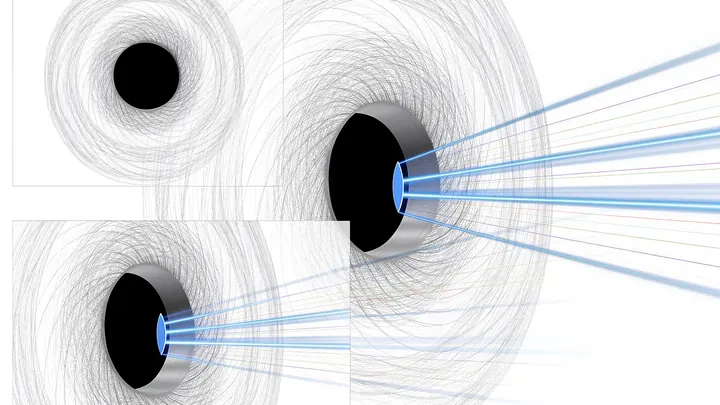
The central black hole's accretion disk funnels matter inward, and magnetic fields near the black hole collimate some of the infalling energy into twin jets moving at nearly the speed of light. These jets emit synchrotron radiation — light produced by electrons spiraling in magnetic fields — across radio wavelengths. As the jets plow into the surrounding gas, they inflate lobes that can be millions of light-years across. The radio emission is often polarized, revealing the magnetic field structure of the jets and lobes.
In practice
Radio galaxies serve as natural laboratories for studying relativistic jets, black hole physics, and the feedback mechanisms that regulate star formation in galaxies.
Fun fact
Some radio galaxies show a 'double-double' structure — two pairs of lobes — indicating that the black hole has restarted its jet activity after a period of quiescence.
A particle with an energy of $$10^{18}$$ eV hitting Earth's atmosphere is like a tennis ball traveling at 200 km/h slamming into a wall. Astrophysicists have debated for decades where such projectiles come from. Gamma-ray bursts, brief and powerful explosions of gamma radiation, have long been suspected as accelerators.
Galaxy Mrk 590 behaves like a radio receiver that sometimes picks up a signal and sometimes fades into static. Its supermassive black hole has been brightening and dimming for decades, and astronomers caught every such 'switch-on.' In 2017, the receiver came alive again, but the VLA radio telescope heard not the signal they expected.
The night sky is full of rings and bubbles, but in the radio band they look different. In data from the Australian radio telescope ASKAP, a structure has surfaced that resembles two soap bubbles blown from the same straw.
At the heart of nearly every large galaxy sits a supermassive black hole. Usually it behaves quietly, but sometimes, like a waking volcano, it spits out narrow plasma jets. These jets glow in the radio band, making the galaxy 'radio-loud.' Astronomers have long known this happens, but they couldn't catch the very moment of switching on.
The galaxy cluster RXC J0528.9−3927 is like a city shrouded in fog: at its center, a radio halo shines brightly, but farther out, beyond the usual boundaries, astronomers have spotted a barely visible glow. It stretches for two million light-years — three times farther than the halo itself.
The night sky looks smooth, but it's actually clumpy — vast communities of galaxies that bend light from distant objects like lenses. When a short, powerful radio burst goes off somewhere in the universe, its path to an Earth telescope can pass near such a clump.
A radio telescope, like a sensitive ear, picks up the whispers of distant galaxies. Hidden among that noise are giants — giant radio sources. These are clouds of charged particles ejected from the vicinity of supermassive black holes.
A bright lantern in thick fog seems dim, while a weak flame in clear air can be seen a kilometer away. A similar oddity baffled astrophysicists almost half a century ago.
Deep beneath the ice of the South Pole, nearly two and a half kilometers down, an unusual telescope is at work. It is not pointed at the sky but through the Earth. Its quarry: neutrinos, nearly elusive particles that pass through planets and stars without interacting with anything.
At the center of the Milky Way, shrouded in dust and glare, lurks a supermassive black hole — Sagittarius A*. Around it, like moths around a flame, swarm dozens of guide stars. Two of them, S2 and S38, with eccentric orbits and periods of just a few years, have become the protagonists in testing the fundamental laws of the cosmos.
The cosmos is full of screams we can't hear. Every time a black hole tears a star apart, a blinding flash is born, and often — a narrow relativistic jet, shooting out thousands of light-years. But if that searchlight is aimed away from Earth, we see only a faint afterglow — a radio echo arriving with a delay.
At the center of many galaxies lurks a supermassive black hole, ejecting relativistic plasma jets over hundreds of kiloparsecs. One such is the radio galaxy ESO 137-G007 in the Norma Cluster, known as the “Corkscrew Galaxy” for its twisted jets.
In the center of almost every large galaxy lurks a supermassive black hole, whose gravitational abyss was first mathematically described by Karl Schwarzschild. When it swallows gas, a dazzling active nucleus is born — a quasar.
In the constellation Aquila, about 40,000 light-years away, one of the most powerful natural accelerators in the Galaxy is at work. It's the microquasar GRS 1915+105—a pair consisting of an ordinary star and a black hole.
Every fast radio burst is like a resounding strike of a bell in the void. And in its fading ring, the entire structure of space is encoded: over billions of light-years, the radio pulse is slightly delayed by every free electron it meets.
In the first moments after the Big Bang, matter and antimatter were almost perfectly balanced. But something tipped the scales — otherwise everything would have annihilated into radiation, leaving the universe empty. One candidate for the role of "tipper" is the ultraheavy right-handed neutrino.
Blazars are long-lasting beams from black holes at the centers of galaxies. Gamma-ray bursts are the briefest flashes from supernova explosions or neutron star mergers. The former act like eternal spotlights, the latter like camera flashes.
Gravitational waves are ripples in the very fabric of spacetime, akin to vibrations of a giant cosmic string. Conventional detectors like LIGO and Virgo pick up low-frequency "notes"—disturbances from mergers of massive black holes of stellar masses.
Blacksmith's bellows fan the fire by forcefully pushing out air. In space, the shock wave from a supernova, a concept introduced by Fritz Zwicky, acts like such bellows: it catches up with a giant bubble of charged particles and magnetic fields formed around a spinning neutron star…
Gravitational waves — the cosmic tremors from distant cataclysms — are so faint that detecting them is like trying to hear a whisper in a hurricane. But a black hole can amplify that whisper many times over.
Cosmic black holes at the centers of galaxies are like giant banyan trees: their aerial root‑filaments stretch for kiloparsecs to harvest nourishing matter. For decades astronomers have debated: how does cooling gas from cluster atmospheres fall into the sphere of influence of a supermassive hole?
In the first moments after the Big Bang, the universe was a boiling cauldron. But then, according to a new hypothesis, it suddenly cooled dramatically — far more than previously thought. In this icy world, dark matter particles, like tiny pendulums, froze and did not begin their oscillations.
A powerful vacuum cleaner sucks in not only dust but also its own collection bag. That's roughly how a black hole behaves at the center of a 'red dot'—a distant galaxy where the glow comes not from the hole itself but from its dense gas shroud. This shroud is so thick it resembles a puffed-up cool star. And, like many stars, it has a magnetic field.
The fabric of space bends under weight, like a stretched trampoline. Gravitational waves — ripples spreading from cosmic cataclysms, such as merging black holes. If such a ripple encounters a massive galaxy or invisible dark matter, they act like a magnifying glass: bending and amplifying the signal.
A stone falls into a pond — near the shore, the ripples are barely visible, while the water churns at the point of impact. The electric field around a charge behaves similarly: close in, it's sharp and tangled, but at a distance it stretches into a smooth wave that carries energy away. Physicists call this distant region the radiation zone.
In a vast hall, a hundred tuning forks are set out. Each one is a pulsar — an ultra-dense stellar remnant spinning at a furious rate, sending out radio pulses more precisely than any clock. When a low-frequency sound wave sweeps through the hall, all the tuning forks start to go slightly out of tune at the same moment.
At the center of many galaxies sits a supermassive black hole. When gas falls onto it, the gas heats up and shines brighter than an entire galaxy: this is an active galactic nucleus. Sometimes a true hurricane erupts from there: a stream of ionized gas racing at tens of percent of the speed of light.
A galaxy is like a glowing pancake studded with stars. If you look at it face-on, you see everything at once — both the bright spiral arms and the dark dust lanes. But tilt the pancake, and the picture changes: layers overlap, light blends together. This very effect, it turns out, creates the illusion of a tight link between radio and gamma-ray emission in distant star systems.
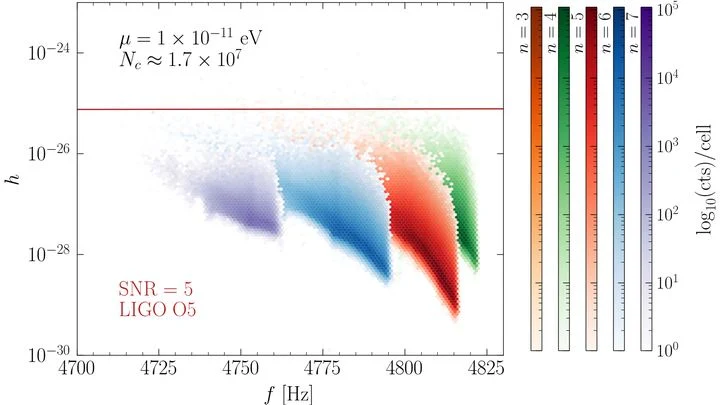
A tuning fork, once struck, makes neighboring strings vibrate. Much the same happens with a cloud of ultralight particles (also called axions) around a rapidly spinning black hole. The hole, like a motor, spins up the particles, and they begin to emit gravitational waves — a trembling of space itself.
A powerful searchlight shines through thick fog. The beam itself is invisible, but the fog begins to glow faintly, and gives away the searchlight's presence.
A fountain shoots from the center of the city at a speed thousands of times faster than a courier bike. Such a 'fountain'—a stream of gas accelerated to 5500 kilometers per second — has been spotted by astronomers in the galaxy GLIMPSED-329380.
The Fermi telescope spent 17 years recording gamma rays from the active nuclei of galaxies with giant black holes at their centers. The glow of their jets resembles a chaotic cacophony: it constantly changes.
Tiny black holes, born right after the birth of the universe, are supposed to evaporate — shedding mass as invisible particles. This was predicted by Stephen Hawking, and this 'Hawking evaporation' contributed to the expansion of the young cosmos.
Red quasars are the brilliant cores of distant galaxies, wrapped in dust that makes their light appear reddish. Astronomers have noticed that such quasars more often than ordinary blue ones exhibit compact radio emission — radio waves coming from a region the size of a galaxy or smaller.
Black holes aren't silent abysses, but nature's tuning forks. Their rapid spin, predicted by Roger Penrose, makes spacetime itself sing, producing a stream of the lightest particles — axions. These accumulate around the hole, like sound in a concert hall, and begin to oscillate in unison.
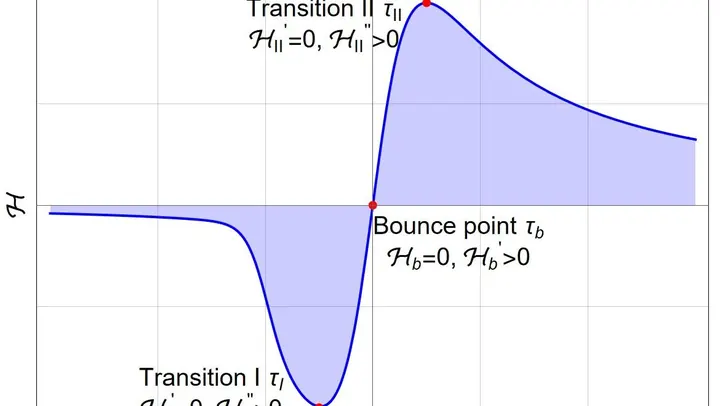
The standard cosmological model describes the birth of the universe as an explosion from a singularity — a point of infinite density and spacetime curvature.
A cosmic neon sign lit up in an incredibly distant galaxy: almost all its light comes from hot gas, and the stars are lost in this glow. The James Webb telescope recorded that the gas, a mix of hydrogen and helium, is so heated that it glows on its own.
If a supermassive black hole lives at the center of a galaxy, it heats the infalling gas to incredible temperatures. That gas glows, and we see it as a quasar — the brightest beacon in the universe. But how do you measure the size of the light source itself?